
Deepfakes Erode Trust but Leave Learning Untouched, Study Finds
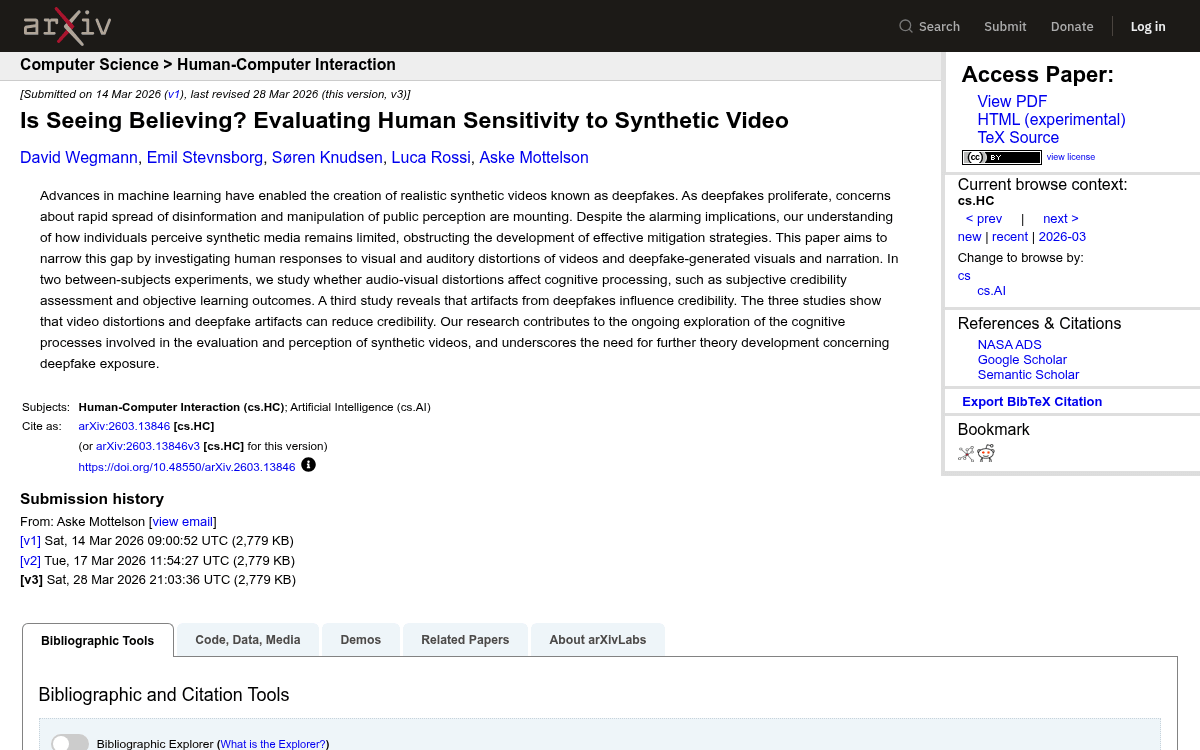
Three preregistered experiments with over 1,000 viewers show synthetic faces and voices quietly erode message credibility, though learning stays intact.
 Pro
Takeaways
- Three preregistered experiments with 1,053 viewers tested how distortions and deepfake artifacts affect credibility and learning.
- Fully synthetic face plus voice dropped credibility from 6.18 to 5.64 on a 7-point scale versus real video.
- Synthetic faces hurt credibility more than synthetic narration; audio manipulation alone barely moved perceptions.
- Learning outcomes stayed identical across all conditions, meaning viewers absorbed facts even when distrusting the messenger.
- All stimuli, data, and analyses are open on OSF for reproducibility.
- Believing a video was altered lowered credibility even when no manipulation was present, correlation r=-0.40 in Study III.
A team from IT University of Copenhagen, Aarhus University, and University of Copenhagen ran three online experiments to answer a deceptively simple question: when people watch a deepfake, do they actually notice something is off, and does it change how much they trust the message? The study ran 1,053 U.S. participants through carefully manipulated versions of the same educational video and measured how visual distortions, audio distortions, and deepfake artifacts shifted credibility, learning, and the subjective feel of watching.
The headline finding: visual distortions and deepfake artifacts reliably lower message credibility and source vividness, while leaving learning largely unaffected. Viewers absorbed the same facts either way, but they trusted the messenger less when the pixels or the face looked wrong.
Why credibility research keeps missing the video layer
Most of what we know about how people judge synthetic content comes from text and still images. The legibility of text, the quality of audio recordings, and the presence of nonprobative photos alongside a statement were found to affect how credible people deemed information to be. Nevertheless, the effects of processing fluency of videos remain mostly underexplored.
Processing fluency is the term researchers use for the subjective ease of taking something in. When a stimulus feels harder to process than expected, viewers unconsciously shift judgments of truth and trust downward. The authors hypothesized that deepfake artifacts, things like odd shading, boundary seams, and mouth-to-speech mismatches, act as expectancy violations that trip this fluency heuristic. Deepfake generation pipelines introduce characteristic artifacts because models must estimate facial geometry, motion, illumination, and texture, and temporally align synthesized audio and video.
The three-step experiment
The team built one 447-second educational video about virology, then progressively degraded it in three studies:
- Study I (n=333): Compared a clean baseline against a version with a ghosting filter overlay. Pure visual distortion, no AI involved.
- Study II (n=355): Added two more conditions: mild echo on the narration, and a one-second audio-video desync.
- Study III (n=365): Swapped in real deepfakes. They used the Latent Image Animator with "vox-pt" weights by Wang and colleagues to synthesize a deepfake version of the video. This approach requires a 256x256 close-up video of a face and a 256x256 portrait picture to generate a 256x256 video of the portrait picture exhibiting the behavior captured in the video. The narration was synthesized by fine-tuning a So-Vits-Svc-fork model on 14 minutes of the presenter's speech.
Study III crossed the two modalities: synthetic face only, synthetic voice only, both, or neither. Every study was preregistered, and all stimuli, code, and data are on OSF.
What the numbers actually say
In Study I, the ghosting filter cut processing fluency from 86.7 to 57.2 on a 0-100 slider, and dropped credibility from 6.2 to 5.8 on a 7-point scale. Small in absolute terms but statistically clean.
Study III is where it gets interesting. Post hoc Mann-Whitney U tests with Bonferroni correction indicated a significant difference between BASELINE (M=6.18, SD=0.99) and SYNTHESIZED VIDEO AND NARRATION (M=5.64, SD=1.17); p=0.02, rank-biserial correlation = 0.24. The synthetic face drove the effect more than the synthetic voice. Audio manipulation alone barely moved the needle.
Three counterintuitive results stand out:
- Learning was untouched. Across every condition, participants absorbed the same virology facts. Distortions and deepfake artifacts hit trust, not comprehension.
- Processing fluency did not explain the credibility drop in the deepfake study. Participants rated the deepfake video as no harder to process than the real one, yet still judged it as less credible. The fluency mechanism that worked for crude distortions broke down for realistic synthesis.
- Uncertainty dominated detection. Even in the absence of synthetic content, more than 10% of participants reported detecting an alteration and roughly a third were uncertain. And believing a video was altered correlated with lower credibility whether or not it actually was, with the strongest effect in Study III (r=-0.40).
The real takeaway for anyone building trust interfaces
The headline is not that deepfakes fool people; prior work already established that. The subtler contribution is decomposing "deepfake" into separable perceptual channels and showing that faces carry more credibility weight than voices, and that even mild visual distortions unrelated to malicious intent produce the same downward credibility shift as actual synthesis.
That has direct implications for provenance UIs and content moderation. If a compression artifact or a bad upload can trigger the same distrust response as a genuine deepfake, warning labels and watermarks need to distinguish between quality problems and manipulation. The authors argue for media literacy training on specific cues: (i) local inconsistencies in shading/illumination and skin texture; (ii) facial geometry and boundary seams; and (iii) audio-visual timing mismatches and mouth-speech incongruence.
Where it falls short
- Single stimulus. One video, one unknown presenter, one topic. Effects could look very different for a familiar politician or a partisan clip.
- Prolific sample. U.S.-based, English-speaking, and likely more internet-literate than the general population.
- One deepfake pipeline. The Latent Image Animator produces particular artifacts. Newer diffusion-based lip-sync systems may leave different fingerprints.
- Coarse fluency measure. A single slider self-report may miss the mechanism the authors were probing for.
Still, the study is a rare piece of clean, preregistered empirical work in a space dominated by detection benchmarks and speculative harm analyses. For anyone shipping a synthetic-media product or a verification tool, the message is that the visual channel is where trust breaks first, and that user uncertainty about authenticity is the default state, not the exception.