
Deep Survival Learner Cuts Treatment Effect Bias 100x in Cancer Studies
A new deep learning method estimates how treatment effects change over time for censored survival data, tackling instability in precision medicine analyses.
 Pro
Takeaways
- Deep Survival Learner estimates conditional treatment effects across time for right-censored survival outcomes.
- Combines doubly robust pseudo-outcomes with a shared-trunk multi-output neural network.
- Joint estimation across time points cuts approximation error sublinearly under smoothness assumptions.
- Beats M-, R-, X-learners and NFT-BART variants on bias under nuisance misspecification.
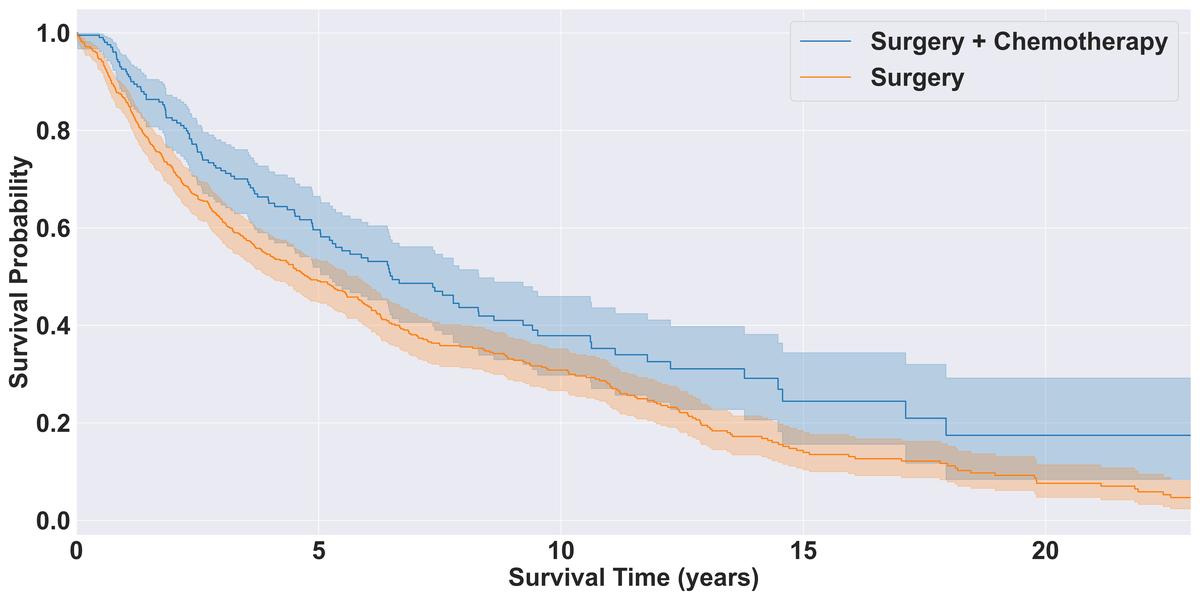
- Applied to Boston Lung Cancer Study, reveals stronger chemo benefit for women, stage II, higher BMI patients.
- No public code yet; censoring model must still be correctly specified for validity.
Estimating who benefits most from a treatment gets thorny fast when the outcome is time-to-death or time-to-relapse. Patients drop out, get lost to follow-up, or simply have not experienced the event yet by the time the study ends. A new statistics paper from researchers at William and Mary and the University of Michigan proposes the Deep Survival Learner (DSL), a neural network approach that estimates how treatment effects vary across patients and evolve across time, rather than collapsing everything to a single follow-up date.
The single-timepoint trap
The conditional average treatment effect (CATE) is the standard target when you want to know how a treatment's benefit differs across subgroups. In survival analysis, right censoring (patients whose event has not happened by the end of follow-up) makes CATE estimation harder. Most existing approaches focus on a single prespecified time point and ignore the temporal trajectory, which leads to unstable estimates.
Clinically, that matters. Chemotherapy benefits often kick in slowly, peak, then fade. Fitting one model for the 5-year mark and another for the 10-year mark, as if the two were unrelated, throws away structure that could stabilize both estimates. Prior work like SurvITE, Causal Survival Forests, and tree-based estimators handle censoring in various ways, but few exploit the smooth trajectory of effects across time.