
DECS Cuts AI Reasoning Tokens by 57% Without Sacrificing Accuracy
A new reinforcement learning framework called DECS cuts reasoning tokens by more than half while matching or beating base model accuracy across seven benchmarks.
 Pro
Takeaways
- DECS wins an ICLR 2026 Oral for cutting reasoning tokens by over 50% without hurting accuracy.
- Theoretical analysis identifies two flaws in prior length penalties that suppress useful exploratory tokens.
- A small NRP detector marks the shortest reasoning prefix that already contains the correct answer.
- Decoupled token-level rewards plus curriculum batch scheduling protect exploration while penalizing redundancy.
- Tested on 7 benchmarks including AIME, MATH500, GPQA-Diamond, and LiveCodeBench with DeepSeek-R1 and Qwen3 backbones.
- Code, models and the NRP detector are open on GitHub and Hugging Face.
Large reasoning models trained with reinforcement learning have a bad habit: once they discover a correct answer, they keep talking. They second-guess, reformulate, verify again, and burn thousands of tokens after the reasoning that actually mattered was already done. A new paper accepted as an ICLR 2026 Oral from Shanghai Jiao Tong University and Fudan University tackles this head-on with a framework called DECS, and the numbers are striking: DECS reduces average reasoning length by 57.17% on the 1.5B model while improving pass@1 accuracy by +2.48 points, demonstrating simultaneous gains in efficiency and performance.
Why length penalties keep backfiring
The default fix for overthinking has been to bolt a small length penalty onto the correctness reward inside GRPO-style training. It sounds sensible, but in practice these methods have consistently traded away accuracy for brevity. The DECS authors dig into the math and identify two specific reasons this happens.
The first is a mismatch between how rewards are assigned and how gradients flow. In GRPO, overlong (yet correct) trajectories receive uniformly negative advantages across all tokens from length penalties. Consequently, when all responses to a given prompt are correct but differ in length, shorter trajectories yield positive advantages while longer ones receive negative ones. The problem is that this negative signal doesn't discriminate between filler and substance. It hits the high-entropy "forking" tokens like wait, however, and alternatively that actually drive exploration and reflection, and over many iterations the model learns to stop generating them at all.
The second flaw is more subtle. Without explicitly decoupling the NRP serving as the minimal sufficient reasoning prefix from subsequent generations, tokens produced after the NRP in shorter trajectories may still receive positive advantages. This falsely reinforces redundant steps, encouraging the model to continue generating beyond logical necessity. In other words, short-and-redundant looks the same as short-and-tight to the reward function.
The Necessary Reasoning Prefix
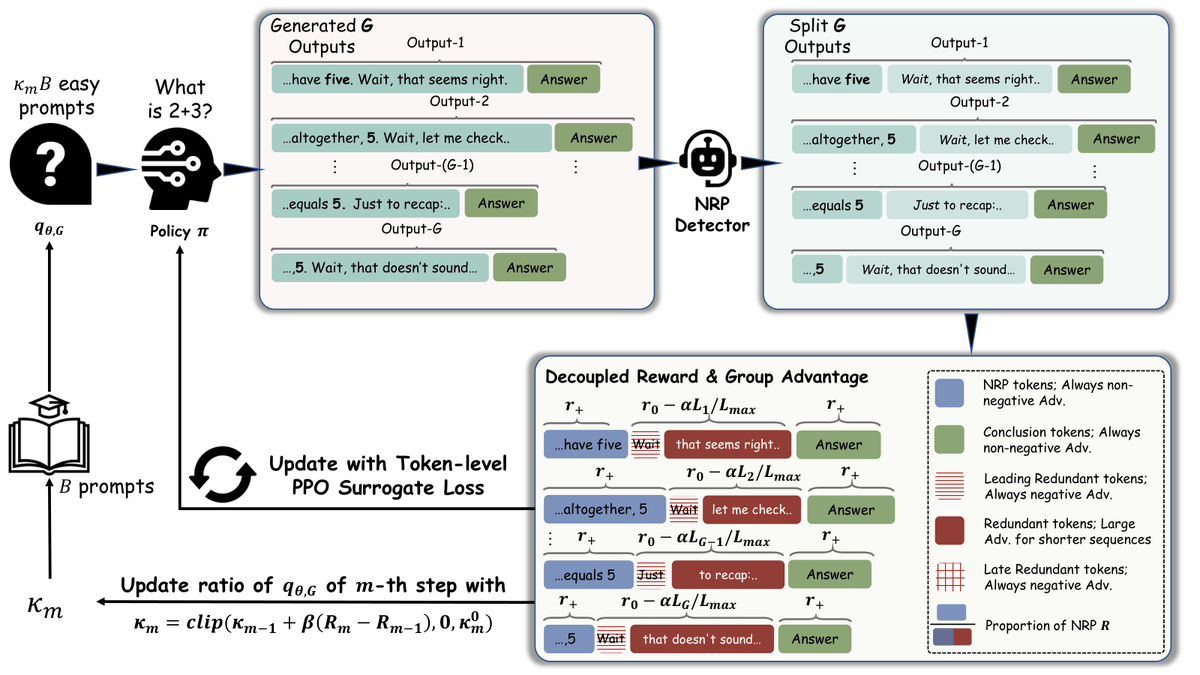
DECS builds on a clean concept the authors call the Necessary Reasoning Prefix, or NRP: the shortest chunk of a chain-of-thought that already contains the correct answer. Everything after that point is by definition redundant.
To find it, the team fine-tuned a lightweight 1.5B judge model. Using pre-defined separator tokens (words like Wait, But, Alternatively, Hmm, However), a reasoning trace is broken into semantically coherent chunks. For each chunk, the judge is asked a single yes/no question: does this segment already contain the correct final answer? The NRP is the concatenation of chunks up to the first "yes." Training data for this detector was generated with Qwen2.5-72B on 5,000 problems from OpenR1-Math-220K, and manual verification found no clear misclassifications in a sample of 100 pairs.
The detector adds surprisingly little overhead. While this adds a minor component to the pipeline, it incurs only 5.1% training overhead, and it generalizes zero-shot: the math-trained NRP detector exhibits near-perfect reliability on science questions and very high accuracy on coding tasks as well.
Two ideas working together
With the NRP boundary identified, DECS applies two coordinated interventions:
- Decoupled token-level rewards. Tokens inside the NRP always receive the maximum reward. Tokens generated after it get a length-scaled reward that is strictly lower, so they always end up with negative advantage. The paper proves that under group-relative advantage computation, the first redundant token following the NRP is mathematically guaranteed to be penalized, which propagates back through autoregressive generation to suppress the whole redundant tail.
- Curriculum batch scheduling. The proportion of easy prompts in each batch is adaptively increased based on how much redundancy remains, using a bounded update rule with a single tuning coefficient (set to 0.2 via grid search). This keeps the negative-gradient pressure on high-entropy tokens below a theoretical threshold that would otherwise cause the model to lose its exploratory instincts.
The authors note an interesting connection to a well-known problem in multi-agent RL: Relative overgeneralization in MARL occurs when agents learn suboptimal joint behaviors due to misleading credit assignment from shared rewards. Analogously, in our single-agent sequence setting, the coarse-grained, sequence-level length penalty acts as a blunt signal.
What the numbers look like
DECS was evaluated on seven benchmarks spanning math, science, and code: AIME2024, AIME2025, AMC23, MATH500, OlympiadBench, GPQA-Diamond, and LiveCodeBench-v6. Training used DeepScaleR as the corpus and the veRL framework, with DeepSeek-R1-Distill-1.5B and 7B as base policies.
The efficiency gains held up across model sizes and out of the training domain:
- On the 7B model, which already overthinks less, DECS still cuts thinking tokens by 49.50%, outperforming all baselines, with a +0.8 point accuracy gain.
- Compression transferred well to held-out tasks: 56.33% fewer tokens in GPQA-D and 33.52% fewer tokens in LCB, even though the NRP detector was only trained on math.
- Applied to a stronger backbone, DECS successfully extends to Qwen3-4B, with 54.80% reduction of reasoning tokens and 1.32 pass@1 improvement on average.
A pass@K analysis on AIME2024, AIME2025 and AMC23 shows the compressed models track the base policy almost exactly across k values from 2 to 128, meaning the model's ability to find solutions given multiple attempts is preserved. Compared side-by-side with baselines like ThinkPrune, LC-R1, AdaptThink and TLMRE, DECS achieved the highest Average Efficiency Score on both scales.
Which tokens actually get cut
A frequency analysis of reasoning behavior tokens gives a clean picture of what DECS is doing internally. The biggest reductions come from self-correction and verification words, along with a sharp drop in conclusion-drawing tokens, which the authors read as the model becoming more confident about its intermediate results. Meanwhile, tokens associated with exploration and alternative-generation stay roughly flat, which is exactly the behavior the theoretical analysis was designed to protect.
Getting your hands on it
Everything needed to reproduce the work is public. The official repository ships the veRL-based training pipeline, evaluation scripts, and both the standard self-consistency and prolonged-generation harnesses. Two trained policies are on Hugging Face: DECS_1.5B and DECS_7B, along with the separate NRP detector that gets served via vLLM during training.
The training loop is straightforward once the detector is up. A minimal launch looks like:
vllm serve --model checkpoints/DECS_NRP_DETECTOR --port 10041
MODEL_NAME=r1_distill_qwen1.5b \
DATA_NAME="deepscaler" \
ROLLOUT_N=16 \
CHUNK_JUDGE_URL=127.0.0.1:10041 \
bash scripts/train/local/train_rl_chunk_local.sh
The one caveat worth flagging: DECS was validated up to 7B (and Qwen3-4B) under a four-A100 budget, so behavior on frontier-scale models remains to be tested. But the method is architecture-agnostic, the overhead is small, and the theoretical guarantees don't depend on model size, which is a promising combination for anyone paying for reasoning tokens at inference time.