
DECODE Boosts Anti-Cancer Drug Discovery Hit Rates by 6x
DECODE trains on paired cell imaging and gene expression data, then predicts drug activity from chemical structure alone with a 6x hit-rate boost.
 Pro
Takeaways
- DECODE learns biological drug behavior from chemical structure using paired transcriptomic and imaging data at training time (paper).
- Reports 20%+ relative improvement over chemical baselines on zero-shot mechanism-of-action retrieval.
- Achieves 6-fold higher hit rate for novel anti-cancer agents in external validation.
- Uses orthogonal disentanglement, contrastive alignment (InfoNCE), and modality-mask reconstruction to filter experimental noise.
- Supports MolFormer and VideoMol backbones; needs only SMILES at inference time.
- Full code, datasets, and configs released on GitHub under lian-xiao/DECODE.
A team of researchers has released DECODE, a framework that tries to close one of the most frustrating gaps in computational drug discovery: structure-based models are fast but biologically blind, while phenotypic assays are biologically rich but slow and expensive. DECODE learns from paired transcriptomic and cell imaging data during training, then predicts biological behavior from chemical structure alone at inference, reporting a 6-fold improvement in hit rates when screening for novel anti-cancer agents.
The scalability versus biology trade-off
Virtual screening today generally falls into two camps. Structural approaches encode a molecule from its SMILES string or 3D shape and can chew through billion-molecule libraries, but they only know what a compound looks like, not what it does inside a cell. Phenotypic profiling flips that: techniques like L1000 transcriptomics (which measures the expression of about 1,000 landmark genes after drug treatment) and Cell Painting (which stains cells with fluorescent dyes and takes high-content microscopy images) capture rich functional signals, but each assay costs real money and generates noisy, batch-dependent measurements.
The researchers frame this as a fundamental trade-off. Structural screening scales to billions of molecules but lacks biological context, while high-content phenotypic profiling delivers deep biology at a steep cost. The engineering question is whether you can transfer the biological signal from the expensive modality into the cheap one, without needing the expensive modality at run time.
Learning from privileged information
DECODE (DEcomposing Cellular Observations of Drug Effects) treats the biology as privileged information, a training-time-only signal that shapes the chemical encoder but disappears at inference. During training the model sees three views of each compound: its chemical structure, its L1000 gene expression fingerprint, and its Cell Painting morphology profile. At inference, only the SMILES is required.

Three ideas do the heavy lifting:
- Geometric signal disentanglement. Each modality is split into a shared response-related component and a modality-specific component using orthogonality constraints. The intuition is that real biology should show up across both assays, while batch effects and stain artifacts stay local to their own modality.
- Contrastive cross-modal alignment. An InfoNCE loss pulls the shared components from structure, transcriptomics, and morphology into a common space, so the chemical encoder learns to output vectors that live near the biological ones.
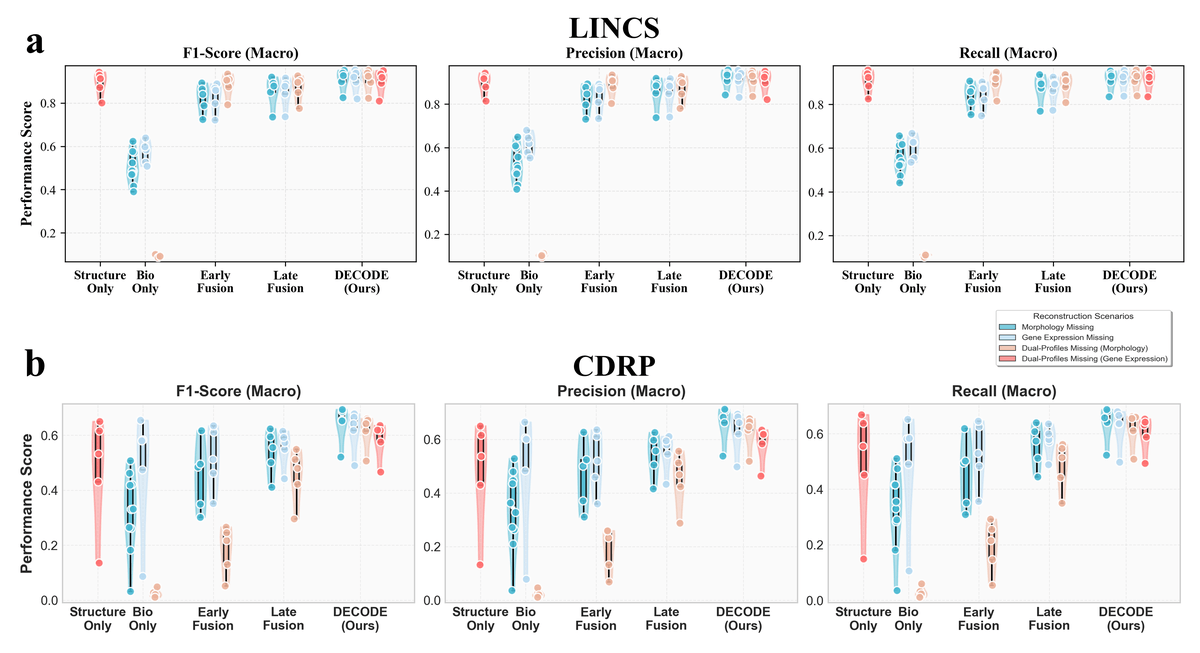
- Modality-mask self-reconstruction. During training, random modalities are dropped and the model has to reconstruct the missing view. This makes the system robust when transcriptomic or imaging profiles are missing in practice, which is the common case.
The molecular encoder itself is pluggable. The reference implementation supports both MolFormer, a transformer over SMILES, and VideoMol, a video-based molecular representation model.
Three ways to use it
The authors define three inference protocols, which correspond fairly directly to real drug-discovery workflows:
- Zero-shot functional retrieval. Given a query compound, find drugs with the same mechanism of action (MOA) using nearest-neighbor search in the learned embedding, with no task-specific training.
- Modality-flexible MOA prediction. Fine-tune for MOA classification while gracefully handling any combination of missing transcriptomic or morphological data.
- Profile-guided virtual screening. A generate-refine-enhance pipeline that scans large chemical libraries for hits against a target phenotype using chemical structure only.
Numbers that matter
On mechanism-of-action retrieval, DECODE reports over 20% relative improvement over chemical-only baselines in zero-shot settings. That is meaningful because zero-shot MOA retrieval is a proxy for whether the embedding actually captures function rather than just structural similarity. Two compounds with different scaffolds but the same MOA should be neighbors, and structural fingerprints famously fail at this.
The more eye-catching result is external validation on anti-cancer screening: a 6-fold increase in hit rate for novel anti-cancer agents. In a field where most virtual-screening hits fail biological validation, moving the hit-rate needle by that margin translates directly into fewer wasted wet-lab experiments.

The training data comes from two well-known paired datasets, LINCS Pilot1 and CDRP-BBBC047-Bray, both of which contain L1000 and Cell Painting readouts for the same compounds. External evaluation uses PRISM Cancer for binary cancer activity, MCELC for multi-label pathway prediction, and target-specific sets including BACE1, COX-1, COX-2, and EP4.
What it is good for, and where it will struggle
DECODE is most useful when you have access to a large virtual library of candidate molecules and want biological prioritization rather than pure similarity search. It is a natural fit for hit finding in oncology, for MOA hypothesis generation on orphan compounds, and for filtering combinatorial libraries before committing to costly assays.
Where it will struggle is anywhere the training biology is thin. The model has only been exposed to compound classes present in LINCS and CDRP, and its biological fingerprint is only as rich as L1000 and Cell Painting allow. Targets that leave no signature in gene expression or cell morphology, such as CNS receptors probed only via behavioral assays, are outside the scope. Extreme out-of-distribution scaffolds may also collapse back toward chemical-similarity behavior since the biological alignment was never trained on them.
Availability
The code, preprocessed datasets, and training configurations are open on GitHub, including pretrained checkpoints for both MolFormer and VideoMol backbones and scripts for all three inference protocols. Installation is a standard pip install -r requirements.txt, and the repository ships two-stage training scripts that separate the disentanglement pretraining from task-specific fine-tuning, making it reasonable to plug in your own compound library and screen against a target phenotype without rebuilding the pipeline from scratch.