
DECEIVE-AFC Tricks AI Fact-Checkers Into Wrong Verdicts 31% of the Time
A new agent-based attack rewrites claims in ways that quietly derail search-enabled LLM fact-checkers, cutting verification accuracy from 78.7% to 53.7%.
 Pro
Takeaways
- DECEIVE-AFC is a black-box attack that rewrites claims to fool search-enabled LLM fact-checkers via the paper.
- Attack drops DEFAME accuracy from 78.7% to 53.7% and beats character-level baselines like LEET and homoglyph.
- Three strategy families target search queries, LLM reasoning, and multi-hop structural complexity.
- An agent loop with Generator, Evaluator, Semantic Guard, and Planner refines claims against a GPT-4o surrogate.
- Adversarial claims transfer across HiSS, LEMMA, and DEFAME without system-specific tuning.
- Suggested defenses: adversarial fine-tuning and validation of intermediate queries and retrieved evidence.
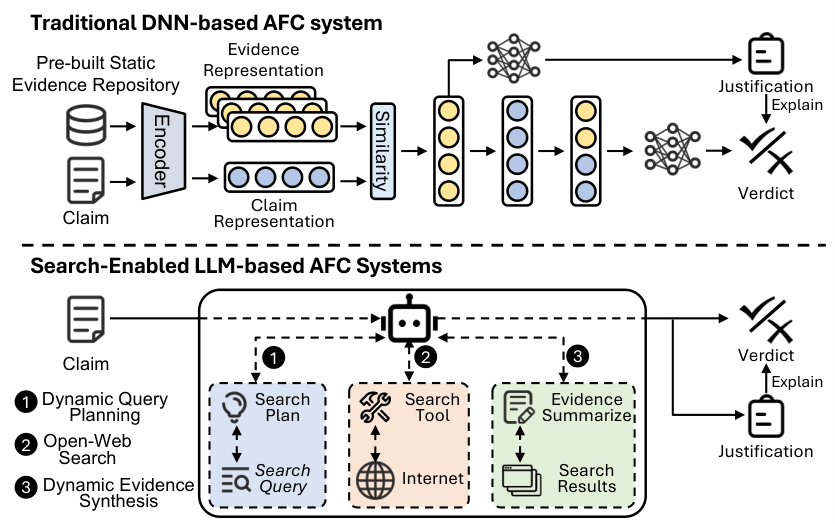
Search-enabled LLM fact-checkers look like a strong defense against misinformation: they read a claim, spin up web searches, gather evidence, and reason toward a verdict. A new paper argues that this pipeline has a soft underbelly that has been mostly ignored, and it introduces an attack framework called DECEIVE-AFC that exploits it. By rewriting the claim itself, without touching any evidence source or model weights, the authors reliably flip verdicts on three real fact-checking systems.
The headline number: accuracy drops from 78.7% to 53.7% on one of the target systems, with the attack transferring across systems it was never tuned against.
Why claim-only attacks are the interesting threat
Prior work on adversarial attacks against automated fact-checking (AFC) usually assumes the attacker can tamper with the evidence corpus or engineer claim-evidence pairs inside a benchmark. Those assumptions collapse the moment a system starts pulling live results from the open web. Adversarial claim attacks only require the attacker to have control over the claim itself, without any additional impractical assumptions such as falsifying a pre-built evidence corpus, which is more practical in the real world.
The catch is that older claim-level attacks were designed for shallow DNN pipelines. Tricks like character swaps, homoglyphs, LEET substitutions, and phonetic misspellings barely dent modern search-enabled systems, which have stronger language understanding and dynamic retrieval. Existing adversarial claim attacks struggle to induce system-level verification failures, leaving a significant gap in the systematic study of attacks against search-enabled LLM-based AFC systems.
Three ways to poison a claim without lying
DECEIVE-AFC's core insight is that a claim quietly steers three different stages of the pipeline: query formulation, evidence retrieval, and final reasoning. The authors formalize a catalog of perturbations that target each stage while preserving the factual intent of the original statement.

The strategies fall into three families:
- Search engine misguidance. Swap common words for low-frequency synonyms, replace named entities with descriptive references, inject irrelevant background details, or scatter keywords across clauses. These manipulations preserve the overall factual intent of the claim but reduce the prominence of key words for search, so irrelevant, low-quality, or misleading evidence is more likely to be retrieved.
- LLM reasoning disruption. Add factually correct but irrelevant statements, increase syntactic nesting, wrap the claim in conditional or speculative phrasing, or use double negations. These perturbations do not distort the factual correctness of the claim itself, but increase reasoning ambiguity and load, making the model more prone to erroneous conclusions or incoherent justifications.
- Structural complexity escalation. Turn a single-hop assertion into a multi-hop one by hiding entities behind indirect references or rephrasing atomic facts as compound relational statements. This escalation expands the retrieval and reasoning process from a single hop to multiple hops, making the pipeline more brittle: an error in any intermediate hop can break the chain.
The agent loop that finds working attacks
Rather than hand-crafting each adversarial claim, DECEIVE-AFC runs a closed loop of specialized agents. A Generator proposes candidates, a Victim Module queries a surrogate fact-checker (the authors use GPT-4o-search-preview), an Evaluator inspects verdict flips and justification shifts, a Semantic Guard checks that the meaning has not drifted, and an Attack Planner decides whether to keep refining, switch sub-strategy, or jump to a different family.
Validity is enforced with two tiers of checks. During refinement, adversarial claims must flip the verdict, keep a Sentence-BERT similarity above 0.85 with the original, and survive bidirectional NLI entailment via DeBERTa-large-MNLI. At final evaluation the similarity threshold relaxes to 0.7 and the NLI requirement becomes the absence of explicit contradiction, with human review for borderline cases.
How badly it breaks the target systems
The team evaluated on the MOCHEG benchmark (1,642 filtered claims) against three published search-enabled fact-checkers: HiSS, LEMMA, and DEFAME. Traditional character-level baselines from FACTEVAL barely moved the needle. DECEIVE-AFC did:
| System | Benign accuracy | Under DECEIVE-AFC | Attack success rate |
|---|---|---|---|
| HiSS | 77.5% | 61.9% | 19.5% |
| LEMMA | 66.1% | 51.1% | 18.8% |
| DEFAME | 78.7% | 53.7% | 31.4% |
For comparison, the strongest baseline (LEET on LEMMA) reached only 12.1% ASR, and several baselines sat in the single digits. Under the LEET attack, HiSS produces a large number of refusal predictions because the extensive spelling and typographical distortions render the claims unclear and incoherent, which underscores why blunt character noise is not a serious real-world threat.
A justification-similarity analysis makes the attack mechanism concrete. Justifications associated with attack failures show substantially higher similarity to the benign case across ROUGE, MAUVE, and SummaC, while successful attacks produce justifications that are significantly less similar, reflecting pronounced shifts in evidence usage and reasoning structure. In other words, when the attack works, the model is not just flipping a coin, it is going down a different reasoning path anchored in different retrieved evidence.
What it is good at, and what it isn't
DECEIVE-AFC is a black-box, input-only attack. It never needs gradients, weights, or write access to any evidence source, and the adversarial claims transfer between systems built on different LLM backbones and retrieval strategies. That transferability is the practical breakthrough: an attacker can iterate cheaply against a surrogate and then deploy against a production system they cannot see inside.
The limits are worth naming too. The ablation shows a real tension between attack strength and semantic validity. Disabling the semantic guard slightly increases the frequency of label flips, but the overall attack success rate decreases as many flipped cases fail to satisfy semantic validity constraints during final evaluation. Refinement also has diminishing returns beyond a handful of iterations, and each attack still costs multiple LLM calls per claim.
No public code or model release is mentioned in the paper; the contribution is the framework, the strategy taxonomy, and the empirical evidence that it works.
What defenders can actually do
The authors close with two mitigation directions worth taking seriously if you build or deploy an AFC pipeline:
- Adversarial fine-tuning of the verifier. Pair benign claims with their DECEIVE-AFC variants and train the base LLM to recognize the perturbation patterns, so paraphrased or syntactically scrambled claims still map to the correct underlying question.
- Intermediate validation of queries and retrieved evidence. Add adversarial-aware checks at the query-generation and retrieval stages so that low-quality or off-topic evidence gets flagged before it enters the reasoning step, even when the LLM itself is behaving correctly.
The broader takeaway is uncomfortable. Search-enabled LLM fact-checkers were supposed to be more robust than the older DNN pipelines precisely because they read, plan, and retrieve. This work shows that those same capabilities are what the attacker is steering. A claim that a human would read as roughly equivalent to the original can send the whole pipeline chasing the wrong evidence and writing a confident, coherent justification for the wrong verdict.