
DCPO Fixes AI Overconfidence Without Sacrificing Reasoning Accuracy
DCPO fixes a fundamental flaw in RLVR training: models that ace benchmarks but wildly overstate their own confidence, without sacrificing any accuracy
 Pro
Takeaways
- RLVR makes models overconfident: GRPO training pushes average model confidence from 0.88 to 0.98, even on wrong answers.
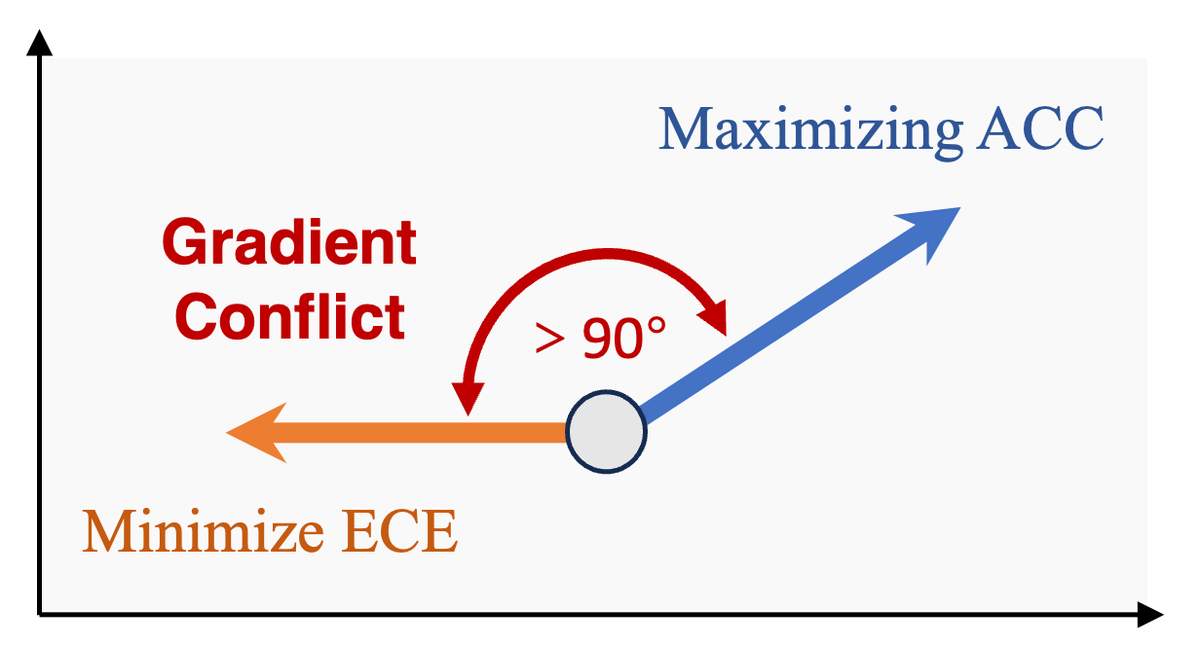
- Gradient conflict proven mathematically: Accuracy and calibration objectives have negatively aligned gradients -- you cannot optimize both simultaneously in a single loss.
- DCPO decouples the two objectives: Reasoning tokens get accuracy rewards; a separate confidence token gets calibration rewards; masked gradients prevent interference.
- Best-in-class calibration, zero accuracy cost: DCPO reduces ECE by ~48% and overconfidence (PCE) by ~65% vs GRPO while matching its accuracy on math and code benchmarks.
- Group-level accuracy as supervision signal: Averaging correctness across the GRPO rollout group provides a low-variance calibration target, a key innovation over noisy binary instance rewards.
- Code released: github.com/icip-cas/DCPO, validated on Qwen3-8B/14B and Llama3.1-8B.
Reinforcement Learning from Verifiable Rewards (RLVR) -- the training recipe behind models like DeepSeek-R1 and OpenAI o1 -- has become the dominant method for teaching LLMs to reason. Give the model a math problem, sample a bunch of answers, reward the correct ones. Repeat. Accuracy climbs. But there is a quiet side effect that nobody talks about enough: the model becomes dangerously overconfident, even when it is wrong.
A new paper, "Decoupling Reasoning and Confidence: Resurrecting Calibration in Reinforcement Learning from Verifiable Rewards", identifies exactly why this happens, proves it mathematically, and proposes a fix called DCPO (Decoupled Calibration Policy Optimization) that eliminates the overconfidence problem without touching accuracy.
The hidden cost of getting smarter
Calibration is the alignment between a model's stated confidence and its actual accuracy. A perfectly calibrated model that says "I'm 80% confident" should be right 80% of the time. RLVR often leads to severe calibration degeneration: RL-trained models tend to become over-confident, assigning extremely high confidence to their output even when the answers are incorrect. This is not a minor statistical artifact -- in high-stakes deployment settings such as medical question answering and legal reasoning, a reliable system must not only produce correct answers but also express calibrated uncertainty to support sound downstream decisions.
The authors measured this directly. GRPO steadily increases the model's average confidence from about 0.88 to above 0.98, and decreases model confidence variance from 0.006 to about 0.001. After GRPO training, PCE (Positive Calibration Error, which measures overconfidence specifically) increases from 0.312 to 0.362. The model gets more accurate and more overconfident at the same time.

Why naively adding a calibration loss makes things worse
The obvious fix is to add a calibration penalty to the RL reward. Several prior methods (RLCR, CCGSPG) tried exactly this. The problem: it trades accuracy for calibration. Improve one, hurt the other. The authors prove this is not a tuning problem -- it is a structural one.
They show there is a fundamental gradient conflict between the two objectives. In plain terms: when you compute the gradient that pushes the model to be more accurate, and the gradient that pushes it to be better calibrated, those two vectors point in opposite directions in parameter space. For over-confident models trained with RLVR, the gradient direction for maximizing accuracy is negatively aligned with the gradient direction for minimizing calibration error -- the Fisher-metric inner product between these two gradients is negative, implying an optimization conflict. You cannot satisfy both at once by mixing them into a single loss.
They also prove why RLVR causes overconfidence in the first place: in the absence of explicit entropy regularization, any optimal solution to the accuracy objective assigns probability mass 1 to a single trajectory. The math of trajectory-level RL structurally pushes the model toward mode collapse -- one answer, maximum confidence, regardless of whether that answer is right.
DCPO: separating the two jobs
The core insight of DCPO is simple: if accuracy and calibration gradients conflict, stop mixing them. Train them on different parts of the output, with different rewards, so their gradients never interact.
Here is how it works, step by step:
- Block-wise output structure. The model is prompted to produce its reasoning and final answer in a reasoning block
o_r, then append a confidence score after a special<conf>delimiter token. The output looks like:[reasoning + answer] <conf> [0.73]. - Separate rewards. The reasoning block gets a standard binary correctness reward (right or wrong). The confidence block gets a calibration reward: the negative absolute difference between the stated confidence and the hybrid accuracy target.
- Hybrid calibration target. Instead of using the noisy binary outcome of a single sample (0 or 1), the calibration target blends the instance-level result with the group-level average accuracy across all rollouts for that prompt. This is controlled by a parameter λ (set to 0.5 by default). The group average is a much lower-variance signal -- the authors prove its variance scales as O(1/G) where G is the group size.
- Masked gradient optimization. During the backward pass, accuracy gradients only flow through reasoning tokens, and calibration gradients only flow through confidence tokens. The two objectives are mathematically isolated.

The authors prove a key theorem: under this decoupled setup, the optimal confidence predictor converges to the true expected accuracy of the policy for that input -- exactly what a calibrated model should output -- without interfering with the reasoning policy at all.
The numbers
Experiments ran on Qwen3-8B (non-thinking mode) across five math benchmarks (MATH-500, AIME 2024/2025, AMC 2023/2024) and three code generation benchmarks (LiveCodeBench v5/v6, HumanEval+). All methods trained on the DeepScaler dataset for math and PrimeIntellect-verifier for code.
Key results on math reasoning:
- Accuracy: DCPO matches GRPO (60.8% vs 60.4% average across five benchmarks). Prior calibration methods RLCR and CCGSPG both drop accuracy noticeably.
- ECE (Expected Calibration Error, lower is better): DCPO achieves 0.128 vs GRPO's 0.248 -- a 48% relative reduction.
- PCE (overconfidence specifically): DCPO cuts PCE from 0.362 (GRPO) to 0.126 on average.
- AUROC (how well confidence ranks correct vs incorrect answers): DCPO hits 0.881 vs GRPO's 0.749, a substantial improvement in the model's ability to know when it knows.
On code generation, DCPO attains the highest average accuracy (0.515), slightly outperforming GRPO (0.514), while substantially reducing average ECE from 0.287 to 0.175. The calibration gains generalize across domains without any task-specific tuning.
DCPO also produces a balanced and continuous confidence distribution, whereas GRPO-trained models exhibit heavily skewed confidence distributions reflecting severe overconfidence, and RLCR collapses confidence estimates toward extreme values, indicating poor confidence granularity.
What the ablations reveal
The ablation study isolates each component's contribution:
- Remove decoupled optimization: ECE jumps from 0.128 to 0.258, accuracy drops from 60.8% to 57.3%. This is the most critical component.
- Remove group-level labels (use only instance-level): Accuracy drops to 58.7%, confirming that the low-variance group signal stabilizes training.
- Remove instance-level labels (use only group-level): ECE rises to 0.209, showing instance-level signals are needed for fine-grained confidence discrimination.
- Use off-policy calibration: Accuracy drops to 56.3%, showing that calibration must be trained on-policy alongside reasoning.
What this unlocks
The practical impact is significant for anyone deploying reasoning models in production. A model that says "I'm 95% confident" and is actually right 60% of the time is actively dangerous in any system that uses confidence scores for routing, abstention, or human escalation decisions. DCPO makes those confidence scores trustworthy without paying an accuracy tax.
In high-stakes deployment settings such as medical question answering and legal reasoning, a reliable system must not only produce correct answers but also express calibrated uncertainty to support sound downstream decisions, as the ability to estimate when outputs are likely to be correct is essential for safe and reliable use. DCPO is the first method to achieve this without the accuracy-calibration tradeoff that has plagued every prior approach.
One limitation worth noting: DCPO adds a structured output requirement (the <conf> block), which means it requires prompt engineering and a format penalty during training. The authors show the format violation rate drops to ~0.2% within a few training steps, and generation length is nearly identical to GRPO (1292 vs 1300 tokens on average). The code is available at github.com/icip-cas/DCPO. The method has been validated on Qwen3-8B, Qwen3-14B, and Llama3.1-8B-Instruct, suggesting the approach generalizes across model families and scales.