
DC-W2S Beats Biology AI Benchmarks Training on Just 28% of Data
DC-W2S trains reliable Process Reward Models for biological reasoning using only noisy, automatically-generated labels — no expert annotation required — and beats models trained on far larger datasets.
 Pro
Takeaways
- DC-W2S trains Process Reward Models (step-by-step reasoning verifiers) for biology using only cheap, noisy automated labels — no expert annotation needed.
- The framework stratifies training data into four reliability tiers (P1–P4) by combining agreement across multiple weak supervisors with consistency in biological embedding neighborhoods.
- A 100k-sample curated subset outperforms the full 351k-sample dataset on out-of-distribution tasks, including a cross-task jump to 89.08% Weighted F1 on BioReason KEGG.
- The trained PRM lifts average F1 from 60.4% (greedy SFT baseline) to 68.5% using Best-of-8 sampling on gene perturbation prediction across four cell lines.
- Biologically grounded embeddings (ESM, CellProfiler) are critical: purely semantic neighborhoods can mislead the consensus signal by retrieving linguistically similar but biologically unrelated steps.
- The paper will release the 351k-trajectory perturbation reasoning dataset with multi-source weak step annotations for future research.
Training an AI to reason correctly about biology is hard enough. Training one to verify its own reasoning steps , without any human expert checking each step along the way , is a problem that has quietly blocked progress in applying large language models to serious scientific work. A new paper introduces DC-W2S (Dual-Consensus Weak-to-Strong), a framework that solves this by teaching a model to be a reliable judge of reasoning quality using only cheap, noisy, automatically-generated labels.
Why reasoning verification matters in biology
The dominant approach to training reasoning models today relies on Outcome Reward Models (ORMs) , systems that only check whether the final answer is correct. This works reasonably well for math, but in biology it creates a dangerous failure mode. A model can hallucinate a plausible-sounding pathway through gene interactions, guess the right answer by chance, and get rewarded for it. A model that "hallucinates" a plausible pathway yet guesses the right answer is arguably more dangerous than one that is transparently wrong, as it can mislead researchers and result in catastrophic waste of experimental time and resources.
Process Reward Models (PRMs) , models that score each individual reasoning step in a chain-of-thought , are the natural fix. A PRM evaluates each intermediate step of a Chain-of-Thought, providing a dense, fine-grained reward signal that enables precise localization of errors, teaching the model how to reason correctly rather than merely the correct answer. The catch: training a PRM requires step-level labels, and getting a domain expert to verify millions of individual reasoning steps about gene perturbations is simply not feasible.
Automated alternatives like Monte Carlo rollouts and LLM-as-a-judge exist, but they produce noisy labels. Naively training on these weak annotations risks the "garbage in, garbage out" problem, where the resulting PRM merely learns to imitate the systemic errors and biases of its automated teachers.
The dual-consensus idea
DC-W2S is built on a simple but powerful insight: not all noisy labels are equally noisy. Some steps are ones where multiple independent weak supervisors agree, and where nearby similar steps in the embedding space also agree. Those are the reliable ones. The framework formalizes this with two orthogonal signals:
- Self-Consensus (SC): Do multiple heterogeneous labeling functions (LLM judges with different prompts, Monte Carlo rollouts from different model sizes) agree on whether this step is correct?
- Neighborhood-Consensus (NC): Do the nearest neighbors of this step in the embedding space also have consistently labeled steps? If a step sits in a "noisy" region of the space, even a locally correct label is suspect.
By intersecting these metrics, DC-W2S stratifies the supervision space into four distinct reliability regimes: P1 (high SC and high NC), P2 (high SC and low NC), P3 (low SC and high NC), and P4 (low SC and low NC). P1 steps are high-confidence anchors. P4 steps are mostly noise. P3 is the interesting middle ground: ambiguous to individual teachers, but sitting in a consistent neighborhood , and it turns out to be especially valuable for out-of-distribution generalization.

How it works, step by step
The pipeline has four main stages:
- Trajectory synthesis: A weak generator (Qwen3-4B) produces 351k chain-of-thought reasoning trajectories over the PerturbQA dataset, a benchmark of gene perturbation questions across four cell lines. Each trajectory reasons through questions like "Does ABCF1 knockdown in HepG2 affect ARCN1 expression?"
- Multi-source weak annotation: Each reasoning step gets labeled by three LLM-as-a-judge variants (Direct, Context, Analogical , differing in how much biological knowledge graph context they receive) and by Monte Carlo rollouts from Qwen3-{1.7B, 4B, 7B}. Labels are aggregated by majority vote.
- Dual-consensus stratification: Every step gets a TSC score (agreement across the labeling functions) and a TNC score (average TSC of its 20 nearest neighbors in embedding space). A key twist: the neighborhood is filtered by biological similarity using gene embeddings from ESM or CellProfiler, so linguistically similar but biologically unrelated steps don't contaminate each other's neighborhoods.
- Anchored training: Two mechanisms exploit the P1–P4 stratification. At the instance level, a distribution-balanced sampling curriculum ensures training data has roughly equal representation of all four regimes, preventing the model from being dominated by trivial P1 examples or overwhelmed by P4 noise. At the label level, a reliability-aware loss masking mechanism suppresses gradients from low-reliability steps.
The student PRM is initialized from Qwen3-4B with its language modeling head replaced by a scalar regression head, trained with binary cross-entropy against the aggregated weak labels.
The results: less data, better generalization
The Best-of-N (N=8) performance using multi-source supervision consistently outperforms training with a single weak source, yielding an average F1 of 68.5% versus 66.9%, and substantially exceeds the SFT baseline of 60.4% average F1. But the more striking finding is what happens when you use the W2S-curated subsets instead of the full dataset.
Upon reaching a scale of 100k instances, the W2S-induced model achieves an F1 score of approximately 64.5%, surpassing both the Full Set with Multi-label baseline (64.0%) and the Full Set with Single-label baseline (62.0%), despite the latter utilizing 351k training instances. In other words, training on 28% of the data , but the right 28% , beats training on everything.
The "less is more" effect is even more pronounced on cross-task generalization. On the BioReason KEGG task, a domain that lies entirely outside the training distribution, the W2S-enhanced models trained with only 100k samples surpass those trained on the full-set counterpart, with CellProfiler (100k) and ESM (100k) achieving Weighted F1 scores of 88.89% and 89.08%, respectively, outperforming the Full Set variant (87.40%). The interpretation: training on all the noisy labels causes the model to overfit to perturbation-specific artifacts, while the curated subset distills more transferable biological reasoning structure.
The P1–P4 breakdown
The paper's ablations on the four reliability regimes reveal a nuanced picture that matters for practitioners:
- P1 (high SC, high NC): The strongest single-pattern regime across all tasks. These are the reliable anchors.
- P2 (high SC, low NC): Strong in-distribution but brittle under distribution shift , a 5-point F1 drop from IID to OOD settings.
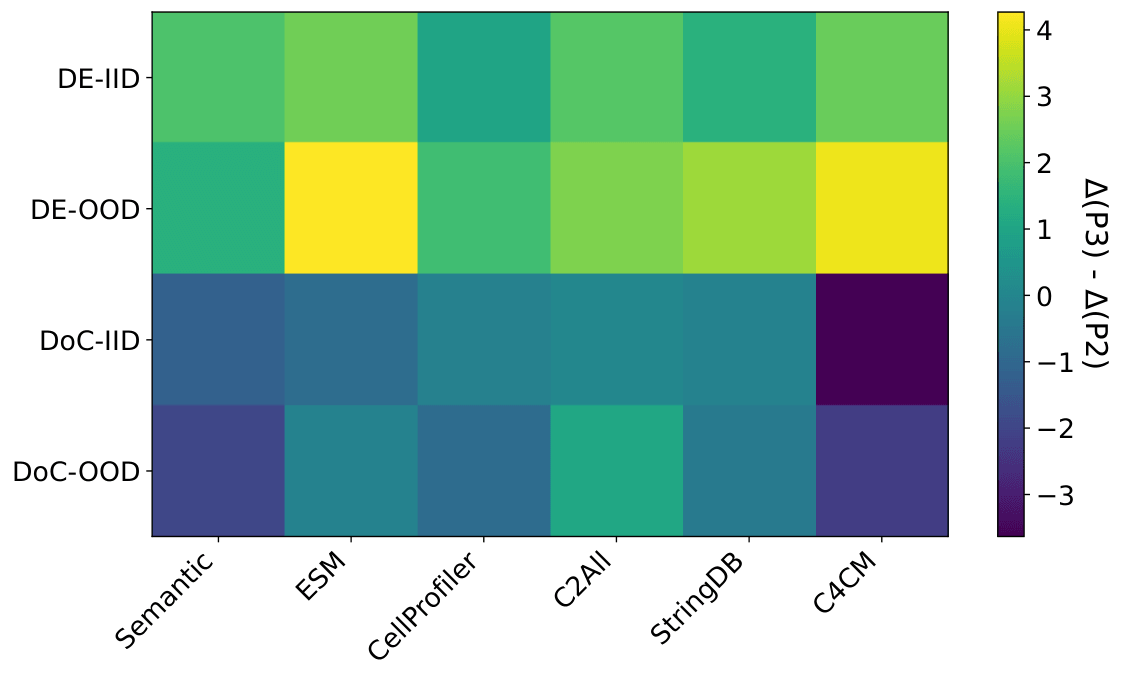
- P3 (low SC, high NC): Weak alone, but when combined with P1 anchors, P3 provides the best OOD gains. P3 captures manifold-consistent cues that transfer across contexts, even when weak teachers disagree pointwise.
- P4 (low SC, low NC): Mostly noise. Safe to mask out first when optimizing for label efficiency.
The choice of biological embedding also matters. Embeddings with richer biological structure (e.g., ESM, CellProfiler) yield larger gains from neighborhood-reliable supervision (P3), while purely semantic or network-only embeddings can make P4 outperform P3 by retrieving linguistically similar but biologically mismatched steps.
What's available and what's next
The authors will release the large-scale perturbation reasoning trajectory dataset with multi-source weak step annotations to support future research. No model weights or code repository are linked in the paper at this time.
The framework's core limitation is that it currently assumes neighborhood label consistency , that semantically and biologically similar steps should have the same correct label. This is a reasonable assumption for biological perturbation reasoning, but may not hold in all domains. The authors also note that the approach inherits limitations from the underlying weak supervisors and is not a substitute for expert judgment in high-stakes deployment.
The broader implication is a shift in how to think about PRM training data: strategic data curation is more effective than indiscriminate training on large-scale noisy datasets. For any domain where expert step-level annotation is expensive , which is most domains , DC-W2S offers a practical path to reliable process supervision without the annotation bottleneck.