
DASH Cuts Qwen2.5-Omni Token Processing by 75% Without Any Training
A training-free method uses audio boundaries to guide token pruning in omnimodal LLMs, hitting 3.8x prefill speedup at 25% retention.
 Pro
Takeaways
- DASH is a training-free token compression framework for omnimodal LLMs that uses audio to guide pruning. Paper
- Cosine similarity drops between adjacent audio embeddings mark semantic boundaries, then project onto video tokens.
- A tri-signal score fuses boundary probability, multi-scale Gaussian uniqueness, and attention with weights 0.4, 0.3, 0.3.
- Matches OmniZip accuracy at 25% token retention versus their 35%, with under 40ms added overhead.
- Delivers 3.8x prefill speedup and 1.7x end-to-end latency reduction on Qwen2.5-Omni benchmarks.
- Apache-2.0 code released integrating with lmms-eval and Qwen2.5-Omni. Repo
Omnimodal models like Qwen2.5-Omni that jointly process audio, video, and text are impressive at joint reasoning, but they produce enormous token sequences. A single clip can generate tens of thousands of tokens, and self-attention scales quadratically, so inference quickly becomes memory and latency bound. A new training-free method called DASH attacks this by letting the audio stream tell the compressor where to cut.
Why fixed windows keep breaking
Prior compression methods treat multimodal token streams as flat sequences. They chop them into fixed windows and score tokens with attention alone. Existing methods such as OmniZip divide video into fixed groups of 4 frames and audio into fixed groups of 50 tokens, regardless of semantic content. That rigidity is the core problem: a burst of rapid dialogue gets the same slice as a stretch of silence.
Attention-based scoring has its own pathology. Attention distributions are extremely sparse, with importance concentrating on a handful of tokens while the vast majority receive near-zero scores. Under aggressive pruning that means transition anchors, the tokens that stitch a scene together, get thrown out first.
Audio as a semantic ruler
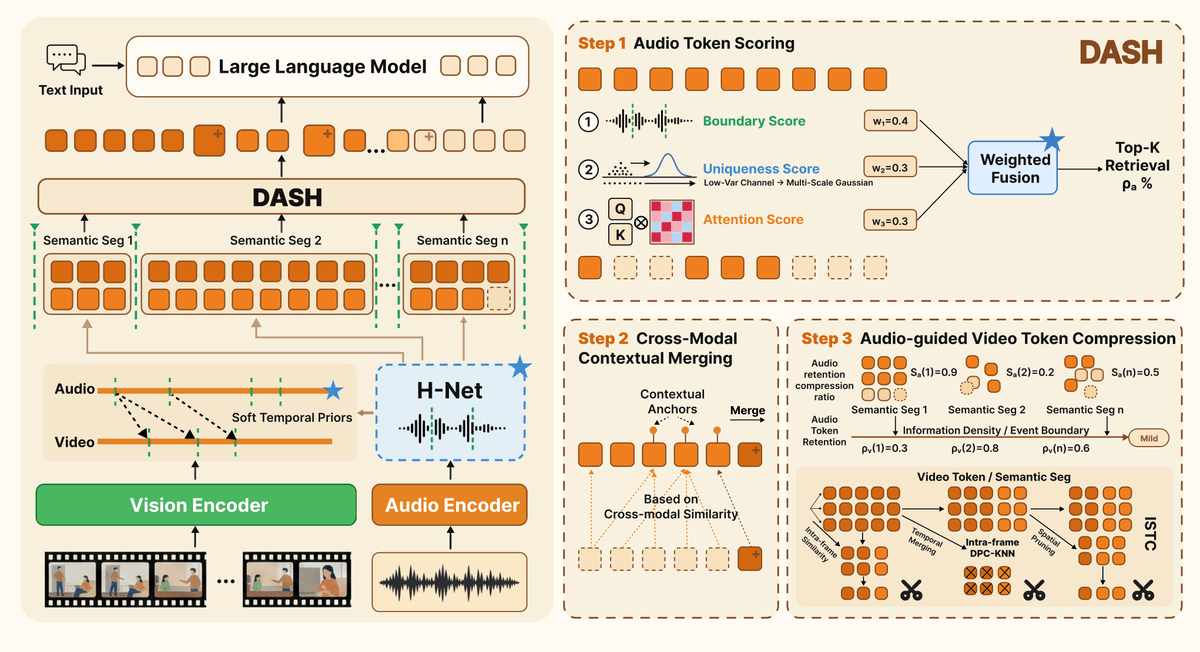
The authors' key insight is that speech carries sharper structural cues than video. Compared to visual tokens, audio embeddings exhibit sharper distributional discontinuities at semantic transitions such as pauses and topic shifts, making them a more reliable boundary signal. Because audio and video tokens are temporally aligned inside the model's time-window structure, boundaries detected in audio can be projected onto video without any learning.
DASH runs entirely as a plug-in between the encoders and the LLM. It adds no parameters, no training, and reportedly less than 40ms of overhead.
The four stages, walked through
DASH operates in four stages on already-extracted encoder embeddings:
- Boundary detection. For each adjacent pair of audio tokens, it computes cosine similarity. A sharp drop signals a semantic transition. A boundary is detected when cosine similarity drops below threshold 0.4 and the distance from the last boundary exceeds a minimum chunk size of 30 tokens, roughly one second of audio. The minimum chunk rule prevents noise from producing 2-3 token slivers.
- Audio to video projection. Boundary positions are mapped onto video token indices by linear temporal ratio scaling. A greedy refinement then keeps only boundaries whose adjacent segments are at least two frames wide, prioritizing the strongest audio-indicated cuts.
- Tri-signal token scoring. Within each segment, audio tokens are ranked by a weighted sum of three signals: boundary probability, probabilistic density-based uniqueness computed with a multi-scale Gaussian kernel that captures token importance across various feature granularities, and normalized attention scores from the audio encoder. Default weights are 0.4, 0.3, and 0.3.
- Adaptive video pruning. Segments tied to information-dense audio keep more video tokens; segments over silence get compressed harder. Frames near projected boundaries get a mild retention boost, then interleaved spatial-temporal pruning from OmniZip finishes the job.
The uniqueness signal is what rescues tokens that attention alone would kill. Among top-50% retained tokens, 631 are rescued by fusion, 866 are shared, and 631 attention-only tokens are replaced, a 42% turnover confirming that fusion fundamentally reshapes selection.
The numbers
Tests were run on Qwen2.5-Omni at 7B and 3B, using AVUT, VideoMME, and WorldSense. The headline result: DASH at 25% retention roughly matches prior methods running at 35%.
- On WorldSense with the 7B model, DASH at 25% retention achieves 44.9% average accuracy, matching or surpassing OmniZip at 35% retention while consuming only 14.9T FLOPs versus 21.4T, a 30% computational saving with improved accuracy.
- On AVUT, DASH at 25% retention scores 60.9% on the 7B model, competitive with OmniZip at 35% (60.6%) despite using only 20% FLOPs.
- At 25% retention, DASH achieves 3.5x prefill speedup on the 7B model and 3.8x on the 3B model, with end-to-end latency reduced to 1.7x (7B) and 1.4x (3B).
- On VideoMME (no subtitles), DASH at 25% ties the full-token baseline at 66.0%.
Ablations confirm both halves matter. Cosine similarity achieves the highest accuracy (44.6%), while dot product (43.6%), change rate (44.0%), and random boundaries (43.8%) perform worse. Weight sensitivity is stable around the default 0.4 boundary weight and degrades if you push it past 0.5.
Using it and where it will not help
The reference implementation is released under Apache 2.0 and drops into Qwen2.5-Omni pipelines. A minimal invocation looks like this:
python demo.py --dash --rho_audio 0.45 --rho_video 0.76Evaluation hooks into lmms-eval for benchmarks like VideoMME. Because DASH is training-free and runs on already-extracted embeddings, it should port to other omnimodal architectures that share the time-window layout, though only Qwen2.5-Omni has been validated.
The limitations are worth knowing. DASH assumes an audio stream with meaningful structure. On silent video, ambient-noise-only clips, or very short sequences, the boundary detector produces little signal and the method falls back to attention-only selection. The boundary-neighborhood retention is a soft prior, not a guarantee that audio pauses coincide with visual cuts, so noisy audio-visual alignment will erode its gains. And like all training-free pruning methods, DASH inherits whatever the underlying encoder considers salient, which means it will not fix systematic weaknesses in the base omnimodal model itself.