
Dartmouth's SLIP Turns Unlabeled Sensor Data Into Language-Aligned AI
Dartmouth researchers release SLIP, a sensor foundation model that speaks natural language and adapts to any channel count or sampling rate without retraining.
 Pro
Takeaways
- Dartmouth's SLIP aligns multivariate sensor data with language, handling variable channels and sampling rates without retraining.
- Hits 77.14% average linear-probing accuracy across 11 datasets, a 5.93% relative gain over baselines.
- Scores 64.83% on sensor question answering and 0.887 BERTScore on signal captioning.
- Pretrained on 600K+ sensor-caption pairs spanning health, environment, IoT, energy, and transportation.
- Repurposes Gemma-3-270M as split text encoder plus cross-attention multimodal decoder, ~220M params total.
- Code, checkpoints, and datasets released under MIT on GitHub and Hugging Face.
Sensor data is everywhere. Phones log accelerometer traces, wearables stream heart rate and PPG, environmental stations record particulates, and hospitals produce endless ECG. The problem is that almost none of it is labeled, and the self-supervised recipes that work so well for text and images tend to fall short here. A team from Dartmouth is proposing a fix called SLIP, short for Sensor Language-Informed Pretraining, that aligns raw multivariate signals with natural language captions and handles arbitrary sensor configurations at inference time.
The pitch is straightforward. SLIP is an open-source framework for learning language-aligned sensor representations that generalize across diverse sensor configurations, integrating contrastive alignment with sensor-conditioned captioning to enable both discriminative understanding and generative reasoning over multivariate time series from heterogeneous sensors. In practice that means one pretrained encoder you can use for classification, retrieval, captioning, and question answering across health, IoT, environmental, and transportation signals.
Why time-series SSL keeps missing the point
Most self-supervised pretraining for sensors is built around reconstruction or forecasting: mask a chunk of the signal, predict what was hidden, or extrapolate the next window. Those objectives teach a model about local statistical structure but not about meaning. A representation that reconstructs an ECG waveform perfectly still has no idea whether it corresponds to atrial fibrillation or a normal rhythm.
A more recent line of work borrows from CLIP and aligns sensor windows with text captions, which does inject semantics. But there is a catch. Recent sensor-language alignment methods improve semantic generalization through captioning and zero-shot transfer, but they are limited to fixed sensor configurations, such as predefined channel sets, signal lengths, or temporal resolutions, which hinders cross-domain applicability. Train on 3-axis accelerometer at 50 Hz and you cannot drop in a 12-lead ECG at 500 Hz without rebuilding the input pipeline. That rigidity has kept sensor foundation models from becoming truly general.
A flexible patcher and a repurposed language model
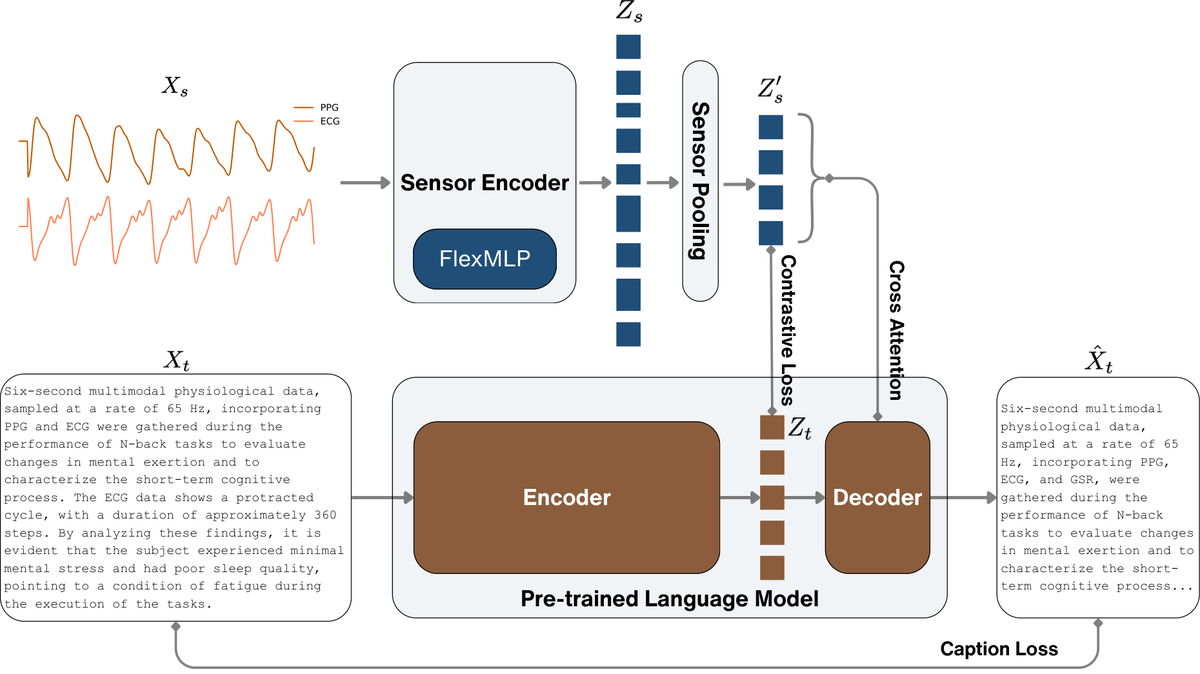
SLIP's architecture has four moving parts. A sensor encoder turns raw multivariate signals into token sequences. A pooler squashes those variable-length token streams into fixed-size representations. A text encoder handles language. And a multimodal decoder ties them together for generation.

The interesting engineering lives in two places. The first is FlexMLP, a weight-sharing patch embedding that dynamically adapts to different temporal resolutions and variable-length inputs without retraining. This is what lets the same checkpoint accept a short PPG snippet and a long polysomnography recording without any surgery on the input layer.
The second is how the language side is built. Rather than bolting a separate text encoder onto a decoder, the authors carve up a single small LLM. A pretrained Gemma-3-270M is split into a unimodal text encoder using the first 12 layers and a multimodal decoder from the last 6 layers, with cross-attention inserted to let the decoder attend to sensor tokens. The full model lands at roughly 220M parameters with 67M trainable, which is small enough to be practical.
Training combines two losses in the CoCa style: a CLIP-style contrastive objective that pulls matched sensor-caption pairs together in embedding space, and an autoregressive captioning loss that teaches the decoder to describe a signal given its embedding. The contrastive side gives you retrieval and zero-shot classification. The generative side gives you captioning and question answering.
600K sensor-caption pairs and a benchmark sweep
Pretraining data is often the hardest part of a story like this, and here it comes from a mix of curated sources. SLIP is pretrained on 600K+ sensor-caption pairs spanning health, environment, IoT, energy, and transportation, roughly one billion time points in total. Captions are generated by extracting time-series attributes such as trend, seasonality, and noise, then augmenting through an LLM pipeline.
Evaluation runs across 11 downstream datasets grouped into four domains:
- Activity recognition: WISDM, UCI-HAR
- Clinical diagnosis: PPG-based stroke, diabetes, and hypertension detection, sleep staging on sleepEDF, and ECG classification on PTB-XL
- Stress prediction: WESAD, StudentLife
- Urban sensing: AsphaltObstacles, Beijing AQI
Results are strong across the board. Across 11 datasets, SLIP demonstrates superior performance in zero-shot transfer, signal captioning, and question answering, achieving a 77.14% average linear-probing accuracy, a 5.93% relative improvement over strong baselines, and reaching 64.83% accuracy in sensor-based question answering. The team also reports a 0.887 BERTScore on captioning, meaning the generated descriptions land close to human-written references in semantic terms.
What this actually unlocks
The practical implication is that a single checkpoint can be reused across sensor stacks that would previously have required separate models. Because the pretrained decoder-only language model is repurposed via cross-attention and an elegant, flexible patch-embedder supports different temporal resolutions and variable-length input at inference time without additional retraining, you can prototype on one modality and swap in another without touching the training pipeline.
Concrete use cases worth calling out:
- Zero-shot classification on new sensor tasks by writing class descriptions as text prompts and doing nearest-neighbor in the aligned space
- Signal captioning for logs and dashboards, where a wearable stream can be summarized in plain language
- Sensor question answering for chain-of-thought clinical or health workflows, using the finetuned checkpoints released for HAR, sleep staging, and ECG
- Feature extraction via
get_sensor_embeddingfor any downstream classifier, replacing hand-tuned SSL encoders
Caveats worth knowing
The obvious limitations are size and scope. A 270M-parameter text backbone is small by current LLM standards, which will cap reasoning quality on complex sensor QA. The 64.83% QA accuracy is a solid step forward but still leaves plenty of room. Captions in the pretraining set are largely synthetic, derived from statistical attributes of the signals, so downstream generation reflects that structure. And while the 11-dataset sweep is broad, several of the domains are still relatively small in size and specialized in nature, so cross-domain generalization to truly novel modalities has not been fully stress-tested.
Getting your hands on it
Everything is released under an MIT license. The code lives on GitHub, the pretrained base checkpoint and task-specific finetuned variants for HAR, sleep, ECG, TSQA, and M4 captioning are on the Hugging Face model hub, and the pretraining and SFT datasets are hosted alongside them. Loading is a one-liner through AutoModel.from_pretrained with trust_remote_code=True.
from transformers import AutoModel, AutoTokenizer
model = AutoModel.from_pretrained("LeoChen085/SLIP", trust_remote_code=True)
tokenizer = AutoTokenizer.from_pretrained("google/gemma-3-270m")
with torch.no_grad():
    text_emb, sensor_emb = model.get_embedding(text, sensors)
For teams sitting on piles of unlabeled wearable, medical, or industrial time-series data, this is one of the more usable open baselines to try before committing to a bespoke pretraining run.