
Dark-EvGS Reconstructs Sharp 3D Scenes From Near-Total Darkness
Dark-EvGS pairs event cameras with 3D Gaussian Splatting to render bright, sharp novel views of scenes captured in near darkness.
 Pro
Takeaways
- Dark-EvGS is the first event-guided 3D Gaussian Splatting method for bright novel-view synthesis in dark scenes.
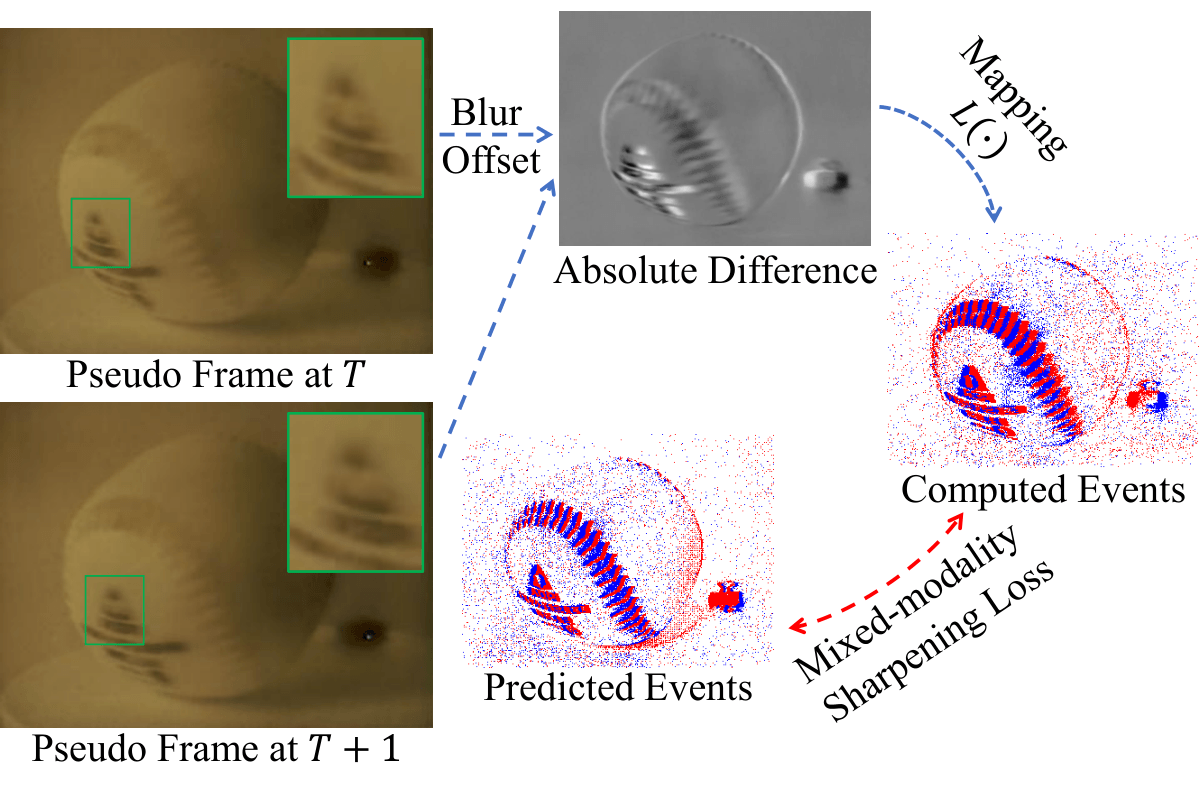
- Triplet-level supervision combines holistic frame loss, event granular loss, and a mixed-modality sharpening loss.
- A Color Tone Matching Block uses channel-wise self-attention to keep rendered views color consistent.
- On the Lion scene at 32 lux, PSNR jumps to 31.22, versus 18.86 for the next hybrid method.
- Training takes about 4 minutes on an RTX 3090 with 41 FPS rendering and roughly 1.2 GB memory.
- Currently static only, pose estimation in the dark remains open, and dataset and code will be released.
Reconstructing a 3D scene from photos taken in near darkness is one of those tasks that quietly breaks most of the computer vision pipeline. Frames come out noisy and motion-blurred, feature matching fails, and pose estimation collapses. A new paper called Dark-EvGS tackles this by pairing an event camera with 3D Gaussian Splatting, rendering bright, sharp views of objects from arbitrary viewpoints using only dark inputs.
The team from the University of Hong Kong, Peking University, and collaborators frame it as the first event-assisted 3D GS framework aimed squarely at low-light radiance field reconstruction. Alongside the method, they introduce triplet-level supervision, a color tone matching block, and the first real-captured dataset for event-guided bright frame synthesis via 3D GS.

Why dark scenes break everything
Standard cameras hit a wall in low light. Their limited dynamic range and the long exposures needed to gather photons produce frames that are simultaneously dim and motion-blurred, which is exactly the wrong combination for reconstructing a scene. Event cameras help because they respond to per-pixel brightness changes asynchronously with microsecond latency and a much wider dynamic range, but under extreme darkness photon scarcity turns the event stream into a noisy mess.
Previous event-based radiance field work sidesteps this entirely. Existing methods are built on neural radiance fields, which are computationally heavy and slow, and newer event-based Gaussian splatting approaches like Ev-GS were designed for normal lighting. Techniques that reconstruct video from events either produce grayscale output or target short-exposure scenarios, so their color and detail assumptions don't survive genuine darkness. Dark-EvGS aims at the harder real-world case where illumination sits under 40 lux.