
Dalian University's RexDrug Beats GPT-4o at Reading Cancer Drug Combinations
RexDrug uses multi-agent reasoning and reinforcement learning to extract complex multi-drug combinations from medical literature, beating GPT-4o and prior baselines on accuracy and interpretability.
 Pro
Takeaways
- RexDrug is a new framework for extracting multi-drug combination relationships from biomedical literature using reasoning-enhanced LLMs.
- It uses a two-stage pipeline: multi-agent reasoning distillation (GPT-4o analyst + GPT-5.1 reviewer) followed by GRPO reinforcement learning with three reward signals.
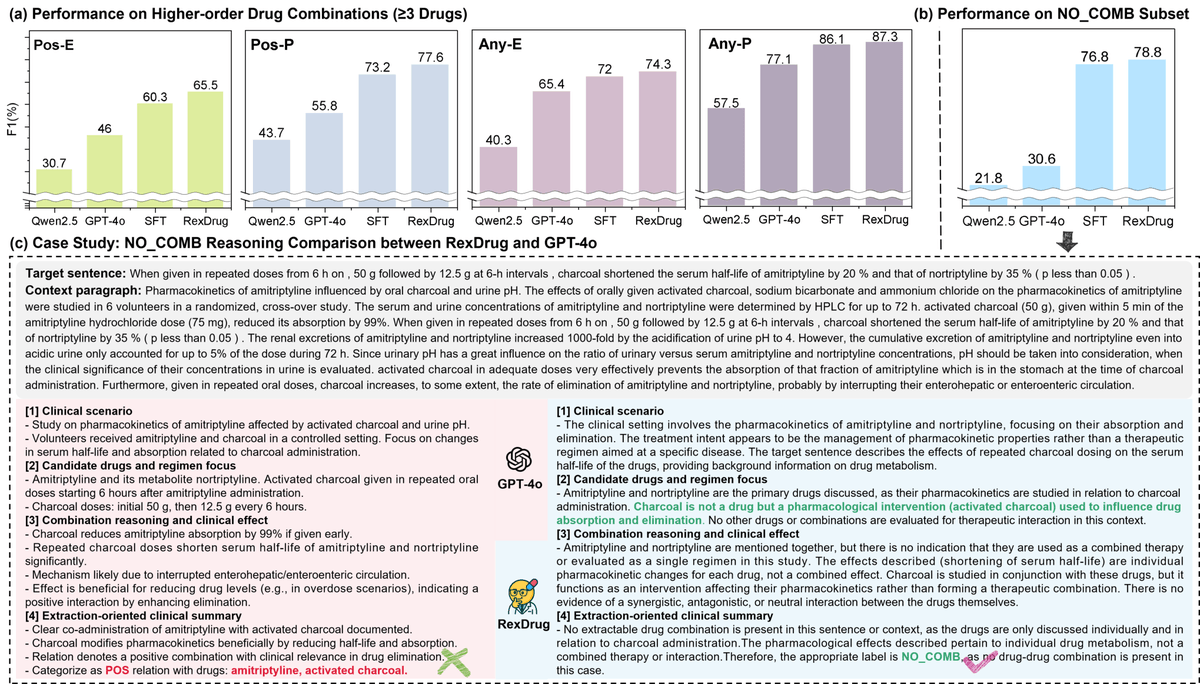
- On the DrugComb benchmark, RexDrug achieves 74.6% Pos-Exact F1, beating GPT-4o (49.2%) and the prior best end-to-end model by ~8 points.
- It generalizes to binary drug-drug interaction extraction, reaching 87.6% F1 on DDI13, surpassing the best baseline by 3.7 points.
- Human expert blind evaluation found RexDrug's reasoning traces more faithful and medically consistent than GPT-4o's, with less hallucination.
- Code and data are open-sourced on GitHub; base models are open-weight (LLaMA3.1-8B, Qwen2.5-7B).
Every oncologist knows that cancer isn't beaten by a single drug. Combination therapies -- cocktails of two, three, sometimes a dozen drugs -- are the standard of care for cancer, HIV, tuberculosis, and malaria. The problem is that the evidence for which combinations actually work is buried in millions of biomedical abstracts, and no team of humans can read them all. Automated extraction sounds like the obvious fix, but it turns out to be a surprisingly hard NLP problem that existing models have largely failed to solve well.
A new framework called RexDrug from Dalian University of Technology tackles this head-on. By combining a multi-agent reasoning pipeline with reinforcement learning, it teaches a 7B-parameter model to think like a clinical pharmacologist -- and the results beat GPT-4o, specialized biomedical models, and every prior baseline on the task.
Why This Is Harder Than It Looks
Most relation extraction in NLP is binary: drug A interacts with drug B, yes or no. Drug combination extraction (DCE) is fundamentally different. A single abstract might describe a five-drug regimen where the evidence for the combination is scattered across multiple sentences, the set of drugs is variable in length, and the clinical effect depends on subtle compatibility logic that requires genuine pharmacological reasoning to interpret.
- N-ary relations: combinations involve 2 to 15 drugs simultaneously, not just pairs
- Cross-sentence evidence: the evidence supporting a combination is often distributed across multiple sentences in an abstract
- Variable structure: unlike fixed-arity tasks (e.g., drug-gene-mutation triplets), the number of drugs in a combination is dynamic per instance
- Label ambiguity: combinations are labeled POS (positive effect), OTHER (co-administered but effect unclear or negative), or NO_COMB (no combination present) -- and the distinction requires clinical judgment
Combination therapies have become the standard of care for diseases such as cancer, tuberculosis, malaria, and HIV, but the combinatorial set of available multi-drug treatments creates a real challenge in identifying effective options. There are over 350,000 articles in PubMed that use the combination drug therapy MeSH heading, with at least 10,000 articles published per year over the past two decades. The scale makes manual curation impossible.
Prior approaches fell into three camps: pipeline methods (NER then classification, with error propagation), end-to-end models optimized for binary relations, and raw LLM prompting. The DrugComb dataset presents a unique NLP challenge as the first relation extraction dataset consisting of variable-length relations, and the relations predominantly require language understanding beyond the sentence level. Even GPT-4o, prompted zero-shot, only reaches 49.2% Pos-Exact F1 on this benchmark -- well below what clinical utility would require.
The Two-Stage Training Recipe
RexDrug's core insight is that you can't just fine-tune a model on labels alone -- you need to teach it to reason pharmacologically before asking it to extract. The framework does this in two progressive stages.

Stage 1: Multi-Agent Reasoning Distillation. The team assigns two LLMs distinct roles: a Medical Reasoning Analyst (GPT-4o) and a Medical Expert Reviewer (GPT-5.1). The Analyst generates step-by-step reasoning traces for each training example, structured into four mandatory sections: clinical scenario, candidate drugs and regimen focus, combination reasoning and clinical effect, and an extraction-oriented clinical summary. The Reviewer then scores each trace on six dimensions -- format compliance, medical validity, semantic consistency, factual consistency, narrative naturalness, and logical completeness -- on a 0-5 scale. Any trace scoring below 4 on any dimension gets sent back with feedback for revision, for up to three iterations. Traces that still don't pass are discarded.
This generation-review-feedback loop yielded 1,098 high-quality reasoning traces from 1,362 training instances (an 80.6% acceptance rate). Human expert evaluation of these traces gave average scores of 4.70 for medical accuracy and 4.68 for logical accuracy. These traces then serve as supervision for a standard fine-tuning (SFT) warm-up on the base model (LLaMA3.1-8B or Qwen2.5-7B with LoRA).
Stage 2: Reinforcement Learning with Multi-Dimensional Rewards. After warm-up, RexDrug applies GRPO (Group Relative Policy Optimization -- a variant of PPO that computes advantages within a group of sampled responses rather than using a separate value model) to further refine the policy. The reward function has three components, combined with weights 0.2, 0.1, and 0.7 respectively:
- Structural Format Reward -- checks that the output contains valid
<think>and<answer>tags, follows the four-section reasoning structure, and produces valid JSON - Combination Coverage Reward -- measures how much of each ground-truth combination is covered by predictions, with a penalty for incorrectly predicting empty outputs (important because NO_COMB cases are over-represented)
- Drug Combination Metric Reward -- a weighted blend of Exact F1 (full match on drugs and relation type) and Partial F1 (partial entity overlap credit), weighted 2:1 in favor of exact matches
The ablation study makes the importance of each reward component concrete. Removing the format reward causes a 13.6-point drop in Pos-Exact F1. Removing the metric reward causes a 7.3-point drop. Removing the coverage reward causes the model to over-predict empty outputs, hurting recall. Each component is load-bearing.
What the Numbers Say
RexDrug was evaluated on two benchmarks. The primary one is DrugComb, a corpus of 1,634 manually annotated biomedical abstracts with 2-15 drugs each, split into 1,362 training and 272 test instances. The secondary benchmark is DDI13, the standard drug-drug interaction dataset for binary relation extraction.

On DrugComb, RexDrug (LLaMA3.1-8B backbone) achieves:
- 74.6% Pos-Exact F1 -- up from 66.7% for the prior best end-to-end model (Seq2Rel), a 7.9-point gain
- 81.4% Any-Exact F1 and 85.3% Any-Partial F1
- It also beats PURE* and RCFIND*, two classification baselines that cheat by using human-annotated entity spans as input (a much easier setting)
On DDI13, RexDrug achieves 82.7% F1 in the full relation extraction setting (no gold entities provided) and 87.6% F1 in the relation classification setting -- surpassing the best prior baseline by 3.7 points. This cross-dataset generalization is important: the RL reward was adapted to DDI13's micro-averaged F1 metric with minimal changes to the rest of the pipeline.
A key finding worth flagging: naively adding chain-of-thought reasoning to LLMs actually hurts performance in zero-shot settings. GPT-4o drops from 49.2% to 43.8% Pos-Exact F1 when forced to reason before answering. This is consistent with prior work showing that LLMs are not reliable zero-shot reasoners for biomedical information extraction. RexDrug's contribution is teaching the model how to reason for this specific task, not just asking it to reason.
Reasoning Quality: Not Just a Metric Game
The team went beyond extraction accuracy to evaluate whether the generated reasoning traces are actually useful. They used ROSCOE, an automated framework that scores reasoning chains on semantic alignment, semantic similarity, logical inference, and linguistic coherence. RexDrug at 7B scale matches or exceeds GPT-4o on multiple ROSCOE dimensions despite being far smaller.
More tellingly, two medical graduate students with pharmacology backgrounds conducted a blind evaluation of 100 test instances, comparing RexDrug and GPT-4o reasoning traces without knowing which was which. RexDrug scored higher on context faithfulness and medical semantic consistency. The experts noted that GPT-4o tends to introduce external assumptions not supported by the text -- a form of medical hallucination -- while RexDrug's reasoning stays tightly anchored to the provided context.
Where It Falls Short
A few limitations are worth noting for anyone considering deployment:
- Reasoning overhead: generating structured reasoning traces adds inference latency compared to direct extraction
- Multi-agent data generation cost: Stage 1 requires GPT-4o and GPT-5.1 API calls for every training example, which is expensive at scale
- Joint NER degrades slightly: when RexDrug is extended to explicitly output named entities alongside relations (RexDrug+), relation extraction F1 drops modestly, suggesting attention is split between subtasks
- Logical inference scores: on the ROSCOE logical inference dimension, RexDrug scores lower than GPT-4o (0.80 vs 0.89 on source consistency), reflecting the capacity limits of 7B models for long-range consistency
- Dataset scope: DrugComb covers abstracts; full-text clinical notes and trial reports remain untested
What This Unlocks
The practical applications are direct. Any pipeline that currently requires a human pharmacologist to read literature and compile drug combination evidence could be augmented with RexDrug. Concretely:
- Drug repurposing: automatically surfacing known multi-drug regimens for diseases where combinations haven't been systematically catalogued
- Clinical decision support: flagging relevant combination evidence at point-of-care when a clinician is considering a multi-drug regimen
- Pharmacovigilance: monitoring literature for newly reported adverse combination effects
- Systematic review acceleration: pre-screening thousands of abstracts for combination evidence before human review
The code and data are available on GitHub, with the DrugComb dataset on Hugging Face. The base models used -- LLaMA3.1-8B-Instruct and Qwen2.5-7B-Instruct -- are both open-weight, meaning the full pipeline can be reproduced without proprietary model access (though Stage 1 data generation used GPT-4o and GPT-5.1).
The deeper contribution here isn't just a better extraction number. It's a demonstration that structured reasoning distillation plus reward-shaped RL can close a large gap between general-purpose LLMs and domain-expert performance on a genuinely hard biomedical task -- using models small enough to run in a hospital's compute environment.