
Dalian Maritime's SAM Spots Camouflaged Objects Across Any Sensor With 2.73M Params
A new framework converts depth, thermal, and polarization inputs into unified SAM prompts, hitting state of the art with just 2.73M trainable parameters.
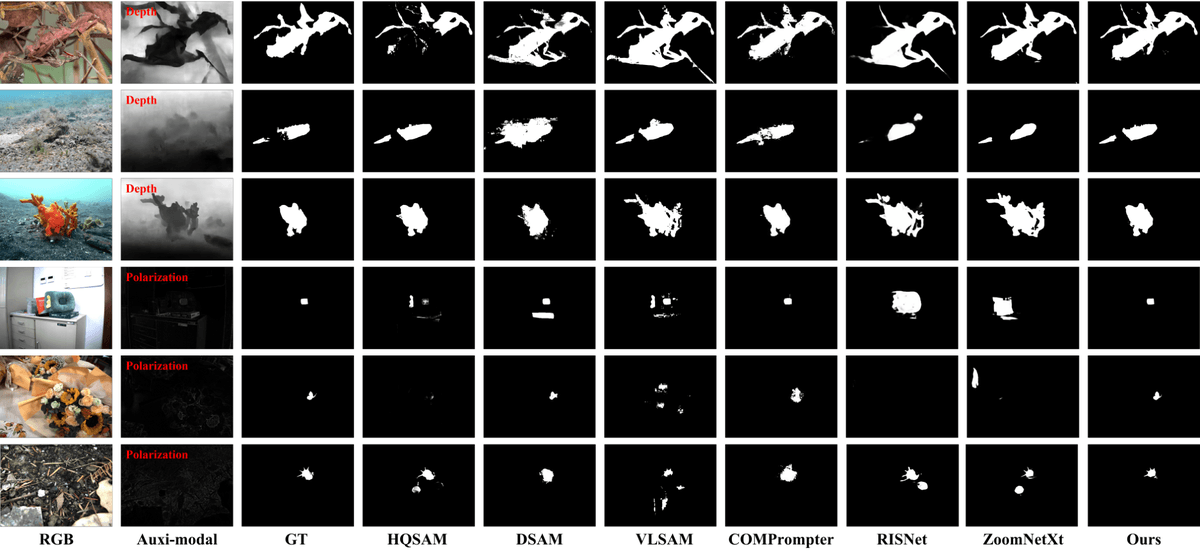
Takeaways
- New framework generates modality-agnostic prompts for SAM, handling depth, thermal, and polarization inputs with a single architecture.
- Uses dual-domain design: data-driven content domain plus knowledge-driven learnable prompt prototypes linked by symmetric cross-attention.
- Achieves state-of-the-art on COD10K, PCOD-1200, and VIAC benchmarks across all three sensor pairings.
- Only 2.73M trainable parameters, vs 121.93M for DSAM, while beating it on every metric.
- Cross-modality transfer: training on RGB-Depth and testing on RGB-Thermal only drops S-alpha by 0.014.
- Fails when both RGB and auxiliary modality lack discriminative cues; no public code released yet.
Spotting a stick insect on a branch or a soldier in dense foliage is exactly the kind of task where standard segmentation models fall apart. Camouflaged Object Detection (COD) tries to solve this, and researchers have found that adding a second sensor such as depth, thermal, or polarization helps considerably. The catch: nearly every existing approach hard-codes the fusion strategy for one specific auxiliary modality, forcing teams to rebuild the pipeline whenever the sensor changes.
A new paper from Dalian Maritime University tackles that rigidity with a modality-agnostic prompt learning framework built on top of the Segment Anything Model. Whatever auxiliary sensor you happen to have is compressed into a set of unified prompts that SAM's decoder can consume without architectural surgery.
Why sensor-specific fusion hits a wall
Most existing approaches rely on modality-specific architectures or customized fusion strategies, which limit scalability and cross-modal generalization. Recent SAM-based methods illustrate the pain point: DSAM constructs a multi-stage framework with dual-branch embeddings, knowledge distillation, and bias correction to extract geometry-aware cues from depth and convert them into prompt representations. Swap depth for a thermal camera and the whole distillation scheme has to be redesigned.