
DACSM Beats Top Vision Models by Injecting Noise Into Cross-Attention
A new transformer framework treats cross-attention as domain translation, injects Gaussian noise into keys and values, and adds multi-scale matching to close domain gaps.
 Pro
Takeaways
- New DACSM framework reframes cross-attention as a stochastic domain translator for unsupervised domain adaptation. Paper
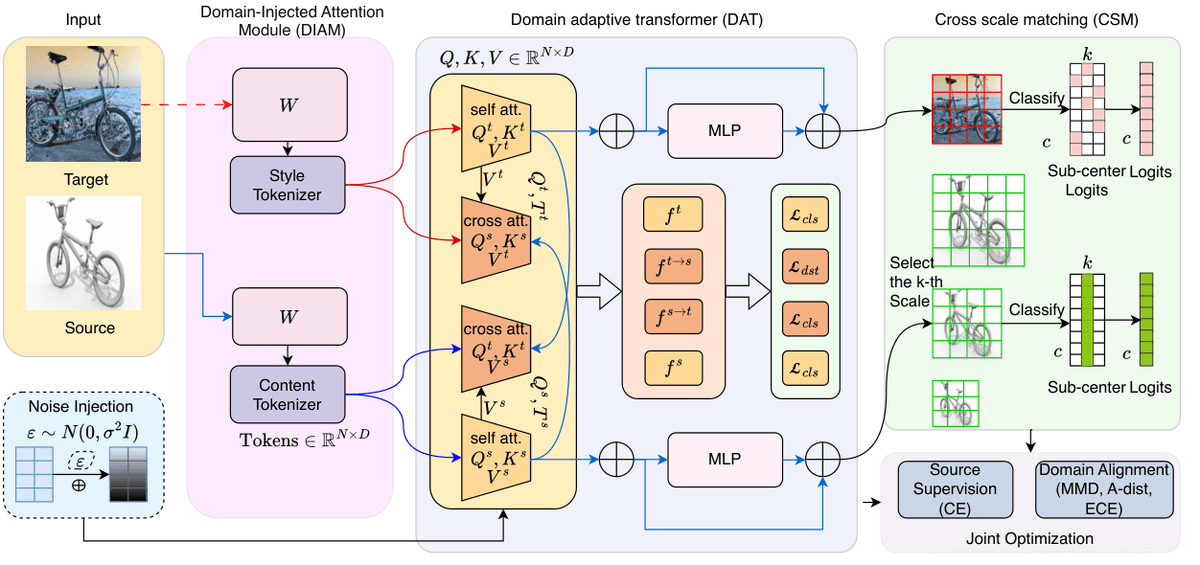
- Adds Gaussian noise to keys and values only, forcing the model to rely on content-carrying queries.
- Cross-Scale Matching module uses per-scale sub-center classifiers to handle size mismatches between source and target images.
- Achieves +2.3 percent over CDTrans on VisDA-2017 and +5.9 percent on the notoriously hard truck class.
- Both noise injection and multi-scale matching contribute independently in ablations, stacking to a combined gain.
- Training is only about 10 percent slower than CDTrans and inference latency is unchanged.
A group of researchers has proposed a rethink of how cross-attention should be used when adapting vision models from one dataset to another. Their paper, Revisiting Cross-Attention Mechanisms, argues that cross-attention should be viewed as a domain translation operator, and that deliberately injecting noise into it makes models better at ignoring style and locking onto content.
The framework, called Domain-Adaptive Cross-Scale Matching (DACSM), targets a long-standing pain point in computer vision: models trained on one dataset degrade badly when deployed on another that looks or is scaled differently. Unsupervised Domain Adaptation (UDA) addresses this by transferring knowledge from labeled source domains to unlabeled target domains, with most research focused on learning domain-invariant features through distribution alignment.
Two gaps nobody fully solved
The authors identify two failure modes in prior transformer-based UDA methods. First is the appearance gap, where source and target images differ in texture, color, and rendering. The second, they argue, has been largely ignored: identical semantic categories frequently appear at drastically different scales across datasets (partial objects versus complete scenes, for instance), causing severe feature misalignment that appearance-level adaptation alone cannot resolve.

Existing transformer approaches like CDTrans use cross-attention to align features, but their single-branch designs bias feature extraction toward source domains, and they fail to exploit the distinct semantic roles of different attention components. The key insight driving DACSM is that inside a Vision Transformer, queries and key-value pairs do different jobs: queries (Q) primarily encode semantic content, while key-value pairs (K/V) capture style and appearance.