
CWI Amsterdam's E2I Cleans CT Scans Without Ever Seeing a Clear Image
A new self-supervised CT reconstruction method blends cross-validation with equivariance to handle scintillator blurring and limited-angle scans without ground truth.
 Pro
Takeaways
- New self-supervised CT method Equivariance2Inverse combines Sparse2Inverse cross-validation with Robust Equivariant Imaging's equivariance term.
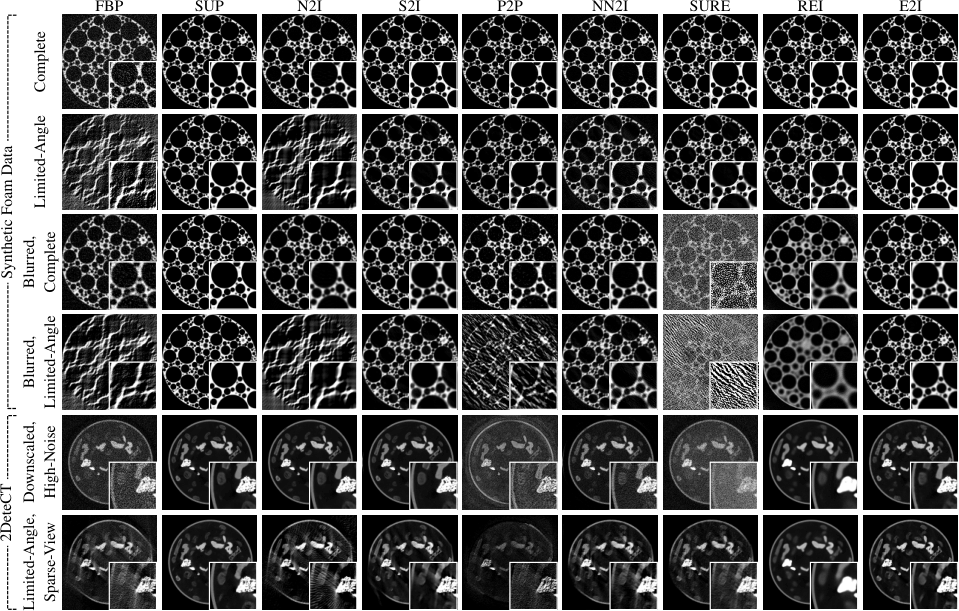
- Benchmark of six methods shows pixel-independence assumptions fail on real scintillator-blurred data.
- On limited-angle 2DeteCT, only equivariance-based methods reconstruct object boundaries correctly.
- E2I ranks first or second on every tested dataset, close to supervised training performance.
- Calibration uses only a background region with no object; no ground truth or noise characterization needed.
- Code and foam dataset available on GitHub and Zenodo.
Training a neural network to clean up noisy CT scans usually requires clean reference images, which are painful or impossible to collect. Self-supervised methods sidestep that by training only on the noisy projection data itself, using a physics model of how X-rays interact with the detector. Those physics models are almost always simplified, and researchers at CWI Amsterdam have now shown that when the simplifications break, the methods break with them. Their fix, Equivariance2Inverse (E2I), is a self-supervised reconstruction method designed to survive two common real-world conditions: scintillator blur and limited-angle geometries.
Where the physics models quietly cheat
Most self-supervised CT methods assume the measurement noise is independent from pixel to pixel, that the geometry is complete (the scanner rotates all the way around the object), and that the projection is a clean linear operator. In practice, energy-integrating detectors use a scintillator that converts each X-ray photon into multiple visible light photons, and those visible photons scatter before reaching the sensor, causing blurring that is well approximated as a convolution. That blur smears the Poisson noise across neighboring pixels, so the "independent noise" assumption silently fails.
Geometry is the other frequent violation. Low-cost C-arm systems and many industrial scanners can only cover a partial arc, producing reconstructions with blurring or streaking artifacts that a naive self-supervised loss will happily learn to reproduce.