
CVPR's NTIRE 2026 Challenge Shows AI Image Detectors Still Break Under Real-World Conditions
A CVPR 2026 challenge pitted 20 teams against 42 generators and 36 image distortions, exposing what still trips modern AI-image detectors.
 Pro
Takeaways
- NTIRE 2026 CVPR challenge tested AI-image detectors against 36 real-world distortions.
- Novel dataset: 108,750 real and 185,750 AI-generated images from 42 open and closed generators.
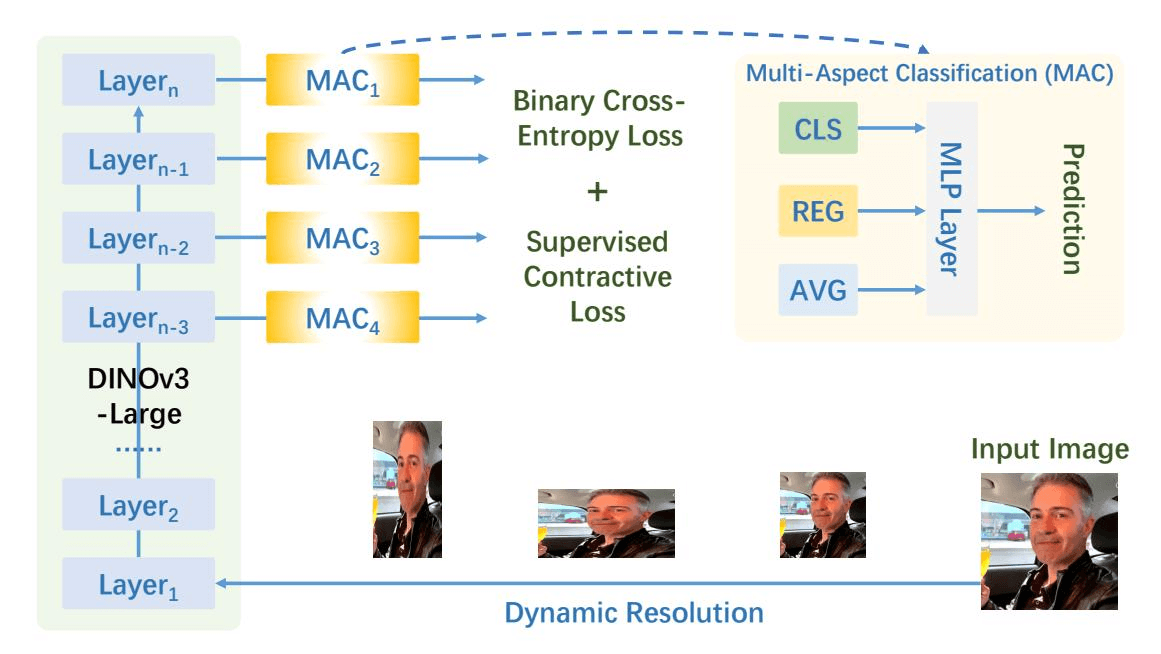
- MICV won with a DINOv3 dual-stream ensemble, hitting 0.9723 average Robust ROC AUC.
- Ant International placed second using two DINOv3-7B experts totaling 14B parameters.
- Winning recipe: giant self-supervised backbones, aggressive augmentation, and complementary ensembles.
- Clean-versus-robust gaps of 15+ points show robustness remains the real differentiator.
Telling a real photograph from a synthetic one is easy in a research paper and hard on the open internet. Once an image has been cropped, re-compressed, watermarked, and passed through a neural codec, most academic detectors quietly collapse. The NTIRE 2026 Challenge was built to measure exactly that gap, and the numbers coming out of it show both real progress and a stubborn ceiling.
Held at the NTIRE workshop at CVPR 2026, the challenge asked teams to detect AI-generated images that had been cropped, resized, compressed, and blurred before reaching the detector. Organizers assembled a new dataset of 108,750 real and 185,750 synthetic images drawn from 42 generators and 36 image transformations, scored by ROC AUC on both transformed and untransformed images. 511 participants registered, and 20 teams submitted valid final solutions.
Why clean-data detectors keep breaking
The core problem is distribution shift. Traditional models perform poorly once images pass through common post-processing like cropping, resizing, compression, or blurring. Older forensic methods leaned on very specific fingerprints such as spectral periodicities from GAN upsampling or checkerboard patterns from transposed convolutions, and those artifacts get scrubbed the moment a platform re-encodes an image.
The organizers designed the dataset to hit detectors where it hurts. The 42 generators span open-source and closed-source architectures, but the training split only exposes teams to 20 of them. The hidden test set is stacked with newer proprietary models like Nano Banana 2, GPT Image 1.5, Seedream 5 Lite, and Grok Imagine, forcing detectors to generalize rather than memorize.
The distortion pipeline is equally aggressive. Each image passes through 1 to 5 consecutive distortions from different groups, ranging from Gaussian blur and JPEG compression to neural codecs, invisible watermarking, and watermark-erasing adversarial attacks