
CVPR's CFT Doubles ViT Accuracy on Images That Fool Standard Vision Models
CFT fine-tunes Vision Transformers on just 1,500 images using LLM-generated concept masks to dramatically cut out-of-distribution failures, accepted at CVPR 2026.
 Pro
Takeaways
- CFT (Concept-Guided Fine-Tuning) is a new CVPR 2026 method that makes Vision Transformers more robust by teaching them to focus on semantic concepts, not backgrounds.
- It uses GPT-4o-mini + GroundedSAM to auto-generate concept masks (e.g., "beak," "wings") with zero manual annotation.
- Fine-tuning requires only 1,500 images (3 per class, half of ImageNet classes) and runs as a lightweight post-hoc procedure.
- On ImageNet-A, ViT-B accuracy more than doubles: 13.26% → 27.76%, outperforming all saliency-regularization baselines.
- Robustness gains generalize to unseen classes, confirming the model learns a better reasoning strategy, not class-specific patches.
- Code is publicly available on GitHub; concept-level masks outperform even ground-truth segmentation masks as supervision.
Vision Transformers are remarkably good at recognizing objects in clean, well-lit, standard photos. But drop one into a sketch, an artistic rendering, or a photo taken from an unusual angle, and accuracy can crater. The culprit is well-known: spurious correlations, where models latch onto background cues like grass, water, or sky rather than the actual object. A new paper accepted at CVPR 2026 tackles this with a surprisingly lightweight fix called Concept-Guided Fine-Tuning (CFT), and the results are hard to ignore.
Vision Transformers often fail under distribution shifts because they learn spurious correlations, such as background cues, rather than semantically meaningful features. The standard fix has been to train models with foreground-background masks, essentially telling the model "look here, not there." But existing regularization methods relying on simple foreground-background masks fail to capture the fine-grained semantic concepts that define an object, such as "long beak" and "wings" for a "bird." Treating a bird as one undifferentiated blob is too coarse to teach a model what actually makes a bird a bird.
Why foreground masks are not enough
The core insight of CFT is that robustness requires concept-level reasoning, not just foreground-level reasoning. A model that learns to look at the general silhouette of a bird will still fail when that bird is painted in watercolor or photographed from below. A model that has learned to look for beaks, wings, and feathers specifically will generalize far better. CFT steers the model to focus on fine-grained semantic concepts like beaks, wings, and fins, leading to massive gains in out-of-distribution robustness.
The problem with concept-level supervision has always been cost: someone has to label which pixels correspond to "beak" and which to "wing" across thousands of images. CFT sidesteps this entirely using the modern VLM stack.

Three steps, no human labels
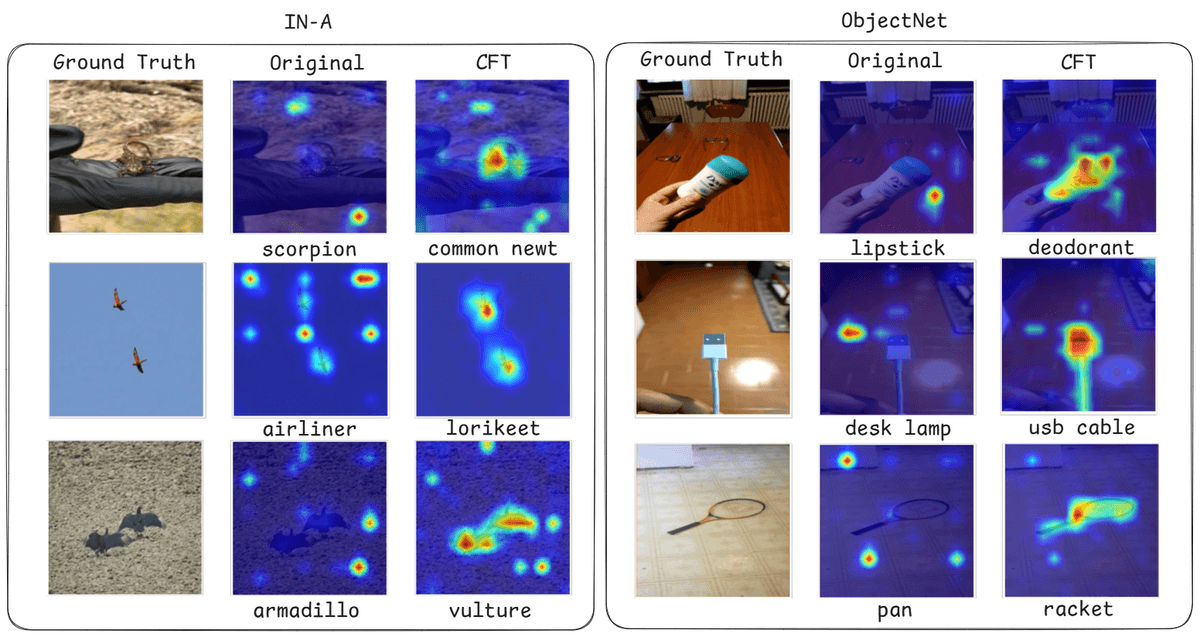
CFT improves vision model robustness on OOD samples by optimizing the model's internal relevance maps to align with spatially-grounded concept masks, which are generated automatically using recent VLM advancements for discovery and grounding. The pipeline works in three stages:
- Concept discovery: GPT-4o-mini is prompted with a label-free method to generate a list of discriminative visual attributes per class, for example "striped tail," "pointed ears," "whiskers" for a cat.
- Concept grounding: A vision-language grounding model, GroundedSAM, spatially localizes these concepts in each training image, producing an adaptive guidance mask. Concepts that appear in fewer than 15% of images or cover less than 20% of the relevant region are filtered out, yielding 1,852 validated concepts across 500 ImageNet classes.
- Relevance alignment: The model is optimized by aligning its relevance map, computed via the transformer-faithful AttnLRP method, with this concept-based mask, encouraging high relevance within concept regions while suppressing spurious background cues, and a concurrent classification-consistency objective ensures accuracy is preserved throughout fine-tuning.
AttnLRP (Attention-aware Layer-wise Relevance Propagation) is the key technical choice here. Unlike gradient-based saliency methods, which can be noisy or unfaithful in transformers, AttnLRP propagates relevance backward through both the attention and MLP blocks of a ViT, producing stable maps that are safe to use as an optimization target. The training loss has two sides: push relevance into concept regions, and push it out of background regions, while a classification-consistency term prevents the model from collapsing its predictions.
The entire fine-tuning runs on only 1,500 images, three per class for half the ImageNet-1K classes, with no manual annotation. That is a remarkably small footprint for a method that modifies how a model reasons about every class it has ever seen.
The numbers
CFT was evaluated against three saliency-regularization baselines: GradMask, RRR (Right for the Right Reasons), and RRDA, across four architectures: ViT-B, DINOv2, DeiT-III, and ConvNeXt-V2. The OOD benchmarks cover a wide range of shift types:
- ImageNet-A: natural adversarial examples that fool standard models
- ObjectNet: controlled background, pose, and viewpoint variations
- ImageNet-R: artistic renditions, cartoons, and sculptures
- ImageNet-Sketch: sketch-based depictions
- SI-Score: synthetic shifts in object location, scale, and rotation
The gains on the hardest benchmarks are striking. On ImageNet-A with ViT-B, the baseline scores 13.26% Top-1. CFT pushes that to 27.76%, more than doubling it, while the best competing baseline (RRDA) reaches only 25.12%. On ObjectNet, ViT-B goes from 33.26% to 54.28%. In-distribution accuracy on standard ImageNet is essentially preserved, with only minor regressions in some configurations. The resulting relevance maps exhibit stronger alignment with semantic object parts, and concept-guided masks provide more effective supervision for model robustness than conventional segmentation maps.
A critical ablation compared CFT against using ground-truth object segmentation masks (the "gold standard" of foreground supervision) with the same loss function. CFT still wins, confirming that the granularity of concept-level guidance is doing real work beyond simply pointing at the right object.
Robustness that generalizes to unseen classes
One concern with any fine-tuning approach is that it memorizes class-specific shortcuts rather than learning a more general reasoning strategy. The authors tested this directly by evaluating performance separately on classes seen during fine-tuning and classes that were held out entirely. Both groups showed comparable gains, with unseen classes averaging +7.98 percentage points on ImageNet-A Top-1. Extensive experiments on five out-of-distribution benchmarks demonstrate that the method improves robustness across multiple ViT-based models. This is strong evidence that CFT is genuinely reshaping how the model attends to images, not just patching specific classes.
Where it falls short
The method has real limitations worth knowing before you reach for it:
- Abstract concepts: GPT-4o-mini occasionally generates semantically valid but visually ungrounded concepts like "aggressive behaviour" for a lion. GroundedSAM cannot localize these, so they produce empty masks.
- Tiny object parts: For parts occupying less than 2% of image area, GroundedSAM's detection rate drops, which can impair fine-grained part-level reasoning.
- Domain mismatch: In specialized domains like medical imaging or satellite imagery, GPT-4o-mini's concept vocabulary may be imprecise. The authors recommend domain-specific LLMs or expert-curated concept lists in those settings.
- Computational overhead: The concept creation and validation stage processes 30 images per class through GroundedSAM, which becomes a bottleneck at scale. AttnLRP also adds compute during training compared to standard gradient methods.
- Artistic shifts: Gains on ImageNet-R and ImageNet-Sketch are smaller than on ImageNet-A and ObjectNet, because artistic datasets inherently minimize background bias, leaving less room for improvement.
What this unlocks
The practical case for CFT is strongest when you have a pretrained ViT that needs to be deployed in a real-world environment where backgrounds, viewpoints, and image styles are unpredictable. Medical triage systems, autonomous vehicle perception, wildlife monitoring, and industrial inspection all fit this profile. The method requires no new annotations, no full retraining, and runs on a tiny slice of your dataset.
Beyond robustness, there is an interpretability dividend. The relevance maps produced after CFT are measurably better aligned with ground-truth object masks across pixel accuracy, mIoU, and mAP. A model that looks at the right things for the right reasons is easier to audit and debug. The method significantly enhances model robustness across multiple ViT-based models and an additional CNN model, and the resulting relevance maps exhibit improved alignment with semantic object parts, providing a scalable path toward more robust and interpretable vision models.
The code is publicly available on GitHub, and the paper appears in the CVPR 2026 proceedings. The core idea, that the right unit of supervision for robustness is not a pixel region but a semantic concept, is likely to influence how the field thinks about saliency-guided training going forward.