
Curriculum Sampling Beats Stable Diffusion 3's Default Schedule by 33%
A single-author ICLR workshop paper argues the timestep sampling distribution used to train Flow Matching models should change during training, not stay fixed.
 Pro
Takeaways
- Pengwei Sun proposes Curriculum Sampling for Flow Matching training, published at the ICLR 2026 DeLTa Workshop.
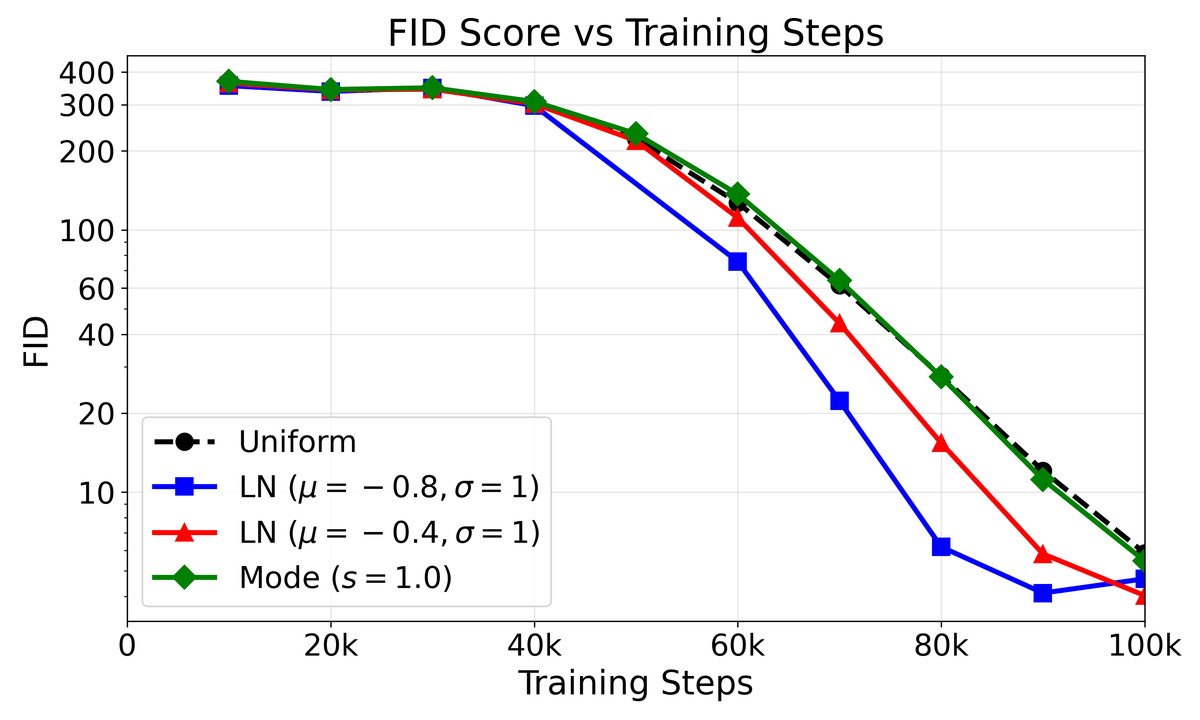
- Popular Logit-Normal timestep sampling converges faster early but hits worse final FID than Uniform sampling.
- Per-timestep loss analysis reveals a U-shaped difficulty profile with persistent errors at trajectory boundaries.
- Two-phase schedule: middle-biased sampling first for structure, then Uniform for boundary refinement.
- On CIFAR-10, FID improves from 3.85 to 3.22 while peaking at 100k steps instead of 150k.
- Simple drop-in scheduler change with no architectural modifications required; no public code released yet.
A new workshop paper is challenging a small but consequential design choice that has quietly become the default in Flow Matching image models: the distribution you use to sample training timesteps. In Curriculum Sampling: A Two-Phase Curriculum for Efficient Training of Flow Matching, author Pengwei Sun shows that the popular middle-biased Logit-Normal schedule trades long-term quality for early speed, and proposes a two-phase alternative that reaches a better FID score in fewer training steps. The work was accepted to the 2nd DeLTa Workshop at ICLR 2026.
The timestep sampling problem
Flow Matching trains a network to predict a velocity field that transports noise into data along a probability path. During training, you sample a time step t from a distribution p(t) and regress against a target defined by the chosen probability path. That distribution p(t) is a knob that seems minor but heavily influences what the model learns first and how well it converges.
Common practice increasingly favors static middle-biased distributions like Logit-Normal, popularized by systems such as Stable Diffusion 3. The intuition: the middle of the noise-to-data trajectory is where most of the semantic structure is decided, so it makes sense to concentrate compute there.
A speed versus quality trade-off nobody was measuring
The paper's first contribution is empirical. Middle-biased sampling accelerates early convergence but yields worse asymptotic fidelity than plain Uniform sampling. Looking at per-timestep training losses reveals a U-shaped difficulty profile, with persistent errors near the boundary regimes. In plain terms: the hardest parts of the trajectory to fit are the very beginning (pure noise to first structure) and the very end (final detail refinement). Middle-biased schedules under-sample exactly those endpoints, leaving fine details unresolved.

Sweeping variants of Logit-Normal (LN) and Mode-based schedules confirms the pattern: none of the middle-biased configurations beat the Uniform baseline on final FID. The best FIDs across the sweep land between 4.03 and 4.56, while Uniform reaches 3.85.

Curriculum Sampling: start biased, finish flat
The proposed fix is disarmingly simple. Curriculum Sampling is a two-phase schedule that begins with middle-biased sampling for rapid structure learning and then switches to Uniform sampling for boundary refinement. Phase one gets the model to a good structural fit quickly; phase two spends the remaining budget on the noisy and near-data endpoints that middle-biased schedules neglect.
Conceptually, the switch looks like this:
if step < switch_step:
    t = sample_logit_normal(mu=0.0, sigma=1.0)
else:
    t = torch.rand(batch_size)  # Uniform
loss = flow_matching_loss(model, x, t)
No architectural changes, no extra parameters, no auxiliary losses. It is a scheduler for the timestep sampler.
The numbers on CIFAR-10
On CIFAR-10, the results are clean:
- Best FID improves from 3.85 with Uniform sampling to 3.22 with Curriculum Sampling
- Peak performance is reached at 100k training steps rather than 150k, roughly a 33 percent reduction in steps to peak
- All Logit-Normal and Mode-only baselines are beaten on final quality
Both dimensions matter: you get a better model, faster.
What this is good for, and where it stops
This is a training recipe change, not a new architecture, so it composes with existing Flow Matching pipelines including video and text-to-image variants that inherit the Logit-Normal default. If you are training a Flow Matching or rectified-flow style model from scratch and care about final FID more than early loss curves, this is essentially a free swap.
The caveats are worth stating plainly. The experiments are limited to CIFAR-10, a small 32x32 dataset, and the paper does not sweep the phase-switch step on larger benchmarks like ImageNet or text-to-image models. The optimal switch point is a new hyperparameter, and how it scales with model size, dataset resolution, or conditional generation is untested. There is also no public code release referenced in the paper.
The broader takeaway
The paper's core claim is that timestep sampling should be treated as an evolving curriculum rather than a fixed hyperparameter. That framing lines up with a wider trend in generative modeling toward dynamic training schedules, including recent work like Stable Velocity, which attacks Flow Matching variance from a different angle. The specific contribution here is small and single-authored, but the underlying observation, that the community's default sampling distribution leaves quality on the table, is likely to prompt follow-up work at scale.