
CUHK's VisionZip Cuts 90% of Visual Tokens and Runs 8x Faster
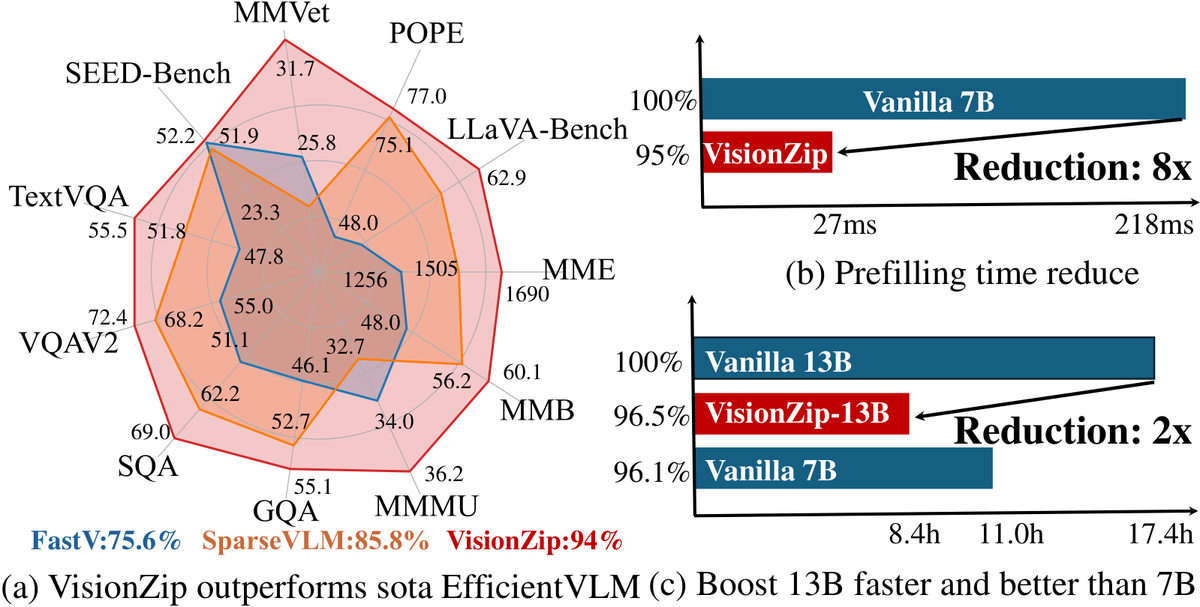
A CVPR 2025 method drops 90% of visual tokens from VLMs, delivers 8x faster prefilling and lets a 13B model outrun a 7B baseline.
 Pro
Takeaways
- VisionZip keeps ~10% of visual tokens and reaches ~95% of full VLM performance with no training required.
- Prefilling time improves 8x; LLaVA-Next 13B runs faster than LLaVA-Next 7B while scoring higher.
- Method combines attention-based dominant token selection with similarity-based contextual token merging.
- Text-agnostic design makes it compatible with multi-turn chat and any LLM acceleration stack.
- Open-source Apache 2.0 release at dvlab-research/VisionZip, with
pip install visionzip. - Now supports LLaVA, Qwen2.5-VL, and Qwen2-VL via a community port; accepted at CVPR 2025.
Vision-language models keep getting faster at seeing and slower at thinking. Every new generation crams more visual tokens into the language model, which lifts accuracy but makes inference painfully expensive. A team from CUHK and HKUST has been arguing that most of those tokens are dead weight, and their method, VisionZip, throws roughly 90% of them away without training a thing.
The paper, VisionZip: Longer is Better but Not Necessary in Vision Language Models, was accepted by CVPR 2025. Its core claim is blunt: by retaining only 10% of visual tokens, it achieves nearly 95% of the performance in training-free mode, and it does so while beating prior token-reduction methods by at least 5 percentage points across almost every benchmark the authors ran.
The redundancy hiding in CLIP and SigLIP
Modern VLMs like LLaVA feed hundreds or thousands of patch embeddings from a vision encoder (usually CLIP or SigLIP) into the language model. The authors observe that these encoders produce visual tokens with heavy redundancy: a small subset of tokens attracts almost all of the attention mass, while the rest carry near-duplicate information. Because visual tokens vastly outnumber text tokens, that redundancy dominates the prefill cost of the LLM.

Previous efficiency work either prunes tokens using the text query (which breaks multi-turn chat, since the pruning changes with every new question) or merges tokens uniformly (which blurs important regions). VisionZip is text-agnostic: it decides which visual tokens to keep before the LLM ever sees the prompt.
Dominant tokens plus contextual tokens
The pipeline is small enough to describe in a paragraph. VisionZip inspects the attention weights inside the vision encoder to identify a set of dominant tokens, the few patches that other tokens already attend to heavily. It then takes the remaining tokens and merges them by similarity into a smaller pool of contextual tokens so nothing important is silently dropped. The concatenation of the two sets is what gets projected into the LLM.

In the reference LLaVA-1.5 configuration, the authors keep 54 dominant tokens and 10 contextual tokens, down from the original 576. Turning it on is two lines of Python on top of a standard LLaVA load:
from visionzip import visionzip
tokenizer, model, image_processor, ctx_len = load_pretrained_model(...)
# 54 dominant + 10 contextual = 64 visual tokens instead of 576
model = visionzip(model, dominant=54, contextual=10)
What the speedups actually look like
The efficiency numbers are the headline. VisionZip improves prefilling time by 8x, and it lets LLaVA-Next 13B infer faster than the smaller LLaVA-Next 7B baseline while scoring higher on benchmarks. Because the method is text-agnostic, it stacks cleanly with anything else you throw at the LLM, from FlashAttention to KV-cache tricks.
Three deployment modes are supported:
- Inference only: drop it into a pretrained model with zero training cost.
- Efficient tuning: a short fine-tune to recover the last few points of accuracy.
- From-scratch training: almost no performance degradation, saving 2x memory and 2x training time according to the authors.
Where it fits, and where it does not
Because VisionZip strips tokens before the language model sees the prompt, it plays especially well with workloads that reuse the same image across many turns. Since VisionZip is a text-agnostic method that reduces visual tokens before input into the LLM, it can adapt to any existing LLM acceleration algorithms and is applicable to any task that a vanilla VLM can perform, such as multi-turn conversations. Video is another natural fit: fewer tokens per frame means more frames in the same budget, which the repo demonstrates by encoding 32 frames while still running twice as fast as the vanilla model that only handled 16.
The obvious caveat is dense, fine-grained tasks. Independent follow-ups evaluating token-compression methods on OCR and multi-turn VQA note that text-agnostic pruners like VisionZip can miss detail when the answer depends on a small region the encoder did not flag as dominant, and the authors' own follow-up (VisionThink) uses reinforcement learning specifically to protect OCR performance under aggressive token reduction. If your workload is chart reading, document QA, or small-text detection, expect to keep more tokens or use a task-aware pruner.
Availability
The code is open-source under Apache 2.0 at dvlab-research/VisionZip, with a pip install visionzip package, a Gradio demo, and a Hugging Face Space for side-by-side comparisons. Support has expanded beyond the original LLaVA target: VisionZip for Qwen2.5VL is now released, and a community port to Qwen2-VL is also available. The underlying message is one worth internalizing before your next VLM design review: the visual token count you inherited from your encoder is probably not the count your LLM needs.