
CUHK's SpreadsheetAgent Beats ChatGPT at Reading Messy Real-World Spreadsheets
Researchers from CUHK MMLab and SenseTime Research introduce a two-stage multi-agent framework that reads spreadsheets in chunks across code, images, and LaTeX.
Takeaways
- CUHK MMLab and SenseTime Research introduce SpreadsheetAgent, a two-stage multi-agent framework for spreadsheet understanding.
- Reads localized regions incrementally via code execution, rendered images, and LaTeX tables instead of flattening whole workbooks.
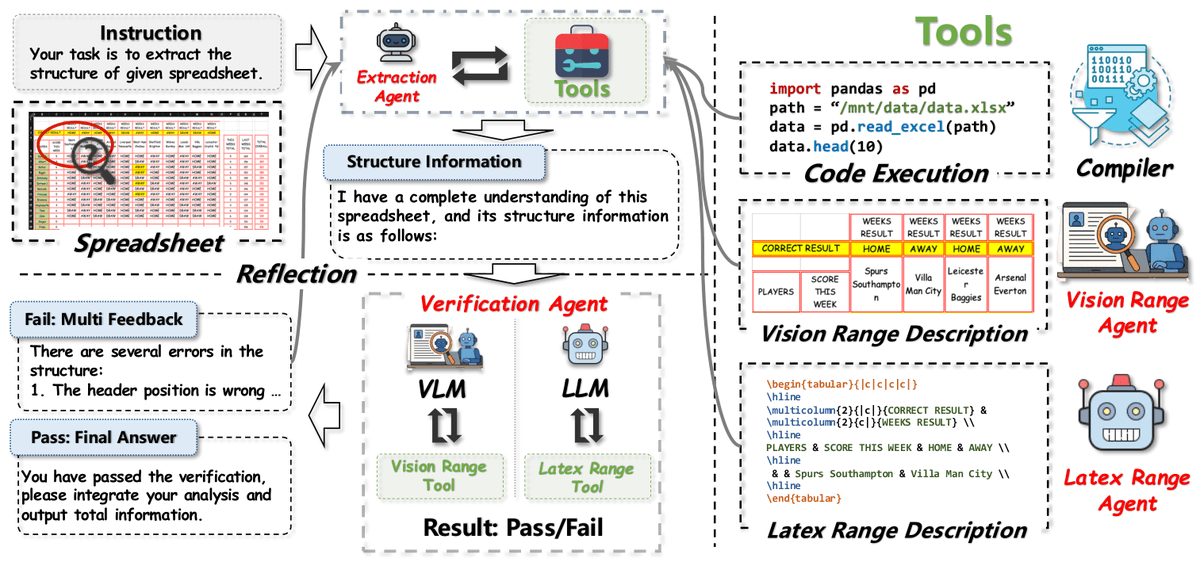
- Extraction agent, vision range agent, and LaTeX range agent build structural sketches with row and column summaries.
- Verification module inspects extracted structures to cut error propagation before downstream reasoning.
- Achieves 38.16% on SpreadsheetBench with GPT-OSS-120B, beating ChatGPT Agent baseline at 35.27%.
- Code released at github.com/renhouxing/SpreadsheetAgent; paper accepted to ACL.
A team from CUHK MMLab, SenseTime Research, Shenzhen Loop Area Institute, and CPII under InnoHK has published a paper introducing SpreadsheetAgent, a multi-agent system that tackles a stubborn weakness in current LLM tooling: reading real, messy spreadsheets. The authors argue that flattening a workbook into text throws away the layout information humans rely on, and that stuffing a large workbook into a context window is a dead end.
Why spreadsheets break LLMs
Enterprise reporting, auditing, and scientific data management all lean heavily on spreadsheets, yet existing LLM-based approaches typically treat tables as plain text, ignoring layout cues and visual semantics. Real workbooks also routinely exceed the input length a model can efficiently process.
That combination is why merged cells, multi-row hierarchical headers, and multi-sheet workbooks are so painful to reason about. Current methods struggle to represent both the structural complexity and the scale, limiting their effectiveness on downstream tasks like question answering and knowledge extraction. The paper reads as an argument that spreadsheet understanding is a distinct modality rather than a table-QA subproblem.

Read a region, then reason
SpreadsheetAgent is a two-stage multi-agent framework built on step-by-step reading and reasoning, where an extraction agent collaborates with a vision range agent and a LaTeX range agent to process spreadsheets incrementally. Rather than ingesting the entire workbook at once, the agents iteratively feed the model small regions in multiple formats: code execution results, images, and LaTeX tables. The model reads and reasons under a tight context budget.