
CUHK's PIRA-Bench Exposes How Badly AI Agents Fail at Reading Your Mind
PIRA-Bench challenges multimodal AI to anticipate what you need next — without being asked — by watching your screen
 Pro
Takeaways
- New benchmark: PIRA-Bench is the first benchmark for proactive GUI agents that anticipate user intent from screenshots without explicit instructions.
- 100 real-world trajectories averaging 32 screenshots each, paired with 3 user profiles, covering multitasking, personalization, and noise-rejection scenarios.
- PIRF framework wraps any MLLM with a dynamic memory module and reflection mechanism, improving final scores across all tested models.
- Massive human gap: Best model scores 28.05 vs. human score of 90.35 — the bottleneck is noise rejection, not intent recall.
- Over-proactivity is the key failure mode: GPT-5.2 achieves 83% recall but only 31% precision in naive mode, making it functionally unusable as a background assistant.
- No model weights released — PIRA-Bench is an evaluation framework; PIRF is a prompting-based wrapper for existing MLLMs.
Every GUI agent you have ever used waits for you to tell it what to do. You type a command, it executes. You forget to mention a detail, it fails. This reactive loop is the fundamental bottleneck of today's AI assistants , and a new benchmark from MMLab at CUHK wants to break it.
PIRA-Bench (Proactive Intent Recommendation Agent Benchmark) introduces a new task: instead of following instructions, an agent must watch a continuous stream of screenshots and predict what the user will want to do next , before the user even types anything. It is the first benchmark built specifically to evaluate this capability, and the results reveal just how far current frontier models are from making it work reliably.
Why reactive is not enough
Current GUI agents operate primarily under a reactive paradigm where a user must provide an explicit instruction for the agent to execute a task. An intelligent AI assistant should instead be proactive , capable of anticipating user intentions directly from continuous visual inputs and offering timely recommendations without explicit user prompting.
Real-world screen activity is rarely linear; it consists of long-horizon trajectories fraught with noisy browsing, meaningless actions, and multithreaded task-switching. Think about how you actually use your phone: you check a message about dinner, switch to Instagram for a few minutes, come back to maps to look up the restaurant, then drift into email. A truly intelligent assistant should be able to piece together that you probably want to book a table , without you ever saying so.
The majority of existing LLM-based agents operating within GUI environments adhere to a predominantly reactive design paradigm. These agents execute user instructions without the capacity for autonomous planning based on environmental feedback, and they only retrieve information based on explicit user inputs, failing to infer latent user intentions.
The benchmark: 100 messy, real-world trajectories
PIRA-Bench is built around 100 annotated GUI trajectories drawn from real mobile and desktop usage, each averaging 32 sequential screenshots. Every trajectory is paired with three distinct user profiles that encode different socioeconomic backgrounds and preferences, creating 300 total evaluation instances. The benchmark tests three distinct capabilities:
- Direct intent recommendation: The visual context alone is enough to infer a future goal (e.g., the user is chatting about a weekend meal, so the agent should suggest booking a table).
- Profile-dependent prediction: The same visual context should yield different recommendations depending on who the user is. A housing search trajectory should prompt a recommendation to buy a luxury apartment for a wealthy user, but suggest affordable rentals for a student.
- Noise rejection: Some trajectories are pure noise , idle scrolling, random app switching, no actionable goal anywhere. The agent must stay silent. Hallucinating a suggestion here is a failure.
PIRA-bench comprises 100 annotated trajectories, with each trajectory containing an average of 32 sequential screenshots and paired with 3 distinct user profiles. The ground truth for each trajectory is established through a consensus-based human annotation process: three independent annotators label the intents they can infer, and only intents agreed upon by at least two of the three are kept as ground truth.
How scoring works
Evaluation uses an LLM-as-a-judge approach (Gemini-3-flash) to semantically compare predicted intents against ground truth, rather than relying on exact string matching. The final score is the product of two metrics:
- F1_avg: Measures how accurately the agent identifies real intents across trajectories where actionable goals exist.
- FPS_norm (Normalized False Positive Score): Measures how often the agent hallucinates intents on trajectories that are pure noise. A perfect model scores 1.0; a trigger-happy model is penalized heavily.
Multiplying these two together means you cannot game the score by being aggressive. A model that hallucinates constantly will see its final score collapse even if its recall is high , which turns out to be exactly the failure mode of today's best models.
The PIRF framework: giving models a memory
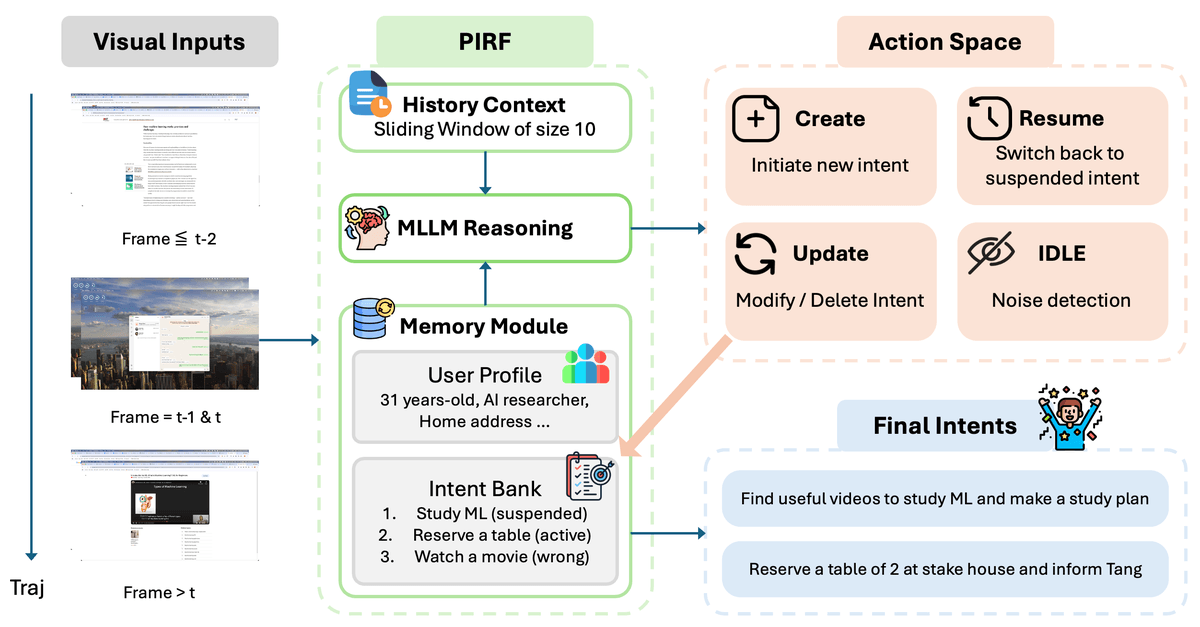
Alongside the benchmark, the authors propose PIRF (Proactive Intent Recommendation Framework) as a baseline architecture. The core idea is to wrap any existing multimodal LLM in a structured cognitive layer that handles the complexity of long, noisy visual streams.
PIRF features a dedicated memory module that dynamically records and tracks ongoing multitasking states and specific user profile contexts. To effectively mitigate hallucinations, PIRF incorporates a built-in reflection mechanism. By continuously evaluating the memorized tasks and executing an auto-deletion process for outdated or completed intents, PIRF maintains a clean, accurate representation of the user's true goals.
At each new screenshot, the underlying MLLM must choose one of four actions:
CREATE, a new task thread has appeared in the visual contextRESUME, the user has switched back to a previously suspended taskUPDATE, the current screen adds more detail to an already-tracked intentIDLE, this frame is noise; do nothing
The framework maintains a sliding window of the last 10 frames for immediate context, while the memory module persists intent threads across the full trajectory. When the reflection mechanism detects that a tracked intent has been abandoned or completed, it issues a delete_intent_id and purges it from active memory , keeping the cognitive load low and reducing stale-intent hallucinations.
What the numbers actually show
The team evaluated four frontier models , Gemini-3.1-Pro, GPT-5.2, Qwen3.5-Plus, and Seed-1.8 , under both a naive sliding-window baseline and the full PIRF framework. Human performance was also measured as an upper bound.
| Method | Model | F1_avg (%) | FPS_norm (%) | Final Score (%) |
|---|---|---|---|---|
| Naive | Gemini-3.1-Pro | 45.08 | 49.61 | 22.36 |
| Naive | GPT-5.2 | 40.75 | 31.31 | 12.76 |
| Naive | Seed-1.8 | 47.68 | 48.85 | 23.29 |
| PIRF | Gemini-3.1-Pro | 56.58 | 45.39 | 25.68 |
| PIRF | GPT-5.2 | 54.68 | 43.90 | 24.00 |
| PIRF | Seed-1.8 | 55.71 | 50.36 | 28.05 |
| Human | -- | 93.89 | 96.23 | 90.35 |
The performance of GPT-5.2 in the Naive setting serves as a stark illustration of the "over-proactivity" trap. While it achieves a remarkable recall of 83.37%, this sensitivity proves deceptive. The accompanying precision is critically low (31.95%), and its noise robustness score is the worst in the table at 31.31%. In plain terms: GPT-5.2 correctly identifies most real intents, but it does so by hallucinating suggestions constantly , including during idle browsing. That is not a useful assistant.
The human performance baseline reveals a substantial gap between current MLLMs and human capability, with the human final score of 90.35 far surpassing the best model performance of 28.05. Crucially, this disparity is driven not merely by the ability to identify intents, but by the profound difference in operational restraint. Humans demonstrate near-perfect precision (98.76%) and noise robustness (96.23%), indicating an almost flawless ability to distinguish true latent goals from background noise.
The real lesson: knowing when to stay quiet
The ablation study drives the point home. When noise frames are stripped out and models only see clean, intent-relevant screenshots, GPT-5.2 hits 92.23% precision and 84.46% F1. Add back the real-world noise, and precision collapses to 50.52% , a drop of over 40 points. While current MLLMs are highly capable of interpreting user behavior in idealized, noise-free environments, they lack the robustness to function reliably in the wild.
PIRF consistently improves every model's final score over the naive baseline, with the biggest gains coming from improved precision and noise robustness rather than recall. For GPT-5.2, PIRF acts as a cognitive filter: while recall remains high, the reflection mechanism drives a dramatic improvement in precision (+18.57 points to 50.52%) and noise robustness (+12.59 points to 43.90%).
The benchmark and project page are available at pira-bench.top. No model weights or training code are released at this stage , PIRA-Bench is a benchmark and evaluation framework, not a trained model. The PIRF framework is a prompting-based wrapper that can be applied on top of any existing MLLM.
What this unlocks
The practical applications of a working proactive GUI agent are significant:
- A phone assistant that notices you are chatting about a flight and proactively offers to book it or set a reminder , without you switching apps
- A desktop agent that sees you copying figures between documents and offers to format a citation or create a summary
- A background automation layer that detects recurring patterns in your screen activity and suggests automating them
The gap between the best model (28.05) and human performance (90.35) is enormous, and the authors are explicit that this is an early-stage benchmark. But the framing matters: the consistent gains achieved by PIRF demonstrate that structured state tracking and self-reflection are viable pathways to mitigate these failures, establishing a rigorous standard for future research into agents that are not only smarter but also more discerning about when to act. The next frontier for GUI agents is not just doing more , it is knowing when to do nothing at all.