
CUHK's AIA Loss Function Fixes Unified AI Image Models Without Splitting Them Apart
New research shows architecture decoupling in unified models works by reshaping attention patterns, and a simple loss can do the same job.
 Pro
Takeaways
- AIA loss aligns cross-modal attention patterns to task-specific references, matching decoupling gains without splitting the architecture.
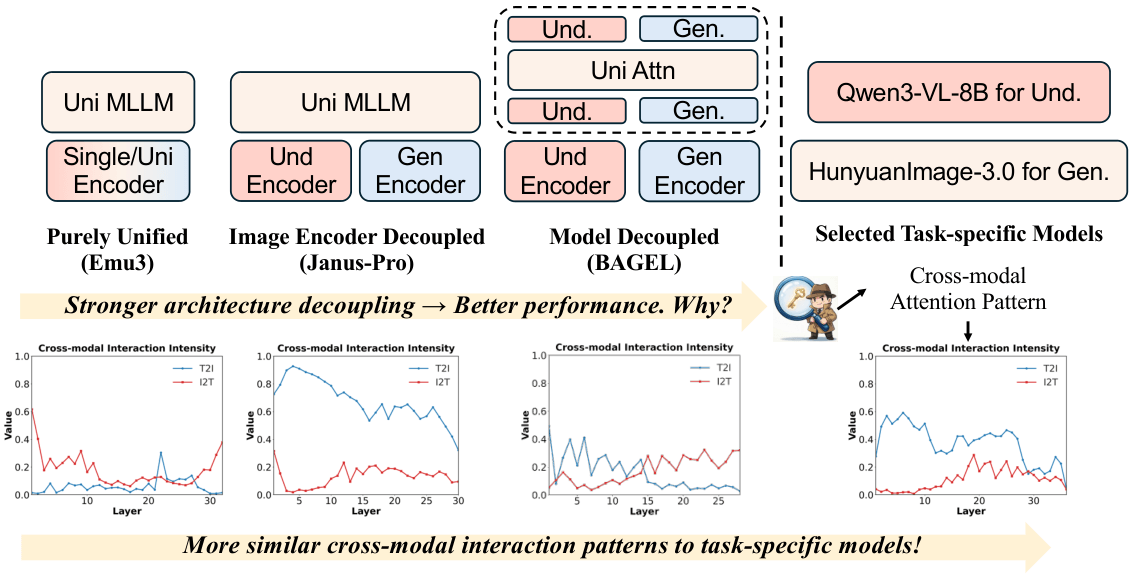
- Analysis shows decoupling does not resolve task conflicts, it just shifts attention to look like single-task models.
- Uses Qwen3-VL-8B and HunyuanImage-3.0 as attention targets, with a Huber loss for flexibility.
- Emu3 with AIA gains 4+ points on MMMU, 174 on MME-P, and 0.07 on GenEval versus baseline.
- Naive feature and output distillation actually degrade performance, confirming attention patterns are the key signal.
- Code and weights available on GitHub and Hugging Face.
Building a single model that both understands and generates images has been one of the messier problems in multimodal AI. Every team seems to end up in the same place: split the architecture into pieces so the two tasks stop stepping on each other. A new paper argues that most of this decoupling treats a symptom rather than the disease, and proposes a loss function that targets the real issue directly.
The work, AIA: Rethinking Architecture Decoupling Strategy In Unified Multimodal Model, comes from CUHK MMLab, Meituan, USTC, and TJU. Code and weights are already on GitHub and Hugging Face.
The conflict at the heart of unified models
A Unified Multimodal Model (UMM) tries to do image understanding and image generation inside one network. The appeal is interleaved reasoning: the model can generate an intermediate image, reason about it, and keep going, all in latent space. Early fully unified architectures like Emu3, Liquid, and Chameleon shared the image encoder and base model, but lagged badly behind single-task approaches.
The response from the field has been to peel the architecture apart. The Janus series, Show-o, and Transfusion decouple the image encoder and training objectives; BAGEL and OneCat use partial MoT/MoE decoupling; MetaQuery, OmniGen2, UniWorld-V1, and Blip3-o freeze the MLLM entirely and only train a diffusion head.
Every step of decoupling brings better benchmark numbers, but it also chips away at the whole point of a unified model. Once you have two encoders and a fixed MLLM, latent-space reasoning is off the table; you have to decode and re-encode between steps.
What decoupling is actually doing
The authors ask a mechanistic question: why does decoupling work in the first place? They measure cross-modal attention intensity, meaning how much attention image tokens pay to text tokens (and vice versa) at each layer, averaged across heads and tokens.