
CUHK Builds NV-Bench to Finally Judge AI Laughter and Sighs
A new benchmark treats laughs, sighs and filled pauses as communicative acts, exposing where expressive TTS systems still fail.
 Pro
Takeaways
- NV-Bench is the first standardized benchmark for nonverbal vocalization synthesis in expressive TTS.
- 1,651 in-the-wild Mandarin and English utterances paired with human ground-truth audio, balanced across 14 categories.
- Introduces PCER, a paralinguistic character error rate scored by a fine-tuned multilingual NV-aware ASR model.
- Evaluates Orpheus-TTS, CosyVoice2 and 3 variants, plus new NV-FlexiVoice and NV-CV3 baselines from the authors.
- Objective metrics correlate strongly with human ratings, with Spearman rho of -0.65 between PCER and IMOS.
- Dataset and evaluator are publicly released under CC BY-NC-SA 4.0.
Modern text-to-speech models can now do more than read words. They can chuckle, sigh, gasp and mumble filled pauses like uhm. But there has been no reliable way to judge whether those sounds actually land in the right place, sound like a real human, or match what the prompt asked for. A group from The Chinese University of Hong Kong, Shenzhen is trying to fix that with NV-Bench, the first standardized benchmark aimed specifically at nonverbal vocalization synthesis.
Why laughter is harder to evaluate than words
Recent expressive TTS models increasingly integrate nonverbal vocalizations (NVs) to enhance human-like communication, incorporating them either as discrete tokens or overlapping layers. The trouble is that most systems have been graded by their own authors on private test sets, or against references where the NV was simply rewritten as text. Without a real human recording to compare against, evaluation collapses into a crude yes-or-no check for whether a laugh happened at all.
The authors argue this misses the point entirely. NVs are not merely acoustic textures but intrinsically communicative acts conveying physiological states, emotions, and interactional intent. A sigh of relief is not interchangeable with a sigh of frustration, and a filled pause that signals hesitation is not the same as one that signals confirmation.
A taxonomy borrowed from linguistics
NV-Bench organizes sounds using a three-level functional taxonomy: vegetative sounds like breathing and coughing that ground speech in physical realism, affect bursts that convey emotional state, and conversational grunts such as filled pauses and prosodic particles that manage discourse. The final label inventory covers 14 categories across Mandarin and English, including breathing, cough, sigh, laughter, several flavors of surprise, dissatisfaction, and question-marking grunts like the English huh.
What is in the benchmark
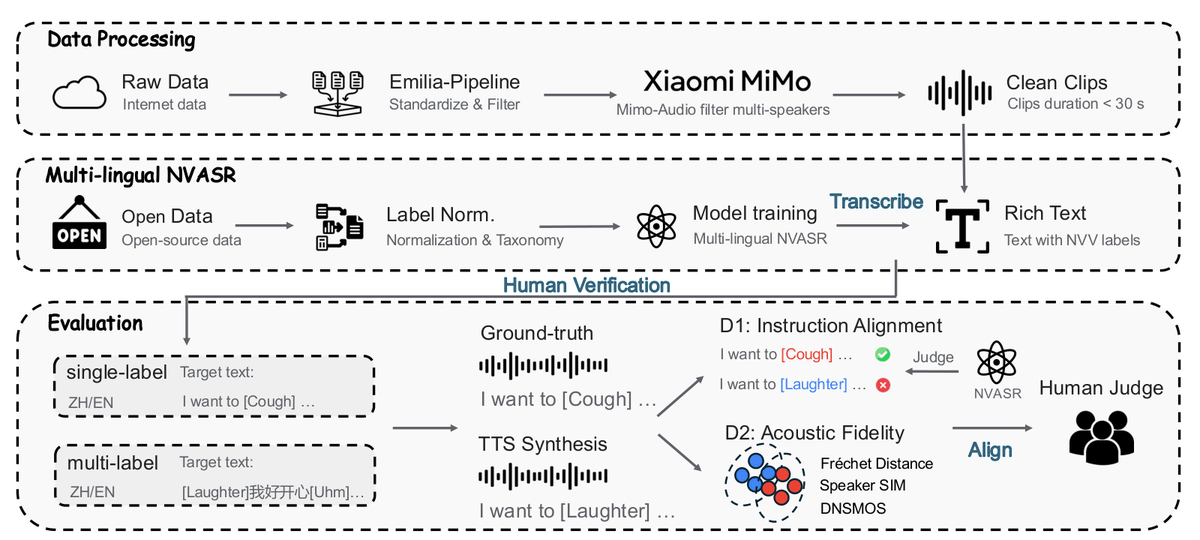
The dataset itself is small but carefully built. NV-Bench provides a public multi-lingual test set of 1,651 utterances curated from online audiovisual media published in 2025 to minimize potential data leakage. It is split into two subsets:
- Single-label: strictly balanced with 50 samples per category, 650 Mandarin and 350 English utterances, isolating fundamental generation capability
- Multi-label: utterances with two or more NV events to stress-test dense paralinguistic conditions
Every prompt is paired with real human ground-truth audio, which is what enables the benchmark to measure distributional gaps rather than just presence or absence. To get there, the team crawled 565,316 raw audio clips totalling roughly 1,560 hours, filtered them through the Emilia-Pipeline, ran the audio LLM MiMo-Audio-7B-Instruct to reject residual multi-speaker clips, and had ten annotators verify labels with cross-annotation Cohen's kappa above 0.85.
Two metrics that actually correlate with humans
The evaluation protocol has two axes. Instruction Alignment uses a new metric called Paralinguistic Character Error Rate (PCER), computed only over NV symbols in the transcription, alongside regular CER and an Overall CER that mixes both. Acoustic Fidelity is measured with Fréchet Audio Distance, Fréchet Distance from PANNs embeddings, WavLM speaker similarity, and DNSMOS.
To score PCER automatically, the authors trained a multilingual NV-aware ASR model by fine-tuning SenseVoice-Small on a consolidated corpus of Emilia-NV, NVTTS, DisfluencySpeech, NVS, SMIIP-NV and MNV-17. It matches the base model on standard ASR test sets while significantly outperforming a Qwen2.5-Omni baseline at detecting NV labels, reaching 1.29% CER on SMIIP-NV.
How current TTS systems actually score
The benchmark was run on Orpheus-TTS, two CosyVoice2 fine-tunes (SMIIP-NV-CV2 and Emilia-NV-CV2), CosyVoice3, and two new fine-tuned baselines the authors introduce: NV-FlexiVoice (a 0.5B FlexiVoice fine-tune) and NV-CV3 (CosyVoice3 fine-tuned on a consolidated NV corpus).
A few findings stand out:
- NV-CV3 leads instruction alignment on Mandarin single-label with 27.69% PCER and 4.90% OCER
- NV-FlexiVoice achieves the lowest Fréchet Audio Distance (0.29) and Fréchet Distance (2.72), meaning its output distribution most closely matches real recordings
- Orpheus-TTS wins on DNSMOS perceptual quality but scores much lower on instruction following
- Even the best systems trail human ground-truth PCER by a wide margin, especially on the multi-label subset where PCER climbs above 30% for every model
Crucially, the objective metrics track human judgment. IMOS shows a significant negative Spearman correlation with PCER at rho equals -0.65, p less than 0.001, and NMOS aligns with Fréchet Distance, which is the kind of validation that has been missing from earlier NV evaluations.
What it is good and bad for
NV-Bench is useful if you are building or shipping an expressive voice model and need a defensible number to report against competitors, or if you want to diagnose whether your model's weakness is placement (fix with better control tokens and training data) or acoustic realism (fix with better vocoders and distributional matching). It is less useful if your target is pure lexical TTS, or if you care about NV categories outside the 14 covered here. It is also bilingual only, Mandarin and English, and the multi-label set is deliberately imbalanced to reflect natural co-occurrence rather than uniform coverage.
Getting it
The dataset is on Hugging Face under CC BY-NC-SA 4.0, and the paper links to a demo page with audio samples, code, and the NVASR evaluator model. That evaluator is arguably as valuable as the benchmark itself: it gives the community a shared, automated referee for a task that until now has been graded mostly by whoever built the model.