
CUHK Builds DatedGPT to Stop LLMs From Cheating on Financial Forecasts
A dozen 1.3B-parameter models with strict annual cutoffs from 2013 to 2024 let researchers backtest LLM forecasts without contamination.
 Pro
Takeaways
- DatedGPT is a family of twelve 1.3B-parameter LLMs with annual knowledge cutoffs from 2013 to 2024.
- Each model is trained from scratch on roughly 100B tokens of FineWeb-Edu filtered by Common Crawl timestamp.
- Instruction data is filtered by Llama-3.3-70B to remove time-sensitive leakage, plus finance-specific tuning sets.
- Perplexity on Bloomberg headlines reverses sharply at each model's cutoff year, confirming clean temporal boundaries.
- Benchmarks match or beat SmolLM, TinyLlama, OPT-1.3B and Pythia-1B, with especially strong IFEval scores.
- Interactive demo available at datedgpt.com; checkpoints and pipeline to be open-sourced upon acceptance.
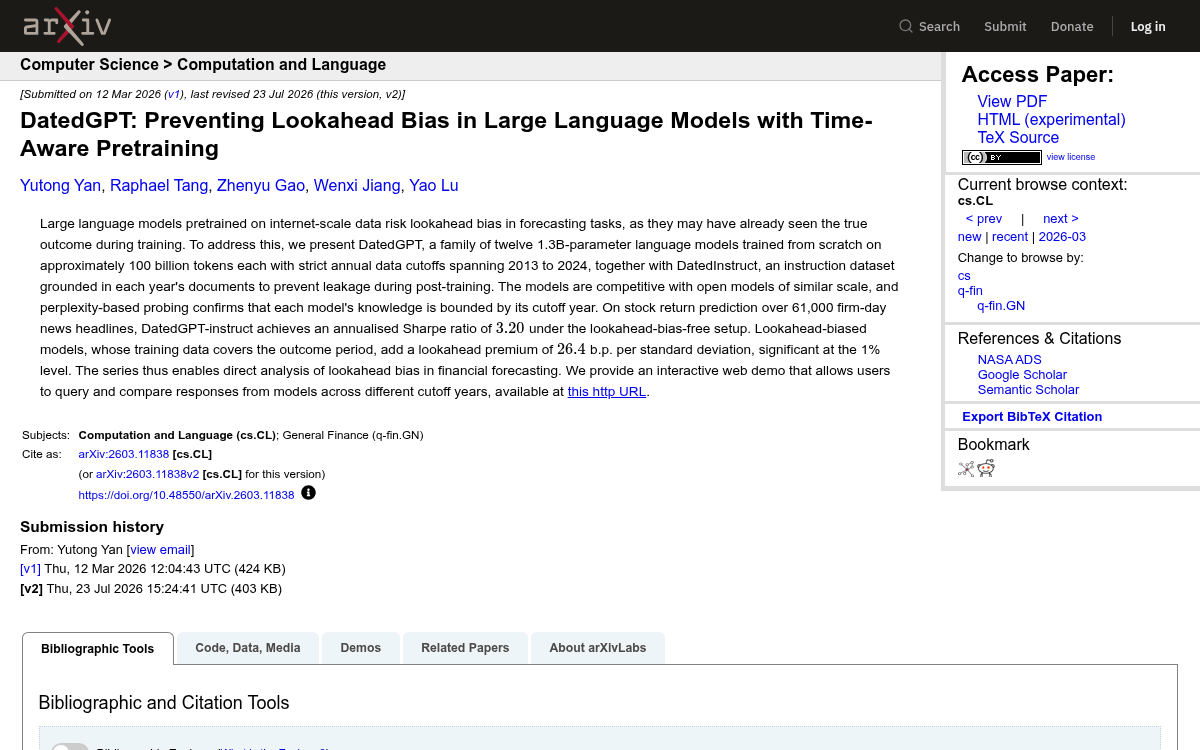
Anyone who has tried to backtest an LLM on financial predictions runs into the same uncomfortable question: is the model actually forecasting, or is it just remembering? A team from CUHK and UCL has released DatedGPT, a family of twelve 1.3B-parameter language models trained from scratch with strict annual knowledge cutoffs from 2013 through 2024, specifically to eliminate this contamination problem for time-sensitive research.
The memorization trap in temporal forecasting
The core issue is called lookahead bias. If an LLM confidently predicts the September 2008 S&P 500 crash, its apparent success may reflect memorised knowledge of the event rather than reasoning over the input. When the model has already read post-hoc analyses of an event during pretraining, asking it to "predict" that event from prior context is essentially a leaky test.
In economic and financial forecasts, the information set available to the model must be strictly limited to what was observable at the time of prediction, and the model itself must never have been exposed to future outcomes. Prior mitigation attempts, such as masking company names or anonymizing context, patch the input but leave the model's parametric memory intact. DatedGPT takes the more expensive route: rebuild the model itself with clean data.
How the twelve models were built
The recipe starts with FineWeb-Edu as the base dataset, filtering documents by Common Crawl timestamp rounded to the year. The authors acknowledge this is imperfect since a 2015 crawl could contain a 1990s page, but the guarantee that matters holds: nothing crawled after the cutoff ever enters training. In total, they curate twelve time-aware pretraining sets, spanning from 2013 to 2024, with approximately 100 billion tokens per year.
Each model uses a Llama-style 1.3B-parameter architecture with 24 layers, an embedding size of 2048, RoPE positional encodings, SwiGLU activations, and RMSNorm. Each round of pretraining requires approximately 2,000 GPU hours on NVIDIA A100 GPUs. That is roughly 24,000 A100-hours across the full series, which is a serious commitment for what amounts to a research artifact.
Cleaning the instruction data too
Instruction tuning is where temporal leakage sneaks back in most easily. A generic Alpaca-style dataset can contain questions that presuppose knowledge of specific events, TV episodes, or product launches. The team ran every candidate example through Llama-3.3-70B-Instruct as a classifier to flag time-sensitive samples and drop them.
The removal rates are revealing:
- Coconot, a safety dataset, lost 39.15% of its samples, largely because much of its data involves copyright-related topics where queries ask the model to generate scripts for specific episodes or seasons of TV series.
- Tulu-3 Instruction dropped 20.17%.
- OpenHermes-2.5 dropped 18.98%.
On top of the general-domain data, the authors added finance-specific instruction sets built for two forecasting tasks: predicting stock returns from news headlines and forecasting future capital expenditure from earnings call transcripts. Roughly 6,000 examples per year were generated per task, each anchored to the publication or reporting date of the underlying document.
Does the cutoff actually hold?
The most important experimental result is not a benchmark score but a perplexity curve. The team evaluated each DatedGPT-base model on Bloomberg news headlines from 2013 to 2024, using the perplexity-based probing method from Cheng et al. The key idea is that lower perplexity on certain data suggests the model has encountered similar textual patterns during training.
A clear trend reversal point is visible around the model's data cutoff, after which perplexity rises steadily. The 2020 model, for example, shows flat or declining perplexity on news up through 2020 and then a monotonic climb afterward. That is exactly the signature of a model that genuinely has no exposure to future text.
Benchmark performance
Despite being trained on only 100B tokens (SmolLM, by comparison, saw trillions), the instruction-tuned models hold their own against similarly sized baselines.
| Model | ARC-C | HellaSwag | IFEval | Avg. |
|---|---|---|---|---|
| SmolLM-1.7B-Instruct | 34.9 | 56.1 | 15.5 | 41.1 |
| TinyLlama-1.1B | 30.5 | 55.0 | 14.8 | 38.2 |
| OPT-1.3B | 27.8 | 53.7 | 17.6 | 38.6 |
| DatedGPT-Instruct-2024 | 34.7 | 53.2 | 35.3 | 42.7 |
| DatedGPT-Instruct-2013 | 33.6 | 47.6 | 34.2 | 40.1 |
The standout number is IFEval, where DatedGPT models score in the 30s while comparable baselines sit near 15. Two other observations matter for downstream users:
- Models with different cutoff years show similar performance, with average scores ranging from 40.1 to 42.7, meaning a 2013-cutoff model is not dramatically weaker at general reasoning than a 2024 one.
- On MMLU the models sit around 24-25, essentially at chance-adjusted floor for that benchmark. If your workflow depends on broad factual recall, these are not the models to use.
What it is actually good for
DatedGPT is a research instrument, not a general-purpose assistant. It is worth using when you need to:
- Backtest LLM-based signals on stock returns, macro forecasts, or event studies without contaminating the historical evaluation window.
- Measure how much of a model's apparent forecasting skill comes from parametric memorization by comparing predictions across cutoff years.
- Study how world knowledge evolves inside LLMs by running the same probe against a 2013, 2018, and 2024 model.
The most directly comparable prior effort is ChronoGPT, a series of chronological GPT-2-scale models produced via continual pretraining with incremental yearly updates from 2000 to 2024, ranging from 124M to 1.5B parameters and trained on less than 10B tokens per year. DatedGPT's difference is scale per year and independence: each model is trained from scratch on roughly 10x more tokens, so there is no risk of residual signal from earlier continual-pretraining passes leaking newer patterns backward.

Availability
An interactive demo is live at datedgpt.com, letting you switch between cutoff years and watch the same question return era-appropriate answers. The authors state they will open-source all model checkpoints, data, and the training pipeline upon paper acceptance. For anyone running temporal evaluations of LLMs, that release will be the moment this becomes genuinely useful infrastructure rather than just an interesting demo.