
CTU Prague Hides Your Photos From AR Cloud Servers Using Scribbles
Researchers show that swapping images for segmentation masks makes cloud-based visual localization privacy-preserving without touching the underlying pipeline.
 Pro
Takeaways
- CTU Prague researchers make visual localization privacy-preserving by obfuscating images, not redesigning the pipeline.
- Modern matchers like RoMa handle SAM segmentations, edges, and masked images out of the box.
- Fine SAM1 borders + RoMa hit 74/84/94 percent recall on Aachen Day-Night at standard thresholds.
- New SOTA for privacy-preserving methods on Indoor-6, beating SegLoc, GSFFs-PR, and DSAC*.
- Released easy-anon tool masks sensitive classes like faces, screens, and signs with negligible accuracy loss.
- Limitations: retrieval still uses original images, SAM obfuscation adds seconds per frame, no formal privacy metric.
Cloud-based visual localization has a nagging privacy problem. To figure out where a camera is, a device typically ships images to a server that stores a detailed model of the scene. That server can see your living room, your face, and the documents on your desk, and the model itself can be inverted to reconstruct recognizable images. A new paper from CTU Prague argues that you don't need a custom pipeline to fix this. You just need to stop sending photos and start sending scribbles.
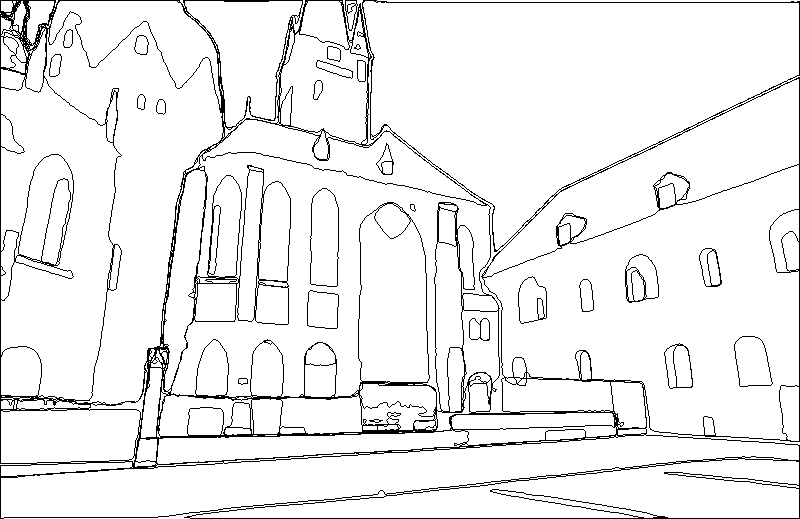
The work, Privacy-Preserving Structureless Visual Localization via Image Obfuscation, shows that replacing RGB images with obfuscated versions such as semantic segmentations lets existing structureless localization pipelines match the images out of the box with no special adjustments. The resulting system is simpler than prior privacy-preserving methods and, on several benchmarks, more accurate.

Why cloud localization leaks
Visual localization estimates the 6-DoF camera pose of a query image against a scene representation. It powers AR/VR headsets, mobile phones, and robots that lack the compute to localize themselves on-device. Both sides of the exchange are informative: cloud systems can reveal private details through the images sent to the server and through the representations stored there.
Sending sparse local features doesn't help either. Inversion attacks can reconstruct detailed images from 2D or 3D point sets paired with descriptors. Prior privacy-preserving work has taken two routes, both with real costs:
- Geometric obfuscation replaces points with lines, planes, or coordinate-swapped pairs. This needs custom pose solvers, more matches, and specialized RANSAC routines, and recent attacks show the original geometry can often be recovered anyway.