
CtrlAttack Hijacks AI Video Physics With 90% Success While Looking Clean
New research shows image-to-video diffusion models can be steered off course by tiny velocity-field perturbations, breaking temporal consistency in both white-box and black-box settings.
 Pro
Takeaways
- CtrlAttack is the first adversarial attack targeting temporal state transitions in image-to-video diffusion models, per the arXiv paper.
- It represents perturbations as a low-dimensional velocity field, integrated over time into a smooth displacement field.
- The same formulation works in white-box and black-box settings by mapping perturbations to pixel space.
- Attack success rate exceeds 90% white-box and 80% black-box against MOFT, DragAnything, SG-I2V, and AnyI2V.
- FID drifts less than 6 and FVD less than 130, so per-frame quality metrics fail to detect the attack.
- Exposes a new security surface for I2V systems used in deepfakes, robotics simulation, and content moderation.
Image-to-video diffusion models have quietly started behaving like miniature world models. Give one a still frame and it will hallucinate a plausible future: a soccer player continues their run, water keeps flowing, a car keeps turning. That implicit grasp of physics is what makes systems like Sora, Runway, and their open-source cousins interesting beyond pretty pixels. It is also, according to a new paper called CtrlAttack, a brand new attack surface that almost nobody has been guarding.
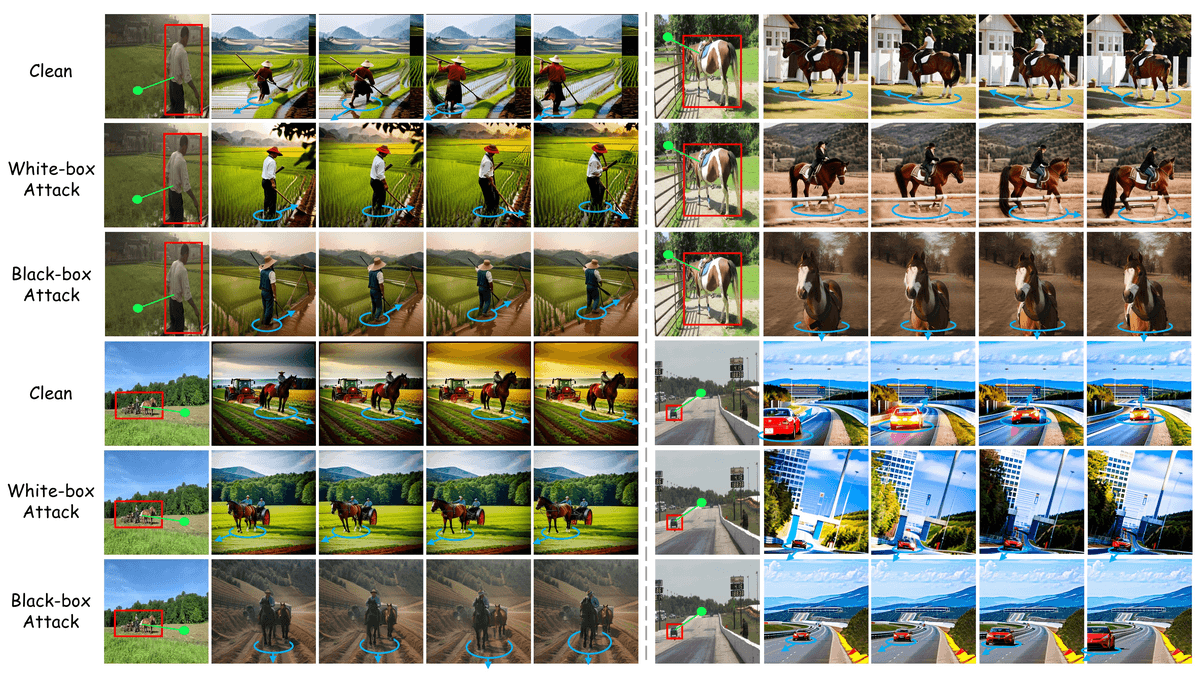
The authors, from Wuhan University and Nanyang Technological University, claim to be the first to analyze the vulnerability of image-to-video (I2V) models and to identify temporal control mechanisms as a new attack surface. Their method can push the attack success rate past 90% in white-box settings and past 80% in black-box settings while barely moving standard quality metrics.

Why frame-level attacks miss the point
Most adversarial work on generative models targets either the text prompt (for text-to-video) or the pixels of a single input (for image-to-image). Neither transfers cleanly to I2V, because the interesting behavior in I2V is not a static output but a trajectory through time. A perturbation that scrambles one frame does not necessarily corrupt the state transitions that produce the next second of video, and it tends to look obviously noisy.
The paper frames the vulnerability at the level of state dynamics: if you can perturb the model's internal notion of how the scene should evolve, you can make a soccer player drift sideways, freeze mid-stride, or teleport, all while each individual frame still looks fine. That is a very different threat model from classic adversarial noise on a JPEG.
The trick: perturbing a velocity field, not pixels
CtrlAttack treats the adversarial signal as a low-dimensional velocity field rather than a per-pixel noise map. Think of it as painting a small number of directional arrows on the image and letting them describe how content should move over time. Temporal integration of that field produces a continuous displacement field, which is what the attacker actually injects.
Two properties fall out of this design:
- Temporal consistency is preserved. Because the perturbation is generated by integrating a smooth velocity field, adjacent frames stay coherent instead of flickering, so the attack survives motion-based defenses.
- It works in both threat models. The perturbation is mapped back into observation (pixel) space, which means it can be applied whether the attacker has gradient access (white-box) or can only query the model as a black box.

Numbers that should worry model providers
The headline results, drawn from the paper's abstract:
- Attack success rate: over 90% white-box, over 80% black-box.
- FID drift: within 6 points, meaning per-frame image quality barely changes.
- FVD drift: within 130, so video-level distributional quality also stays close to clean output.
In other words, a defender running standard quality checks on generated video would see essentially normal FID and FVD numbers while the semantic trajectory of the video is being hijacked. The authors compare against motion-conditioned baselines including MOFT, DragAnything, SG-I2V, and AnyI2V, sweeping the perturbation budget, iteration count, and query budget to show CtrlAttack dominates across all three regimes.

Where this actually matters
If you are shipping an I2V product or using one downstream, the practical implication is that content-authenticity checks based on frame quality are not enough. A malicious actor who can influence the input image, whether by poisoning a dataset, tampering with an upload pipeline, or crafting a doctored still, can steer generated videos toward misleading motion while leaving the pixels looking clean. This is particularly relevant for:
- Deepfake and disinformation pipelines that feed I2V models with prepared stills.
- Robotics and simulation stacks that use video diffusion as a rough world model for planning, where wrong dynamics are worse than ugly frames.
- Content-moderation systems that rely on per-frame classifiers rather than motion-level analysis.
Limits and open questions
A few caveats are worth flagging. The paper is an attack paper, not a defense paper, so there is no proposed mitigation beyond identifying the surface. The evaluation focuses on temporal-control baselines rather than commercial closed models, so real-world transfer to systems like Sora or Runway Gen-3 is not directly demonstrated. And the black-box results, while strong, still assume the attacker can issue queries and observe outputs, which is easier in an API setting than in a fully offline product.
No public code repository or model release is mentioned in the submission. For teams building on I2V, the takeaway is less about running this specific attack and more about broadening threat models: robustness of a video generator is not just about how good each frame looks, but about whether the physics it implies can be quietly rewritten by a smooth field of arrows.