
CSIRO Finds LLM Explanations Make Users Accept Wrong AI Answers
A CSIRO user study finds LLM-generated explanations make people trust AI extractions more and catch fewer errors than passage retrieval.
 Pro
Takeaways
- CSIRO study of 162 users compared PDF, BM25 top-3 passages, and LLM explanations for AI answer verification.
- LLM explanations were fastest but drove acceptance to 86.5% when the true correct rate was 70%.
- BM25 passage retrieval cut time from 45.8s to 33.0s without hurting accuracy or inflating trust.
- Users trusted the extraction AI more when an LLM vouched for it, even without trusting the explanation itself.
- For synthesized answers (lists, summaries), showing the full PDF produced the best error detection.
- Read the full paper for the experimental protocol and statistical results.
When an AI extracts structured data from a document, how does the human checker actually decide whether to believe it? A team of researchers at CSIRO ran a controlled user study with 162 people to find out, comparing three ways of presenting the evidence behind an AI-generated answer. Their paper lands on an uncomfortable finding: the most helpful-looking option, an LLM explanation, is also the one most likely to lull users into accepting wrong answers.
The verification problem nobody has measured
Knowledge management applications increasingly incorporate generative AI methods, in which specific details are extracted from unstructured text to build structured datasets for systematic reviews, clinical evidence, or legal discovery. The catch is that hallucinations and misinterpretations still slip through, and policy in these sectors puts the burden of catching them on the human user.
Commercial systems like Perplexity and Elicit have responded by attaching supporting information to every answer, ranging from source links to retrieved passages to natural-language justifications. But comparatively little attention has been paid to how users interpret, trust, and act upon this supporting information. The CSIRO group set out to measure exactly that.
Three ways to show your work
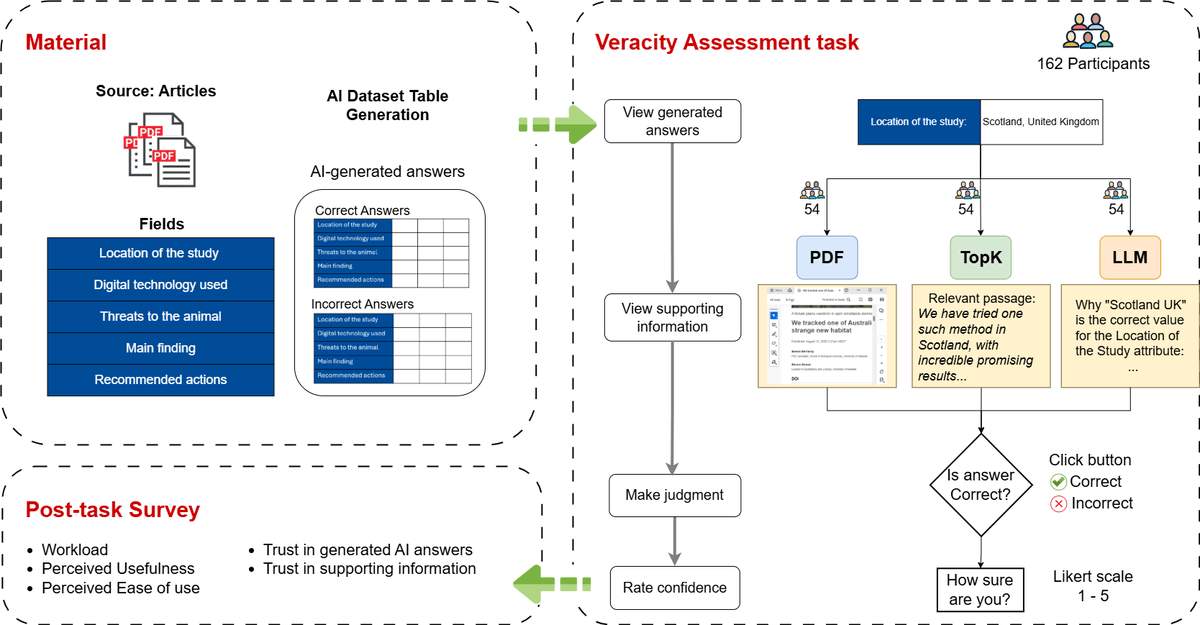
The team built a data-extraction task around three science articles from The Conversation, each with five fields to fill in (location of study, technology used, threats, main finding, recommended actions). Answers were generated with GPT-OSS:20B, and roughly 30% of them were swapped out for plausible-but-incorrect variants produced by the same model with a modified prompt.
Participants were randomly split into three groups, each seeing a different kind of supporting information:
- PDF: the full source article, with normal scroll and search. No automation.
- TopK: the three most relevant paragraphs, retrieved with BM25 using the generated answer as the query.
- LLM: a natural-language explanation from GPT-OSS:20B stating whether the answer was supported by the article and why.

For each answer, participants clicked a tick or cross and then rated their confidence. Response times, accuracy, acceptance rates, workload, and trust were all logged.
Speed goes up, error-catching goes down
Both automated tools cut verification time significantly. Median judgment time dropped from 45.8 seconds with the PDF to 33.0 seconds with TopK and 25.4 seconds with LLM explanations. Workload ratings and ease-of-use scores also improved for both tools, and overall accuracy did not drop in a statistically significant way (PDF 85.7%, TopK 83.1%, LLM 80.8%).
The interesting divergence shows up in acceptance rates. Since 70% of answers were correct by design, a well-calibrated user should accept about 70% of them. Acceptance rates were significantly higher than this benchmark in the LLM condition, and significantly lower in TopK. Users in the LLM group accepted 86.5% of answers, PDF users 71.5%, and TopK users 64.7%.
Zoom in on the incorrect answers only, and the story sharpens. Inappropriately high reliance can result in a failure to detect AI errors. Accuracy on incorrect answers differed across groups, with mean scores significantly poorer in the LLM condition compared with both the PDF and TopK conditions. In other words, the LLM explanation was persuasive enough that people stopped noticing when the underlying extraction was wrong.
Trust bleeds sideways
Self-reported trust results reveal a subtle mechanism. Participants did not rate the LLM explanation itself as more trustworthy than the PDF or retrieved passages. But Trust in the AI was significantly higher in the LLM condition over both PDF and TopK. Seeing another AI vouch for an answer made people trust the extraction system more, even when they were not consciously placing more faith in the explainer.
The effect grew worse when the field being verified required synthesis. For list-style or summary answers (threats, main finding, recommended actions), acceptance rates were significantly higher for LLM than both PDF and TopK, and PDF users were more accurate than LLM users. Short excerpts and confident-sounding summaries both fall short when a claim actually needs to be checked across large chunks of text.
What this changes for anyone building a RAG UI
The study lines up with earlier work by Si et al. showing that LLM-generated fact-check explanations can convince users of false claims. The CSIRO team frames it through classic human-automation research: automating information acquisition (finding relevant passages) helps, but automating the decision itself (recommending a verdict) invites complacency.
Practical takeaways from the paper:
- Passage retrieval is the safer default. BM25 top-K was almost as fast as an LLM explanation, held accuracy steady, and if anything nudged users toward healthy skepticism.
- Prescriptive LLM explanations amplify over-reliance. If you must use them, consider contrastive framings that argue for and against a claim rather than delivering a verdict.
- Complex fields deserve the full document. For anything requiring synthesis across sections, showing the source PDF still produced the best error detection.
- Composite views may help. Letting users switch between passages, explanations, and full text could preserve efficiency without collapsing critical judgment.
The paper does not release code or a dataset, but the setup is straightforward to replicate: jsPsych for the task interface, BM25 over article paragraphs, and GPT-OSS for both extraction and explanation. For anyone shipping a RAG or extraction product where correctness matters, the study offers something rarer than a new model: evidence about which interface choices quietly make users worse at their job.