
CSIC-UPC's ACXON Cuts Robot Plan Explanations by 70% in Plain English
Researchers introduce ACXON, an ontology-driven algorithm that lets robots explain why one plan beats another using up to 70 percent fewer knowledge tuples.
 Pro
Takeaways
- Paper in Information Sciences proposes an ontology and algorithm for robots to explain why one plan beats another.
- ACXON extracts only divergent knowledge between two plans and builds a contrastive natural language narrative.
- Extends the OCRA ontology with plan qualities like cost, makespan and number of tasks, formalized in OWL 2 DL.
- Cuts knowledge tuples used by 40 to 70 percent versus the AXON baseline across three IPC planning domains.
- Interaction time for spoken level-3 narratives drops from about 13 minutes to roughly 4 minutes.
- Implementation know-plan is open source and integrates with ROSPlan and KnowRob.
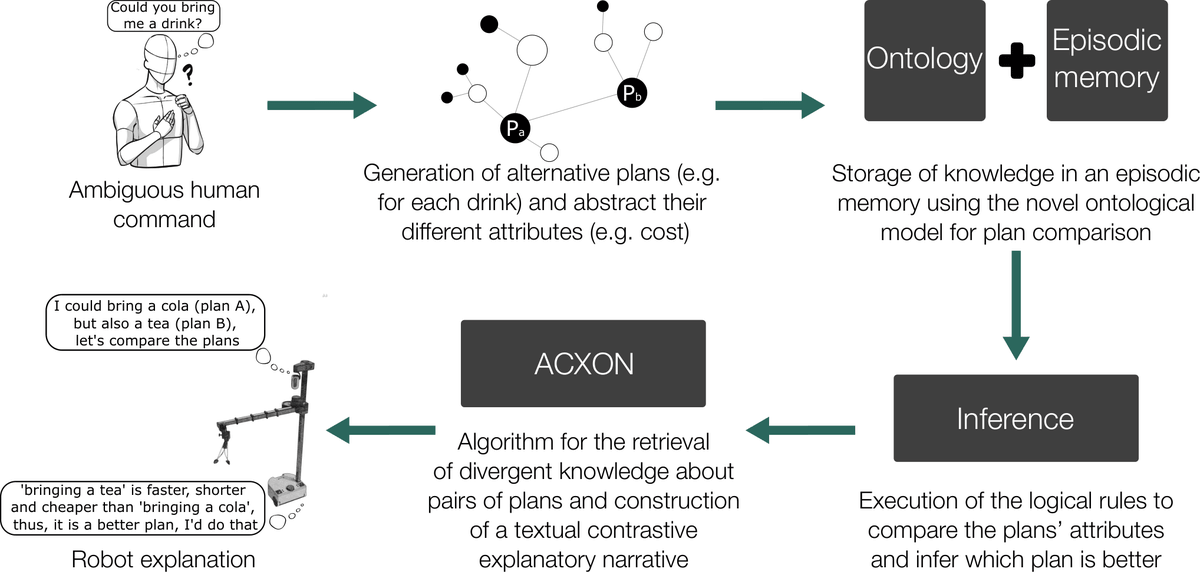
When a robot has two valid ways to fulfill a request, picking one over the other is only half the job. The harder half is telling the human why. A team from the Institut de Robòtica i Informàtica Industrial (CSIC-UPC) and King's College London has proposed a formal way to do this, published in Information Sciences and available on arXiv. Their contribution is a new ontology for comparing competing robot plans, plus an algorithm called ACXON that turns the comparison into a short, contrastive natural language explanation.
The scenario the authors keep in mind is deliberately mundane. A human gives an ambiguous command like "can you bring me a drink?", the robot decomposes it into concrete goals, and it finds a plan to achieve each goal, such as fetching any of the available drinks. It then compares the options and disambiguates. The robot has to justify its choice, or ask the human to break the tie, and it has to do so in a way a non-specialist can follow.
Comparing plans versus finding one
Most planning research focuses on generating a single valid plan. Here the assumption is that two valid plans already exist and the robot must compare them to identify the better one. That shift changes what the robot needs to represent. It has to reason about the qualities of each plan, how those qualities relate to each other, and how the plans relate as wholes.
The authors build on an existing ontology called OCRA, which had a gap: it did not define any classes or relationships to model plan properties, and it did not specify how an agent should actually decide which plan is better. The paper introduces new formal concepts, focusing on three generic qualities that come up in almost every temporal planning problem: cost, expected makespan, and number of tasks (the number of sequenced actions in a plan).