
CSD-VAR Beats Diffusion Models at Separating Style from Subject in Images
A new ICCV research paper splits a single image into reusable content and style tokens by exploiting the multi-scale structure of visual autoregressive models.
 Pro
Takeaways
- CSD-VAR is an ICCV 2025 paper on splitting content and style from a single image using VAR models. Paper
- Authors show early and final VAR scales encode style while middle scales encode content.
- Three tricks: scale-aware alternating optimization, SVD-based style rectification, augmented K-V memory.
- Beats DreamBooth, B-LoRA, and Inspiration Tree across content, style, and text alignment metrics.
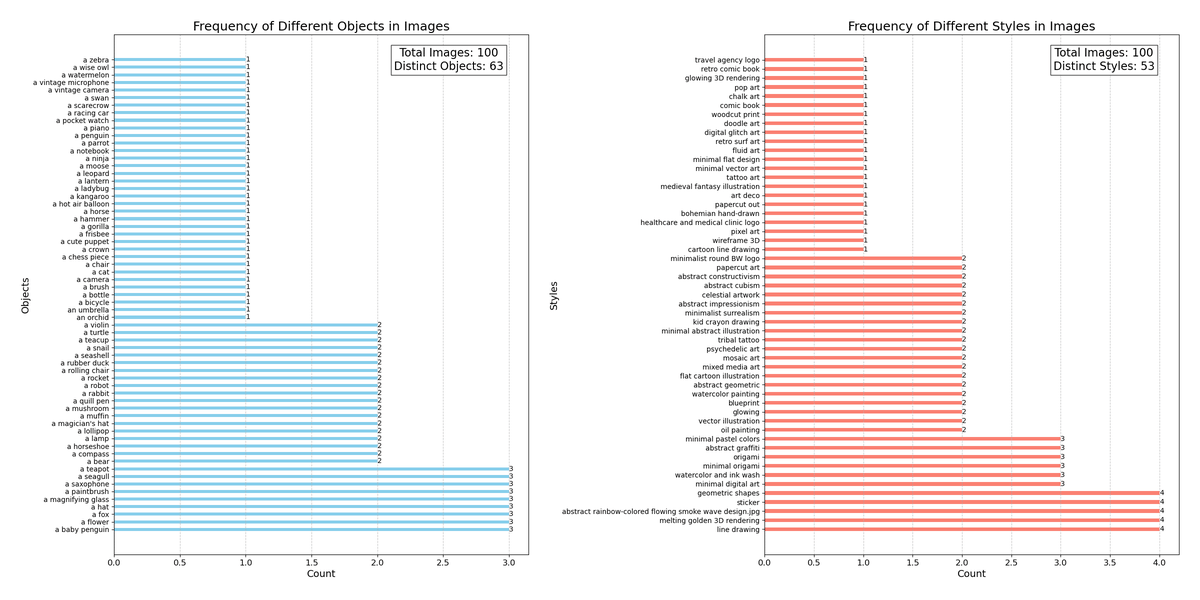
- Introduces CSD-100, a 100-image benchmark with 63 objects and 53 styles. Project page
- Trains in 200 steps on a single A100, but still struggles with highly detailed subjects.
Pulling apart the subject of a picture from the way it is drawn has been a diffusion-model game for the last two years. A new paper called CSD-VAR, accepted at ICCV 2025, argues that the next-scale prediction machinery inside Visual Autoregressive (VAR) models is actually a better fit for the job, and it backs the claim with a method, a benchmark, and a fairly convincing set of numbers.
The authors, led by Quang-Binh Nguyen, frame the task as content-style decomposition (CSD): given one image, learn two separate embeddings so you can later drop the subject into a new scene, or paint a new subject in the extracted style. Prior work on explicit content-style decomposition, they note, has been tailored for diffusion models. CSD-VAR is the first attempt to do the same thing inside an autoregressive image generator.

Why bother moving off diffusion
Visual Autoregressive modeling is the newer kid on the generative-image block. Instead of generating tokens sequentially, VAR shifts from next-token prediction to next-scale prediction, predicting an entire token map at each scale. Generation starts with a 1x1 token map and expands progressively up to a KxK grid, refining details at every step. Backbones like Switti and Infinity have shown that this approach matches diffusion quality while being noticeably faster at inference.
That coarse-to-fine structure is exactly what the paper wants to exploit. Diffusion models denoise a single latent globally, which makes it hard to say which parameters own the color palette and which own the shape. VAR literally builds the image in resolution layers, so the authors ask a simple question: do those layers already specialize?
The scale experiment that drove the design
To answer that, the team ran a diagnostic on 35 images. They dropped tokens from one scale at a time, reconstructed the image, and measured how much the style similarity to the original changed using DINO and CSD-S scores. The result was cleanly bimodal: removing the smallest scales (1, 2, 3) or the very last scale (10) wrecked the style, while the middle scales mostly carried subject shape and category. That partition, styles at the extremes and content in the middle, becomes the backbone of the method.

Three ingredients that make it work
Starting from a textual-inversion baseline (freeze the model, learn two new text tokens for <content> and <style>), CSD-VAR layers on three fixes:
- Scale-aware alternating optimization. The style embedding is trained mostly against losses at scales 1, 2, 3 and 10, and the content embedding against scales 4 through 9. The two embeddings are updated in separate iterations so their gradients do not mix.
- SVD-based style rectification. Even with the split, some subject information bleeds into the style token. The authors ask an LLM to generate around 200 sub-concepts of the target subject (a "dog" concept gets "Golden Retriever", "Bulldog", and so on), embed them with CLIP, run SVD, and keep the top 10 singular directions as a "content subspace". The style embedding is then projected orthogonal to that subspace, mechanically removing subject leakage.
- Augmented Key-Value memory. Text embeddings are a thin channel for complicated textures or subjects. CSD-VAR prepends a handful of learnable K and V vectors inside the self-attention of one transformer block, at scale 1 for style and scale 4 for content. Think of it as a small scratchpad the model can write attributes to that no single text token could hold.
The mechanics of the SVD projection are the cleanest part of the paper. Concretely:
M = stack(clip_text_encoder(subconcepts))   # Q x d
U, S, Vt = svd(M)
V_r = Vt[:r]                                # top-r content directions
P = V_r.T @ V_r                             # projection matrix
e_style_clean = e_style - e_style @ P       # remove content component
CSD-100, a benchmark that did not exist
Because no public dataset properly evaluated this task, the team built one. CSD-100 is a dataset of 100 images designed to capture diverse content and styles for comprehensive benchmarking. They started from the RB-Modulation prompt list, generated roughly 18,000 candidate images with Flux 1.0, manually curated down to 1,000, then used GPT to filter to a final 100 spanning 63 objects and 53 styles. Evaluation runs 50 prompts per concept with 10 samples each, for 50,000 generated images total.

How it stacks up
On CSD-100, CSD-VAR beats DreamBooth, B-LoRA, and Inspiration Tree across content alignment (CSD-C, CLIP-I), style alignment (CSD-S, DINO), and text alignment (CLIP-T). With the Infinity backbone it hits 0.660 CSD-C and 0.795 CLIP-I for content, versus 0.523 and 0.592 for B-LoRA. The Switti backbone leads on style with 0.564 CSD-S. A 100-participant user study, with 7,500 responses, echoed the numbers: preference wins on content alignment, style alignment, and prompt adherence.
Ablations confirm each piece is pulling weight. Removing the scale-aware split drops CSD-C from 0.603 to 0.501; killing the SVD rectifier tanks style alignment; dropping the K-V memory hurts almost every metric. Sweet spots reported: 4 learnable tokens per embedding, top-10 SVD components, and a single K-V-augmented block (adding more blocks helps alignment slightly but costs text fidelity, a classic overfitting tell).
What it is and is not good for
The obvious use cases are one-shot personalization workflows: extract a character from a piece of concept art and put it in twenty different settings, or lift a distinctive illustration style off a single frame and reapply it to arbitrary subjects, all without training a full LoRA. Because the method sits on top of pretrained Switti and Infinity weights and only trains embeddings plus a tiny K-V memory, the whole thing runs on a single A100 in 200 steps.
The honest limitation, called out by the authors, is intricate subjects. When the input contains fine-grained internal detail, the current scale partition still smears some of it into the style channel. They also flag CSD-100 as an evaluation set for now, with plans to grow it into a training resource. The ICCV project page hosts additional qualitative results, and the full paper is on arXiv. A public code release was not available at the time of the paper.