
CreativeBench Proves Bigger AI Models Get Correct but Less Creative
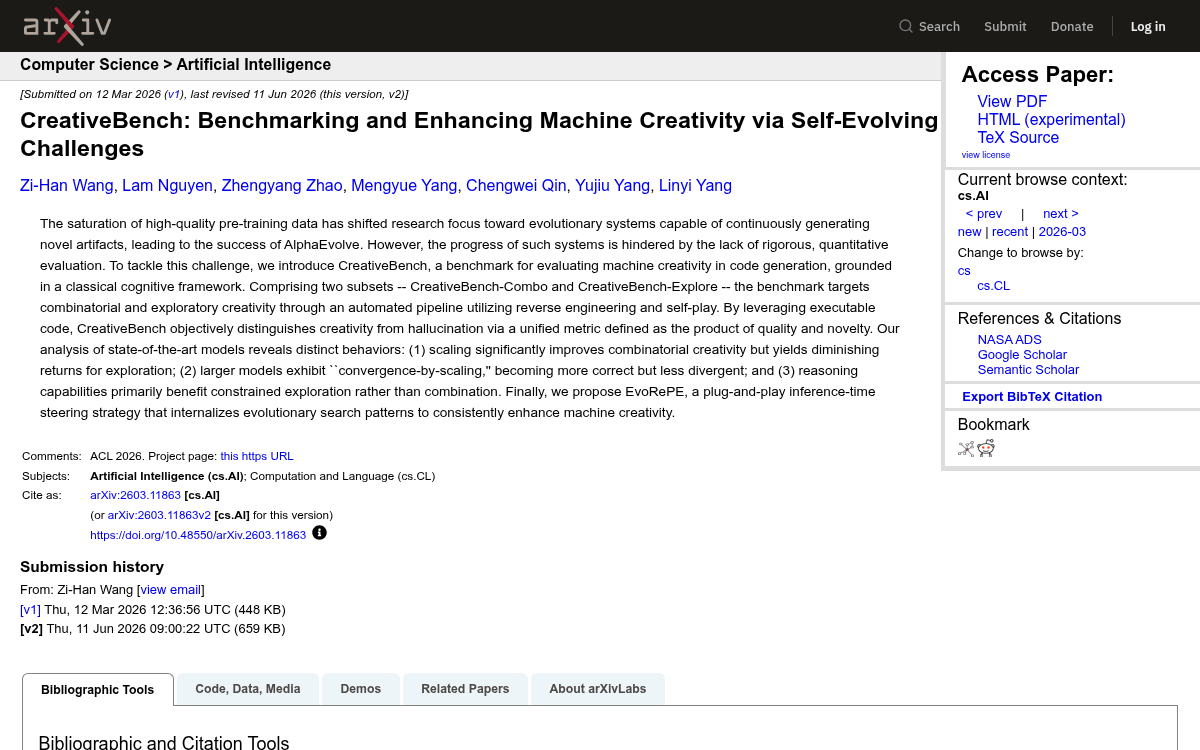
A new benchmark and inference-time steering method measure and boost machine creativity in code, revealing that scaling makes models more correct but less original.
 Pro
Takeaways
- CreativeBench evaluates code-generation creativity via two subsets: combinatorial fusion (1,308 problems) and constrained exploration (551 problems).
- Unified metric
Creativity = Quality × Noveltydistinguishes creativity from hallucination using sandbox execution plus embedding and n-gram distances. - Human validation shows 89.1% instance validity and Spearman rho of 0.78 with expert rankings.
- Scaling improves combinatorial creativity but yields diminishing returns for exploration; larger models are more correct but less divergent.
- Reasoning mode helps constraint-driven exploration significantly but barely improves cross-domain combination.
- EvoRePE steers residual activations with a creativity vector, boosting scores with near-zero inference overhead.
A team from SUSTech, Tsinghua, Peking, Bristol, HKUST-GZ, and Xi'an Jiaotong has released CreativeBench, a benchmark that tries to answer a question most code-generation evaluations dodge: is the model actually being creative, or just hallucinating? Alongside it, they propose EvoRePE, a training-free steering trick that nudges models toward more creative outputs at inference time.
The motivation is that high-quality web data is saturating, and the field is turning to evolutionary systems that continuously generate novel artifacts, as seen in AlphaEvolve. The problem is that we have no rigorous way to score whether those systems are being creative or just wrong in interesting ways. Existing work either relies on subjective assessments that cannot distinguish creativity from hallucination, uses tasks too simple to elicit genuine creative behavior, or lacks grounded quantitative metrics for evolving systems.
Two flavors of creativity, one score
CreativeBench is grounded in Margaret Boden's cognitive framework, which splits creativity into combinatorial (mashing familiar concepts together in unfamiliar ways) and exploratory (navigating a constrained space to find something new). The benchmark has two matching subsets built through an automated pipeline.

The construction tricks are the interesting part:
- Combo tasks (1,308 problems): Built by reverse engineering. The pipeline first fuses code from two different domains into a single verified solution, generates test cases by executing it in a sandbox, then asks a model to write the problem statement that this solution answers. That guarantees every task has a working reference.
- Explore tasks (551 problems): Built by self-play. A Constraint Generator and a Solver play a game where each round adds a new negative constraint that forbids the specific algorithmic pattern the Solver just used. Constraints are stacked so higher levels strictly subsume all prior restrictions, pushing the Solver toward structurally distinct algorithms until it hits its capability limit.
Everything is evaluated with a single unified metric: Creativity = Quality × Novelty. Quality is Pass@1 measured in a sandbox. Novelty combines a semantic embedding distance (via CodeXEmbed) with a character-level 4-gram distance to penalize near-copy edits. The multiplication is the whole point: a correct-but-boring answer and a novel-but-wrong answer both score near zero. Only solutions that are both correct and meaningfully different from baselines get high scores. Human experts validated 89.1% of instances and showed strong agreement between automated and human creativity rankings with Spearman's rho of 0.78.
Scaling makes models correct, not creative
Running the benchmark on Gemini-3-Pro, GPT-5.2, Claude, DeepSeek-V3, Qwen3, and the Qwen2.5 family from 1.5B to 72B produced three findings that will probably annoy people who thought scaling solves everything:
- Scaling favors combination over exploration. Larger models get much better at cross-domain fusion but see diminishing or negative returns on exploratory tasks. The authors frame this through a compression lens: scaling expands the compression budget so models get better at connecting distant domains, but the same stronger distributional priors make high-likelihood routine solutions more stable, hurting the ability to jump into low-probability regions.
- Convergence-by-Scaling. Pass@1 climbs with size while novelty declines or plateaus. Bigger models are more correct but more standardized.
- Reasoning helps exploration, not combination. Turning on thinking mode barely moves combinatorial scores but significantly boosts exploratory ones. Cross-domain fusion apparently relies more on knowledge retrieval than long chains of thought.
Even the strongest model tested, Gemini-3-Pro, stays below 60% Pass@1 on both subsets, so there is plenty of headroom.

EvoRePE: steering the residual stream toward creativity
The second contribution is a plug-and-play method that extracts a "creativity direction" from a model's own activations. The recipe is straightforward representation engineering:
- Take pairs of (standard prompt, evolved prompt) from an evolutionary run like AlphaEvolve or GEPA.
- Compute the activation difference at some layer for each pair.
- Take the first principal component of those differences. That is your creativity vector.
- At inference, add
α · vto the residual stream at that layer.
On Qwen2.5-7B-Instruct with AlphaEvolve as the evolutionary backbone, adding EvoRePE lifted the Combo creativity score from 0.175 to 0.193, and it improved results even on vanilla prompting without any evolutionary search. The gains hold across a wide layer range (22 to 28) and steering strengths (α from 0.05 to 0.45), so it does not depend on a magic hyperparameter. Cost-wise it is roughly free at inference, compared to the massive O(N × M) inference overhead of running a full evolutionary loop.
Availability and caveats
The authors release the data and code on the CreativeBench homepage referenced in the paper. The main limitations are honest: everything is currently Python, the benchmark inherits some generator bias from the LLM pipeline that built it, and the team did no large-scale training experiments with it. The natural extensions the authors flag are other creative domains such as storytelling, music, 3D design, and scientific hypothesis generation, where reliable execution-grounded quality signals do not exist yet.
For anyone building evolutionary code systems or trying to measure whether their model does anything beyond memorization, this is a useful arrow in the quiver. The Quality × Novelty formulation is simple enough to steal for adjacent domains, and EvoRePE is cheap enough to bolt onto an existing pipeline in an afternoon.