
Cornell's DDVI Replaces Weak VAE Encoders With a Diffusion Model
A new black-box inference method swaps Gaussian encoders for diffusion posteriors, giving VAEs sharper latent structure and better ancestry clustering on real genomes.
 Pro
Takeaways
- DDVI replaces the Gaussian VAE encoder with a diffusion model that iteratively refines latents from noise.
- Training uses a regularized ELBO plus a wake-sleep style diffusion loss, avoiding backprop through sampling.
- Beats normalizing flows, adversarial autoencoders, and Path Integral Sampler on MNIST and CIFAR-10 with structured priors.
- Achieves top cluster purity (0.45) and NMI (0.66) on 1000 Genomes ancestry clustering.
- Code is available at github.com/topwasu/DDVI; paper accepted to AAAI 2025.
- Best suited for probabilistic programming and dimensionality reduction, not raw image sample quality.
Variational autoencoders have a well-known weakness: the encoder that maps data to latent space is usually a plain Gaussian, which cannot match a complicated true posterior. A team from Cornell has released Denoising Diffusion Variational Inference (DDVI), which replaces that simple encoder with a diffusion model that iteratively refines the latents. The AAAI 2025 paper shows the approach beats normalizing flows and adversarial autoencoders on synthetic benchmarks and on a real biology task: inferring human ancestry from genomes.
The gap that keeps eating your ELBO
In amortized variational inference, you train an encoder q(z|x) to approximate the true posterior p(z|x), and the gap between the two is exactly the slack in your ELBO. If your prior p(z) is anything more interesting than a blob, say a pinwheel, a Swiss roll, or the manifold of human genetic ancestry, a diagonal Gaussian encoder simply cannot match it. Prior work has plugged in normalizing flows or GAN-style adversarial encoders, but flows need invertible layers and adversarial training is notoriously unstable.
DDVI takes a different route. It introduces an expressive class of diffusion-based variational posteriors that perform iterative refinement in latent space, trained with a novel regularized ELBO inspired by the wake-sleep algorithm. In practice, that means the encoder does not spit out a single Gaussian, it runs a mini reverse-diffusion process inside the VAE bottleneck.

How the diffusion posterior actually works
The recipe has three moving parts. The encoder produces a starting noise sample y_T, then a learned reverse chain q(y_{t-1}|y_t, x) denoises it step by step until it lands on z, which is then decoded back to x. A user-specified forward diffusion r(y|z,x) defines the ground-truth trajectory the reverse chain should undo.
Training combines two objectives that are optimized in alternation, echoing the classic wake-sleep algorithm:
- Wake step: sample real data, take a gradient step on the standard ELBO (reconstruction plus the KL between the diffusion posterior and prior).
- Sleep step: sample latents from the model, apply the forward noising process, and train the denoiser with the usual noise-prediction loss from DDPM.
The clever bit is that the sleep term is itself a lower bound on a reversed KL divergence, so adding it keeps the whole objective a valid ELBO on log p(x). Unlike diffusion samplers such as Path Integral Sampler, DDVI never backpropagates through the sampling trajectory, which the authors argue makes credit assignment tractable enough to jointly learn the generative model, not just do inference.
Numbers on structured priors and real genomes
The team benchmarks against AEVB (the vanilla VAE), AEVB with inverse autoregressive flows, adversarial autoencoders (AAEB), hierarchical VAEs, and Path Integral Sampler. On MNIST and CIFAR-10 fitted with pinwheel, Swiss roll, and square priors, DDVI takes the best ELBO in almost every configuration. On the pinwheel prior with MNIST, for instance, it reports an ELBO of about -3.88 versus -4.19 for the IAF flow and -12.13 for the plain VAE.

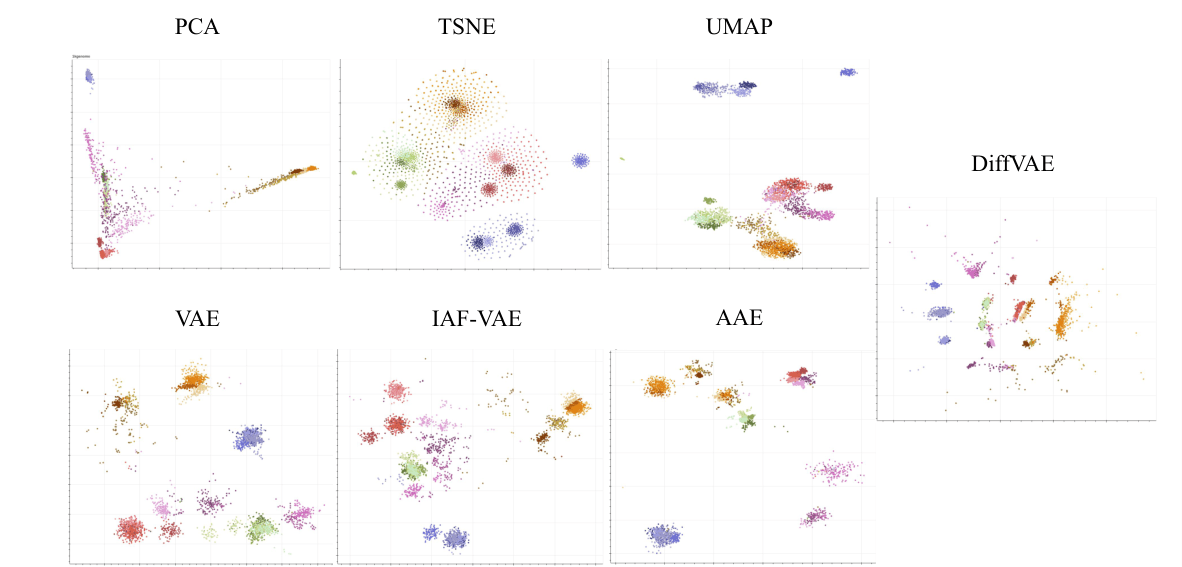
The more interesting test is the 1000 Genomes dataset, where the goal is to cluster individuals by ancestry from raw genotypes. Across up to 20 clusters, DDVI hits 0.45 cluster purity and 0.66 normalized mutual information, both the highest in the table, while classical methods like PCA, t-SNE, and UMAP were included as visualization baselines.
When to reach for it, and when not to
DDVI is aimed at exactly the settings where diagonal Gaussians fall apart: probabilistic programming with hand-designed priors, dimensionality reduction where the latent geometry matters, and semi-supervised learning with partitioned priors. If you only care about pixel-quality image samples, latent diffusion models like Stable Diffusion are still the tool of choice, since DDVI targets structured posterior fit rather than sample fidelity.
The authors flag two honest caveats. Training adds a diffusion inner loop, so wall-clock cost is higher than a standard VAE, though ablations show DDVI keeps improving after baselines plateau. And because the loss adds a regularizer beyond the pure ELBO, it may not help models that do not benefit from extra regularization.
Code, configs, and the AAAI experiments are available in the topwasu/DDVI repo, making this straightforward to slot into an existing VAE codebase where you already have a nontrivial prior and want a posterior that can actually match it.