
Cornell's CraftLink Turns Expert Craft Videos Into Interactive Knowledge Graphs
A Cornell Tech-led team proposes a seven-pattern grammar for documenting the tacit, improvisational side of craft that recipes and tutorials miss.
 Pro
Takeaways
- Cornell Tech, Stanford, and Cornell researchers propose an elementary grammar for documenting craft expertise.
- Seven patterns capture granularity, reflection, notes, links, segments, branches, and revision loops.
- The grammar builds on Knight and Stiny's making grammar with primitives stuff, things, doing, sensing.
- CraftLink prototype turns narrated craft videos into interactive graphs via a multimodal LLM.
- User study with seven expert crocheters validated flexibility, adjustable detail, and personal-to-shareable translation.
- Embodied sensory knowledge and third-party data handling remain acknowledged limitations of the approach.
Recipes tell you to knead the dough. They do not tell you when to switch from stretch-and-fold to slap-and-fold because the hydration is running high. That gap between a written procedure and the situated, improvisational knowledge an expert actually uses is the target of new research from Cornell Tech, Stanford, and Cornell University, which proposes an elementary grammar for documenting craft workflows and demonstrates it with a prototype interface called CraftLink.
The paper, (De)composing Craft, is heading to CSCW '26. Its core contribution is not a model or a benchmark, but a small vocabulary of seven repeatable patterns that let craftspeople externalize the parts of expertise that linear step-by-step instructions tend to erase.
Why recipes and tutorials keep failing
Most documentation focuses on the linear steps leading to final artifacts, neglecting the distinct tacit knowledge, improvisational actions, and situated adaptations needed to meet the unique demands of each craft project. The authors ground this in interviews with 16 expert craftspeople across woodworking, metalworking, baking, weaving, and fiber arts. A recurring theme: experts constantly deviate from written procedures based on how the material is behaving, and those deviations are exactly what novices need to see.
Drawing on Andrew Abbott's distinction, they argue craft is rule-based rather than rule-bound, meaning experts follow structure but know when and how to break it. Existing computational design grammars (shape grammars, PotScript, CoilCAM) can describe geometry, but they say little about the reasoning, sensing, and repair that expertise actually consists of.
Seven patterns for the messy middle
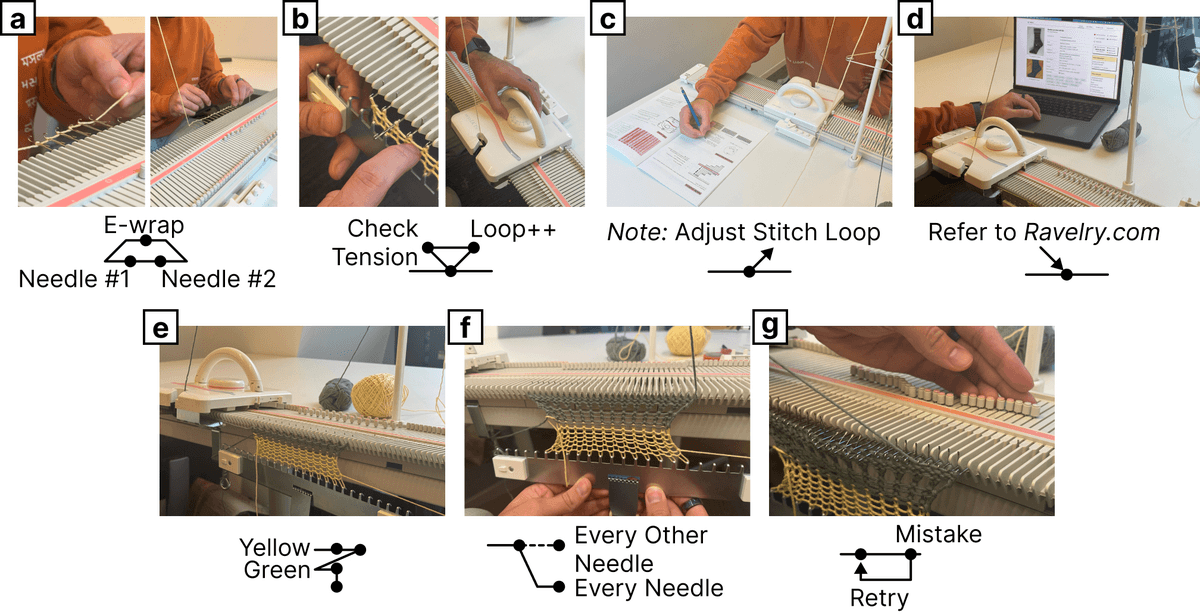
The grammar builds on Knight and Stiny's earlier making grammar, which describes craft in terms of four primitives: stuff, things, doing, and sensing. The new work adds seven patterns that capture the non-linear connections between them:
- Granularity Shifts mark steps as low, medium, or high detail so the same document can serve novices and experts.
- Reflective Loops represent the sense-and-adjust cycles where a maker checks tension, grain, or dough and changes course.
- Note-to-Self annotations capture things video cannot show, like how much force was applied.
- External Links point to forums, videos, or references the maker actually relied on.
- Segments divide a workflow into collapsible chunks (sleeve, body, collar).
- Branches record deviations from a canonical pattern along with the intent behind them.
- Revision Loops preserve the undo-redo trail of failed attempts and repairs, the paths-not-taken.

CraftLink: turning unstructured video into a graph
To show the grammar is usable, the team built CraftLink, a pipeline that ingests a narrated craft video and produces an interactive graph. The pipeline has five stages: record and upload, analyze with a multimodal LLM prompted with the grammar, generate a directed graph in React, let the expert refine it, and publish a read-only view for collaborators.
In the reference implementation, the team uses Google's Gemini 1.5 pro, guided by a structured prompt based on the grammar, and constrains the model to produce a fully connected graph whose node timestamps span the video. The output is a JSON of foundational elements, timestamps, relationships, and detected patterns, which is rendered with React Flow. Nodes are color coded: yellow for things, green for doing, pink for sensing. Clicking a node jumps to the corresponding video timestamp.
Experts can then edit, delete, or annotate nodes before sharing. Consumers open the refined graph, toggle segments open or closed, dial granularity up or down, and see reflective loops and branches overlaid on the workflow.
What the user study found
The evaluation ran with seven expert crocheters, each with at least five years of experience. Each recorded a 15 to 20 minute narrated video, refined the auto-generated graph, and then reviewed another participant's graph. Feedback clustered around four themes:
- Adjustable granularity was seen as essential for serving both novices and peers.
- The grammar accommodated freehanding and non-linear workflows better than traditional patterns.
- Participants distinguished between documentation for themselves and documentation intended for others, and the grammar helped translate between the two.
- Embodied knowledge, tension, feel, hand pose, still resisted capture. One participant called this an unavoidable trade-off.
What it is good for, and what it is not
The grammar is aimed at knowledgeable but non-master practitioners, not absolute beginners. It is best suited to workflows where improvisation matters and the interesting knowledge lives in deviations, tension checks, and repairs, think crochet, machining, baking sourdough, hand-carving, or ceramics. It is not a substitute for hands-on apprenticeship, and it does not pretend to encode sensory feel.
There are also open questions the authors flag directly. Sending expert video to a third-party MLLM raises privacy and intellectual property concerns, and some participants adjusted their recording angles to avoid showing their faces. The team suggests future implementations could swap in local models via Ollama to keep data on device. Code and models are not publicly released with the paper; CraftLink is a research prototype used for the evaluation.
The deeper argument is that documentation should stop pretending to be a finished recipe. Treating it instead as scaffolding that can be extended, remixed, and Frankensteined together, as one participant put it, is a better fit for how skilled communities actually accumulate knowledge across time and distance.