
Cornell's CAT Framework Beats Darkness by Teaching Quantum Light to Think
Cornell-led team trains a quantum light source and a Transformer together, cutting the photon budget for image classification by up to 6x.
 Pro
Takeaways
- Cornell-led team introduces correlation-aware training (CAT), jointly optimizing a quantum light source and a Transformer backend.
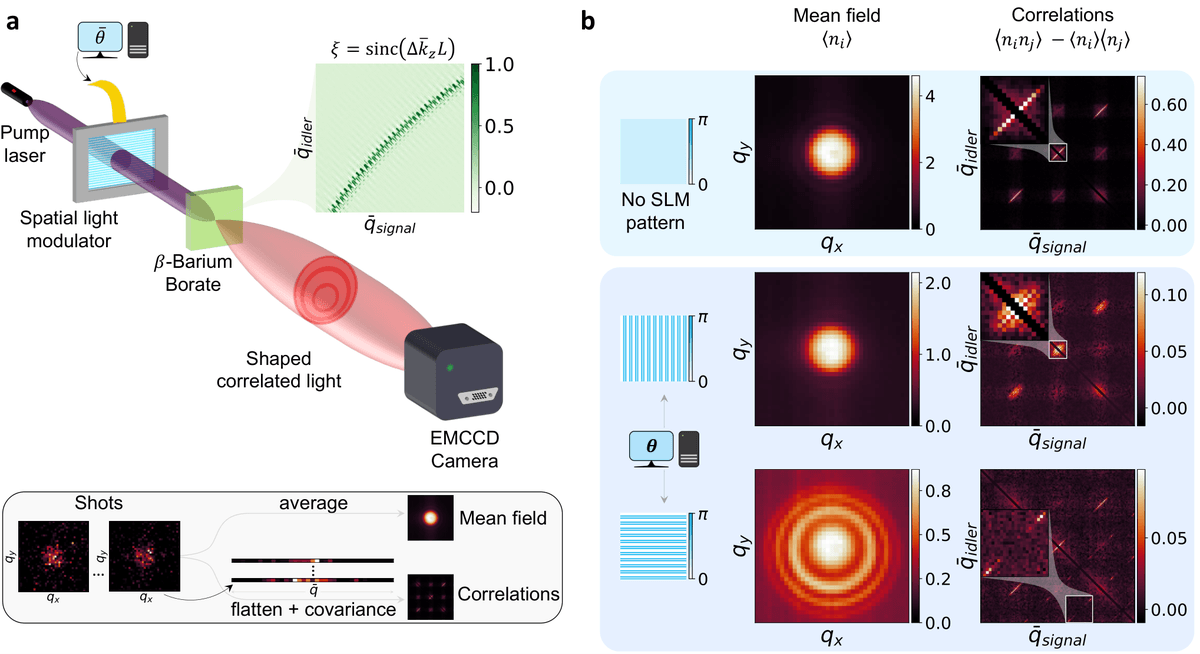
- Uses SPDC biphotons shaped by a spatial light modulator, with a Set Transformer classifying frames from an EMCCD camera.
- Achieves up to 18 percentage points accuracy gain over conventional uncorrelated illumination in sub-unity SBR conditions.
- Cuts required photon budget by 2-6x in experiment on MPEG-7 shapes, and up to 10x in cell organelle simulations.
- Uses a straight-through estimator to backpropagate through stochastic photon sampling without exploding memory.
- Code and data released on Zenodo; detector loss remains the key practical bottleneck.
A team spanning Cornell, Yale, Boston University, and NTT Research has shown that you can teach a quantum light source and a neural network to cooperate, letting a computer vision system recognize objects in conditions so dark that the noise is louder than the signal. The trick is to stop trying to reconstruct a clean image and instead train the pattern of photon correlations directly for the classification task at hand.
The paper, titled Ultra-low-light computer vision using trained photon correlations, introduces a framework called correlation-aware training (CAT). It demonstrates end-to-end optimization of a trainable correlated-photon illumination source together with a Transformer backend, using no more than 100 shots per inference. The reported gain is substantial: up to 15 percentage points of accuracy over conventional uncorrelated illumination in ultra-low-light and noisy conditions, and a consistent lead over untrained correlated-photon setups too.

Why photons run out before pixels do
In many real imaging scenarios, the bottleneck is neither resolution nor model capacity. It is photons. Live-cell microscopy, deep-tissue imaging, and other low-light applications cap the number of photons you can send at a sample before you damage it. When light is scarce, camera frames are dominated by shot noise (the statistical jitter of counting discrete photons) and background clicks from the detector.
Vision Transformers thrive on statistical correlations between pixels, but those correlations get buried at ultra-low light levels. Quantum optics offers a workaround. Photon sources like spontaneous parametric down-conversion (SPDC) emit pairs whose positions are correlated by physics, while noise clicks are not. The detection of one photon constrains the expected location of its twin, and deviations from this pattern provide additional information about the object across spatially separated pixels.
The catch, historically, is that estimating those correlations well enough to exploit them requires averaging thousands of frames, which defeats the purpose in low-latency or low-dose applications.
Making the light source a trainable parameter
Instead of treating illumination as a fixed input, the authors expose the SPDC source's photon statistics as learnable knobs and optimize them jointly with the classifier. The physical setup uses a 355 nm laser pumping a beta-Barium borate crystal to produce correlated signal and idler photons at 710 nm via type I phasematching, with a spatial light modulator placed in the pump beam path to control the pump's angular spectrum. Because the spatial correlations between the SPDC photons depend on that pump angular spectrum, shaping the SLM shapes the correlations.