
Cornell Reveals How YOLO26 Cuts CPU Latency 43% by Ditching Old Detection Plumbing
YOLO26 strips out NMS and Distribution Focal Loss, adds three training tricks, and posts up to 43% faster CPU inference on COCO.
 Pro
Takeaways
- YOLO26 removes Non-Maximum Suppression and Distribution Focal Loss, enabling native end-to-end inference and cleaner exports.
- New training tricks: ProgLoss balances loss terms, STAL boosts small-object recall, MuSGD stabilizes convergence.
- YOLO26n hits 39.8% mAP on COCO at 38.9 ms CPU latency, roughly 43% faster than YOLO11n.
- INT8 quantized exports retain near-FP32 accuracy on Jetson, Snapdragon, and ARM CPUs.
- First Ultralytics release unifying detection, segmentation, classification, pose, and oriented boxes natively.
- Full review paper on arXiv covers YOLOv5, YOLOv8, YOLO11, and YOLO26 architectures and benchmarks.
Real-time object detection has been dominated by the YOLO family for nearly a decade, and a new review from Cornell researchers lays out the biggest architectural break the Ultralytics line has made in years. The paper walks through YOLOv5, YOLOv8, YOLO11, and the freshly released YOLO26, and it makes clear that YOLO26 is not just another point-release polish. It rips out two long-standing components that made YOLO awkward to deploy, and rebalances training around small objects and stable convergence.
The headline is simple: the review documents that YOLO26 is the first Ultralytics release to natively unify five vision tasks in one framework, while also being the first to ship without Non-Maximum Suppression (NMS) or Distribution Focal Loss (DFL) in the graph. YOLO26 introduces architectural simplifications that remove bottlenecks such as Non-Maximum Suppression (NMS) and Distribution Focal Loss (DFL), adopts a novel MuSGD optimizer for stable convergence, and incorporates training refinements such as Progressive Loss Balancing (ProgLoss) and Small-Target-Aware Label Assignment (STAL).
Why the old plumbing had to go
Two components have been quietly hurting YOLO on edge hardware for years. NMS is the post-processing step that filters overlapping boxes using IoU and score thresholds. It runs on the CPU, adds latency variance at batch size one, and forces per-scenario threshold tuning. DFL, in turn, treats each bounding box coordinate as a probability distribution over discrete bins, which improves localization but introduces operators that don't quantize cleanly and often break during export.
Competing lines like YOLOv12 and YOLOv13 pushed accuracy up with attention modules but continued to rely on NMS and DFL, creating latency and export friction on low-power devices. YOLO26's answer is to delete both. The head removes Distribution Focal Loss (DFL)-based distributional regression in favor of a lighter, hardware-friendly parameterization of bounding boxes. Eliminating DFL prunes operators that were brittle across compilers and runtimes, reducing graph complexity and easing quantization. The decoder is then reworked so the model emits a compact, non-redundant set of predictions directly, no suppression pass required.

Three training tricks that actually matter
Ripping out DFL and NMS would normally hurt accuracy. YOLO26 compensates with three training-side changes:
- ProgLoss (Progressive Loss Balancing): Schedules the relative weights of classification, localization, and auxiliary terms to prevent domination by easy negatives or large objects in later epochs, improving convergence smoothness.
- STAL (Small-Target-Aware Label Assignment): Adjusts assignment priors and spatial tolerance to ensure tiny, occluded, or low-contrast instances receive adequate supervisory signal, boosting recall in edge-centric imagery (UAV, smart cameras, mobile robotics).
- MuSGD optimizer: A hybrid that blends standard SGD with Muon-style curvature and momentum updates borrowed from large language model training. It shortens time-to-convergence and dampens the oscillations that typically plague the last few epochs of training.
What the COCO numbers say
On MS COCO validation at 640 px, the pattern is consistent: YOLO26 matches or slightly beats YOLO11 on accuracy while dropping CPU latency significantly. YOLO26n reports approximately 39.8% mAP (up to 40.3% in end-to-end mode) at around 38.9 ms on CPU, substantially faster than YOLO11n at comparable accuracy. The larger variants scale predictably.
| Model | mAP50-95 (%) | CPU ONNX (ms) | Params (M) | FLOPs (B) |
|---|---|---|---|---|
| YOLOv8n | 37.3 | 80.4 | 3.2 | 8.7 |
| YOLO11n | 39.5 | 56.1 | 2.6 | 6.5 |
| YOLO26n | 39.8 (40.3 e2e) | 38.9 | 2.4 | 5.4 |
| YOLO26s | 47.2 | 87.2 | 9.5 | 20.7 |
| YOLO26m | 51.5 | 220.0 | 20.4 | 68.2 |
| YOLO26l | 53.0-53.4 | 286.2 | 24.8 | 86.4 |
Early previews indicate substantial CPU-side speedups (approximately 43%) and consistent performance under FP16/INT8 quantization. Transformer-based detectors like RT-DETRv3 and DEIM-D-FINE still lead on absolute AP (mid-50s at higher parameter counts), but they carry heavier compute and are far less friendly to CPU-bound edge stacks.
The deployment story
The real breakthrough is not the fractional mAP gain, it's what the simplified graph enables downstream. By removing DFL and NMS, the exported graphs map cleanly to ONNX, TensorRT, CoreML, and TFLite with fewer custom kernels, facilitating INT8 and FP16 deployment with minimal accuracy loss. The simplified operator surface reduces conversion friction and improves determinism across compilers.
That has concrete implications. INT8 exports of YOLO26 retain nearly the same mAP as FP32 versions, enabling smooth deployment on resource-constrained hardware such as the NVIDIA Jetson Orin and Xavier series, Qualcomm Snapdragon AI accelerators, and ARM CPUs. For anyone who has spent a weekend debugging why an ONNX-exported detector drops accuracy after INT8 calibration, this is the interesting bit.

Where each model fits
The review is useful as a decision guide across the four Ultralytics generations:
- YOLOv5: The durable baseline. Best when you need a reproducible pipeline with the widest export coverage and are fine with anchor-based, NMS-based inference.
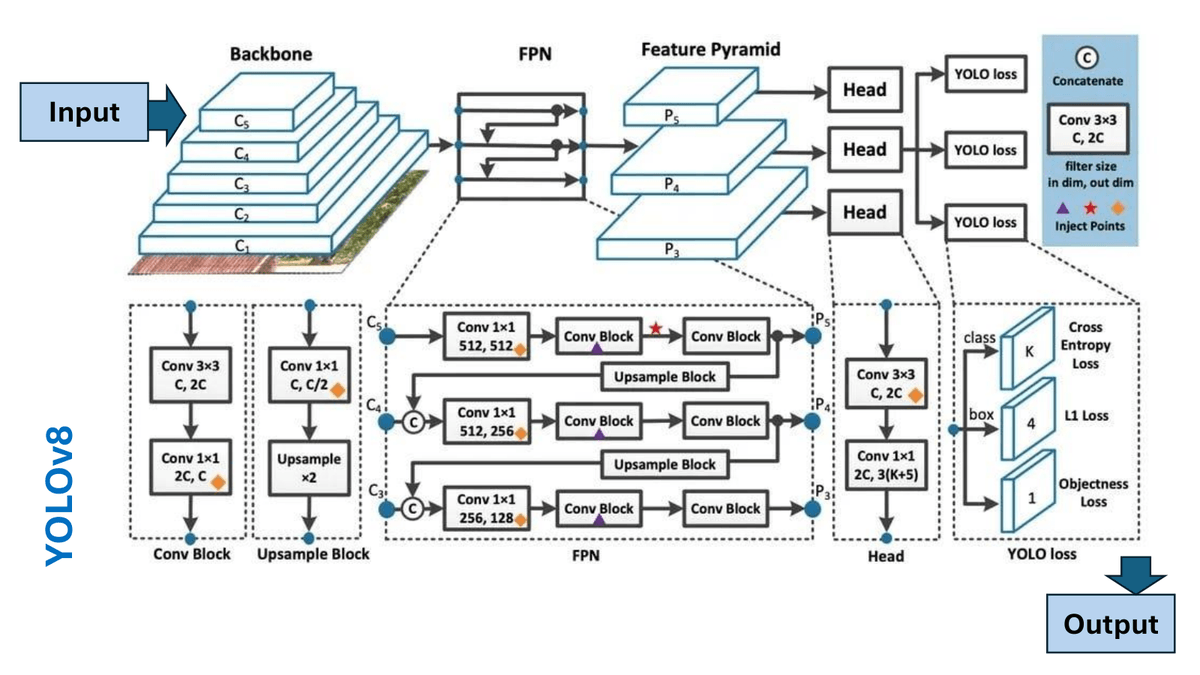
- YOLOv8: Introduced the decoupled head and anchor-free predictions. Good default if you need first-class instance segmentation, keypoints, or classification alongside detection.
- YOLO11: More accurate than YOLOv8 under similar latency budgets, and more stable under transfer and domain shift, particularly for small-object and moderately dense scenes. Still uses NMS.
- YOLO26: The edge-first choice. Pick this when CPU or embedded GPU latency matters, when you need INT8 quantization without accuracy cliffs, or when you want end-to-end inference without threshold tuning.
Where it still struggles
The paper is honest about the remaining gaps. Dense, heavily occluded scenes are still a weak spot for anchor-free detectors in general. Anchor-free detectors improve localization granularity, yet their performance in dense scenes still lags behind human perception. Domain adaptation is the other open problem, models trained on curated data continue to generalize poorly to new lighting, sensor characteristics, or unusual textures without additional adaptation work.
Open-vocabulary detection is also not part of YOLO26. If you need to detect classes by natural language description rather than a fixed label set, you still need to bolt on something like CLIP or GLIP externally. The authors flag hybrid CNN-Transformer designs and language-conditioned heads as the next frontier for the family.
Getting the code
YOLO26 ships through the standard Ultralytics package, with pretrained checkpoints across the n/s/m/l/x scales and the same task coverage (detection, segmentation, classification, pose, oriented bounding boxes) exposed through a single API. The earlier generations remain available: YOLOv5 on GitHub, and YOLOv8 and YOLO11 through the same Ultralytics package. For most new projects targeting anything smaller than a data-center GPU, YOLO26 is now the sensible default.