
Cornell and CMU Show Bad Captions Make Audiences Judge Speakers Harshly
A preregistered experiment finds that error-prone automatic captions systematically lower ratings of both the speaker and their message, regardless of accent.
 Pro
Takeaways
- Preregistered experiment with 207 participants shows error-prone captions lower ratings of both speaker and content.
- Effect held across accents, meaning speakers with higher ASR error rates get penalized twice in practice.
- Novel design used ElevenLabs voice cloning to swap accents while keeping face and gestures identical.
- Google Meet had the worst word error rate (0.31) among seven tested ASR services.
- Direct implication for AI-scored video interview platforms that transcribe candidates before human review.
- Full paper and preregistration are publicly available.
Automatic captions have quietly become a default layer on top of nearly every talk, meeting, and lecture. A new study from researchers at Cornell and Carnegie Mellon argues that when those captions are wrong, audiences don't just blame the software. They blame the person on screen.
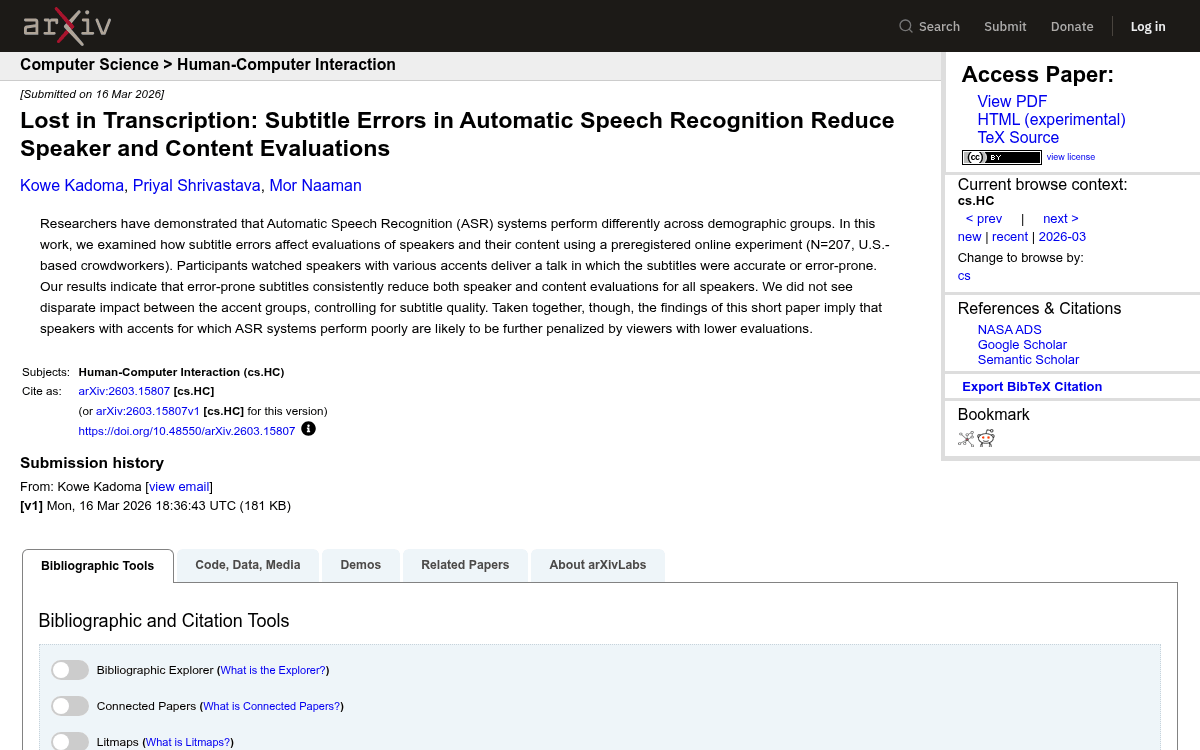
The paper, Lost in Transcription, ran a preregistered online experiment with 207 U.S. crowdworkers and found that error-prone subtitles consistently reduced ratings of both the speaker and the content of a talk, even though the audio itself was identical. Because ASR systems exhibit systematic performance gaps across race, gender, and dialect, speakers whose accents already trigger more transcription errors get penalized twice.
The bias behind the bias
Speech recognition has a well-documented fairness problem. Koenecke et al. showed that commercial ASR systems produce significantly lower word error rates for White speakers than Black speakers, even when both groups uttered identical phrases. Prior HCI work has also shown that failed voice interactions cause real emotional harm, with Black speakers reporting higher self-consciousness and lower self-esteem than White speakers when errors occur.
Most of that research looked at private failures, like arguing with a smart speaker. This study zooms in on the public case: a live audience reading garbled captions under a speaker's face. The authors wanted to know whether viewers quietly transfer the machine's mistakes onto the human.
Cleanly separating accent from everything else
The methodological trick is what makes the results credible. Earlier work compared different speakers with different accents, which tangles voice with face, gestures, delivery, and topic. This team held everything constant except the voice.

They picked four low-view TED Talks from India by South Asian men discussing entrepreneurship, cut one-minute clips from the middle, then used ElevenLabs' voice changer to generate two audio tracks per video: one in Standard American English (SAE) and one in Indian English. The video, face, and gestures were identical across conditions. Only the voice, and therefore the accent, changed.
For subtitles, the authors ran the AI-processed videos through Whisper, Google Meet, Zoom, YouTube, Otter, Apple, and Adobe, measured word error rate (WER) against a hand-annotated ground truth, and picked the worst performer to build realistic error-prone captions.
Which transcription services stumbled
Google Meet was the loser, with an average WER of 0.31 across the clips. Here are the mean WERs the authors reported on the non-SAE tracks:
| System | Mean WER (non-SAE) |
|---|---|
| Adobe | 0.169 |
| Whisper | 0.181 |
| YouTube | 0.188 |
| Otter | 0.197 |
| Zoom | 0.229 |
| Apple | 0.253 |
| Google Meet | 0.307 |
The error-prone captions were realistic rather than adversarial. Sample slip-ups included turning "Borhi Kitchen" into "body kitchen," "cushy job" into "khushi job," and "corporate job" into "pocket job." Small errors, but the kind that quietly accumulate over a minute of screen time.
What the audience did with the errors
Participants watched two videos each and rated the subtitles, the speaker (clarity, knowledgeability), and the content (clear main points, genuine message) on 5-point scales. The pattern was unambiguous.
- Speaker evaluations with error-prone captions: 3.48 (non-SAE) and 3.43 (SAE)
- Speaker evaluations with accurate captions: 3.98 (non-SAE) and 3.88 (SAE)
- Content evaluations with error-prone captions: 3.87 (non-SAE) and 3.80 (SAE)
- Content evaluations with accurate captions: 4.21 (non-SAE) and 4.26 (SAE)
A linear mixed model with participants as a random effect confirmed subtitle quality had a large, significant main effect on speaker ratings (beta = 0.451, p < 0.001) and content ratings (beta = 0.341, p < 0.001). Accent had no significant main effect, and there was no interaction. The speaker was judged clearer and more knowledgeable when the captions were clean, full stop.
The uncomfortable implication
The lack of an accent effect is less reassuring than it might look. The authors' logic is compositional: if accurate captions raise everyone's ratings by the same amount, and ASR systems produce worse captions for non-standard accents in the wild, then speakers with those accents receive worse captions, and therefore worse audience judgments, by default.
That has direct consequences for anyone shipping ASR into consequential workflows. The paper flags asynchronous video interviews specifically, where candidates record themselves answering predefined questions without an interviewer, the video is uploaded to a review system where ASR generates a transcript, and a hiring manager evaluates it later. Managers reading messy transcripts may downgrade candidates whose accents the system handled poorly, without ever realizing they are grading the ASR rather than the person.
What is actually new here
The real contribution is methodological. This work overturns an earlier finding by Kim et al. showing that errors in ASR-based subtitles do not affect the perception of the speaker or their content. By using generative voice cloning to hold face, gestures, and delivery constant while swapping accents, the authors argue their design made subtitle quality the primary source of variation, which is likely why the effect surfaced.
There is no model release, but the study, materials, and analysis plan are preregistered on OSF. The authors point future work toward perceived subtitle quality as a fairness metric, arguing that WER treats all errors equally when audiences clearly do not, and toward adaptive caption interfaces that adjust font, chunking, or timing to compensate for higher error rates on certain speakers. If you build products that put ASR text underneath a human face, the practical takeaway is that your caption pipeline is now part of how your users judge each other.