
CoRE Benchmark Catches Frontier LLMs Faking Emotional Reasoning
A new benchmark called CoRE probes six frontier LLMs on cognitive appraisal theory, exposing systematic gaps in how they reason about emotion.
 Pro
Takeaways
- New CoRE benchmark probes LLM emotion reasoning using cognitive appraisal theory across 17 dimensions and 15 emotions.
- Six frontier models tested: GPT-o4-mini, Gemini 2.5 Flash, DeepSeek R1, QwQ 32B, Phi 4, LLaMA 3 8B.
- LLMs over-weight Effort as a core appraisal dimension while humans treat it as minor.
- Perceived Fairness barely factors into LLM reasoning, except when predicting anger.
- Emotions collapse onto a single valence axis; cultural personas produce no measurable shift.
- Personality personas do produce psychologically plausible shifts in appraisal patterns.
Ask a language model whether a scenario is sad or joyful and it will usually give you the right label. Ask it why, using the cognitive machinery humans actually use to interpret emotional situations, and things start to fall apart. A new benchmark called CoRE puts six frontier LLMs through a psychology-grade emotion probe and finds that their internal reasoning is structured but noisy, over-indexed on strange dimensions like effort, and almost completely blind to culture.
The gap between labeling emotions and reasoning about them
The paper argues that most emotion evaluations for LLMs are surface-level. Recent foundation models are typically trained and evaluated on emotion-related tasks using supervised learning with discrete emotion labels, focusing on surface phenomena such as recognizing expressed or evoked emotions. That tells you whether a model can name an emotion, not whether it understands the cognitive process that produced it.
The authors ground their probe in cognitive appraisal theory, a framework from cognitive psychology. The theory proposes that a person's emotional reaction to a stimulus depends on how they interpret it along precise appraisal dimensions, such as goal-congruence, self-responsibility, or pleasantness. In other words, anger is not just a label attached to a bad event; it is the output of specific judgments about fairness, agency, and control.
Inside CoRE: 70,000 prompts, 17 dimensions, 6 models
CoRE (Cognitive Reasoning for Emotions) is built on top of a seminal 1985 human study by Smith and Ellsworth. The team constructed 274 unique scenarios spanning 15 emotion categories (happiness, pride, hope, interest, surprise, challenge, boredom, disgust, contempt, shame, guilt, anger, frustration, fear, and sadness), each paired with 17 appraisal questions targeting 8 core cognitive dimensions. Scenarios were seeded from the original human study, expanded with GPT-4o, then validated by human annotators with affective computing expertise.
The evaluated lineup is deliberately diverse across size, openness, and reasoning capability:
- GPT-o4-mini
- Gemini 2.5 Flash
- DeepSeek R1
- Qwen QwQ 32B
- Phi 4 14B
- LLaMA 3 8B
Crucially, the benchmark uses self-appraisal rather than the more common other-appraisal. Prior work focused on LLMs predicting emotions of external agents, which is confounded by implicit assumptions about demographics or context, reflecting social priors and learned stereotypes rather than the model's own reasoning. Models are asked how they themselves would appraise the situation, on Likert-style scales lifted directly from the human study.
The effort obsession and the fairness blind spot
Running PCA on each model's appraisal ratings reveals what dimensions implicitly drive its emotion reasoning. Two anomalies jump out.
First, most LLMs treat Effort as a first-class cognitive dimension. Effort appears highly correlated with the topmost principal component for most models, whereas for humans it appears as a standalone factor on the fifth PC, explaining considerably less variance than dimensions like pleasantness or perceived fairness. LLMs tend to perceive Effort, Problem, and Pleasantness as highly correlated aspects of the same broader construct. The clearest sign of this: models predict Pride from high effort and low problem ratings, essentially conceptualizing pride as effortful achievement rather than as a self-conscious positive emotion.
Second, models mostly ignore fairness. Perceived Fairness rarely explains any variance in LLM appraisal ratings, except for QwQ and LLaMA, but is correlated with the topmost PC in human results and strongly correlates with percepts of Pleasantness and Goal-path congruence. The one exception is anger, which the models drive almost entirely from perceived unfairness rather than valence.
There is also a value-action gap worth flagging. When the models are asked directly which appraisal dimension matters most, they nominate Responsibility and Control. LLMs almost never select Effort as most important when explicitly asked, yet Effort emerges as a highly influential dimension in practice, consistently contributing to the variance in their downstream appraisal ratings. What they say they use is not what they actually use.

Emotions collapse to a single axis
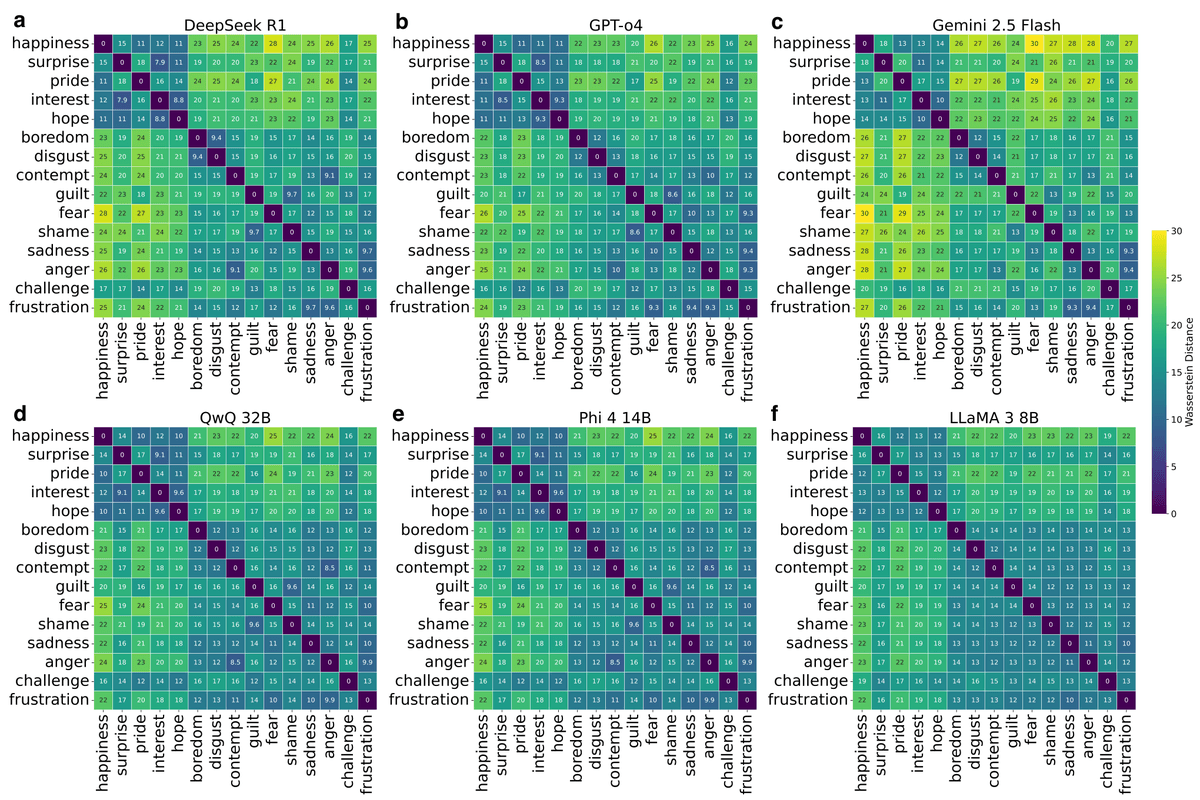
Using Wasserstein distances between the appraisal distributions of each emotion, the authors examined how emotions are organized inside each model. The answer is disappointing: valence emerges as the primary axis separating emotions across all models, with emotions clustering into positive and negative groups and no other clear basis of separation. Humans distinguish emotions along multiple cognitive axes; LLMs mostly split good from bad.
This becomes concrete in supervised classification experiments using SynthTree, an interpretable model that combines tree partitioning with local linear models. Trying to predict all 15 emotions from appraisal vectors produces uneven, unstable results. Collapsing labels into four valence-by-arousal quadrants makes performance jump substantially and become uniform across categories, confirming that appraisal geometry inside LLMs is fundamentally two-dimensional.

Culture-blind, personality-sensitive
The team ran the same prompts under two kinds of in-context personas: nationality (USA, Mexico, Nigeria, Denmark, Japan) and Big Five personality traits (high/low agreeableness, conscientiousness, extraversion, neuroticism, openness).
The results split cleanly. Cognitive appraisals from all LLMs remain statistically indistinguishable across all cultures studied, contrary to expectations from human studies. Personality personas, by contrast, produced psychologically plausible shifts: positive personas increased self-control, understanding, certainty, and pleasantness while lowering perceived obstacles, and negative personas produced the mirror image, with high neuroticism specifically amplifying perceived effort and exertion.
That asymmetry has real product implications. Building an emotionally aware assistant that adapts to a user's personality description is plausible today; building one that respects cultural context is not, at least not through in-context prompting alone.
What is fragile and what still works
The paper is careful not to say LLMs are hopeless at emotion reasoning. Several patterns line up with theory:
- Responsibility, control, and problem/obstacle appear as top cognitive dimensions across nearly every model, matching human results.
- Situational control is treated as distinct from self- or other-control, mirroring the human dual-agency structure.
- Guilt and shame are consistently linked to high self-responsibility and low enjoyment, and disgust to unpleasant but well-understood situations.
- Proprietary models (GPT-o4-mini, Gemini, DeepSeek R1) show more compact appraisal structures than open-source ones, with the top six PCs explaining roughly 80% of variance versus 50-60% for most open models.
Where things break down: fine-grained distinctions between related emotions (frustration vs. anger, hope vs. interest, shame vs. guilt), universal emotions like sadness and disgust which end up poorly predicted, and any reasoning that depends on fairness or cultural context.
Availability and what to do with it
The authors state that both the full CoRE benchmark and the analysis code will be released. The released data will include all 4,658 vanilla prompts, 274 explicit value-probing prompts, 23,290 cultural persona prompts, and 46,580 personality-based prompts, totaling 74,802 prompts, along with 448,812 model generations.
For anyone building emotionally aware applications, mental health tools, or agentic systems that need to model user state, CoRE is a useful stress test that goes beyond emotion classification accuracy. It answers a different question: does the model actually reason about why someone feels the way they do, or is it just matching keywords to labels?