
CONVAD Gives Factory AI the Words to Explain What It Flags
CONVAD adds a concept bottleneck layer to visual anomaly detection, letting models explain defects in words rather than heatmaps alone.
 Pro
Takeaways
- CONVAD adapts Concept Bottleneck Models to visual anomaly detection, adding human-readable concept explanations alongside pixel heatmaps. Paper
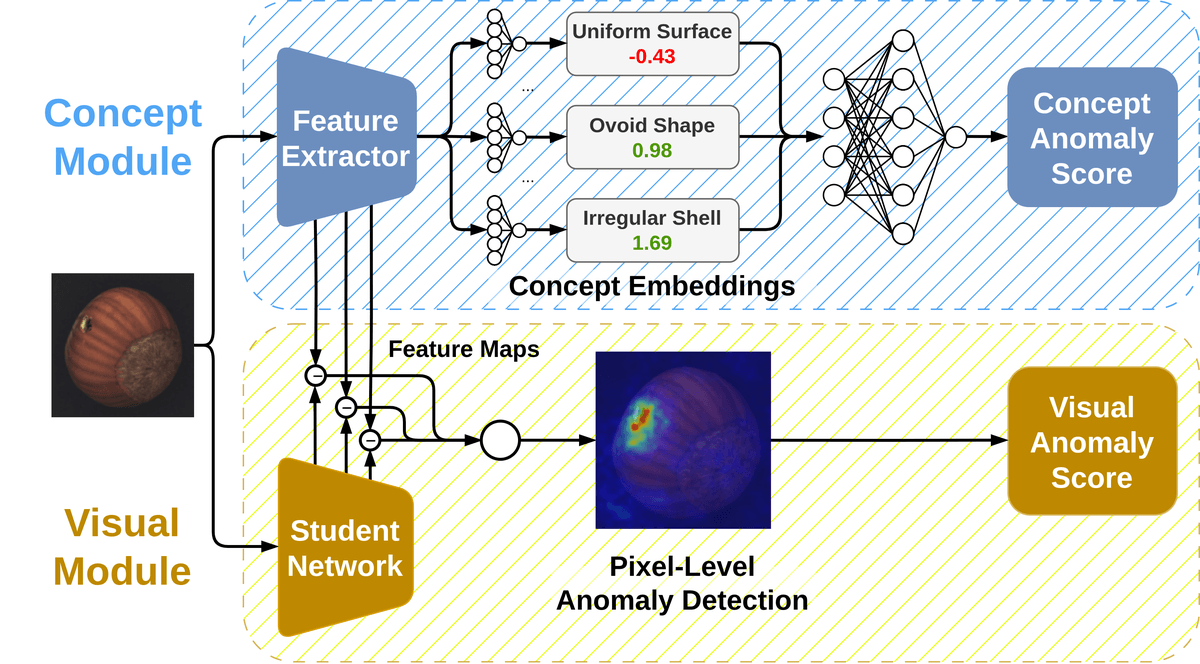
- Dual-branch architecture pairs a supervised CBM branch for concepts with a student-teacher visual branch for pixel-level localization.
- Automated VLM pipeline (Gemma3 plus CLIP) generates concept vocabularies for MVTec AD, VisA, and Real-IAD without manual annotation.
- MobileNet-v2 backbone yields 2.25M parameters and 15ms CPU inference, roughly 1000x smaller than VLM-based interpretability baselines.
- Weakly-supervised training with a few real anomalies plus synthetic ones from Nano Banana closes most of the gap to full supervision.
- Concept-level interventions let human experts fix a few predictions at test time and boost accuracy without retraining.
Factory-floor anomaly detectors are good at pointing at pixels but bad at explaining themselves. A new framework called CONVAD (Concept-Aware Visual Anomaly Detection) tries to fix that by grafting Concept Bottleneck Models onto the standard visual anomaly detection pipeline, so that a flagged image comes with a list of human-readable attributes like surface discontinuity, visible ink, or dark interior alongside the usual anomaly heatmap.
Most VAD models train only on normal images and produce anomaly segmentation masks, but those visual insights alone fail to deliver a human-understandable description of the anomaly. That is fine for a researcher squinting at a saliency map, less fine for a quality-control operator who needs to know why a part was rejected. CONVAD is the first attempt to answer that question with structured concepts rather than a large vision-language model bolted on at inference time.
Concepts as a bottleneck, not an afterthought
A Concept Bottleneck Model (CBM) is a two-stage network: an extractor g maps an image to a vector of predicted concepts, and a predictor f maps those concepts to the final label. The intermediate concept layer acts as a bottleneck, constraining the downstream prediction to depend on the input entirely through the concept predictions. That constraint is what makes the model interpretable, and it also enables something standard anomaly detectors cannot do: test-time intervention, where a human overrides a wrong concept and the label prediction updates without any retraining.
The catch is that CBMs need concept annotations, and no such labels exist for industrial anomaly datasets. The authors build them automatically with a three-step VLM pipeline:

- Context-aware list creation. A 5% sample of images is fed to Gemma3 with a Chain-of-Thought prompt that first describes the image, then extracts up to five semantic concepts per image.
- Grouping and filtering. The raw list is deduplicated by the VLM using few-shot examples, then concepts are encoded with the CLIP ViT-B/32 text encoder and near-duplicates are removed by discarding one concept from each pair exceeding a cosine similarity of 0.9.
- Automatic annotation. Each image gets binary labels for every remaining concept via a category-aware VLM prompt.
The output is a concept vocabulary that behaves sensibly: anomalous-class concepts include both general anomaly indicators such as uneven tone and surface discontinuity and fine-grained descriptors such as visible ink, dark interior, and hole, with the latter exhibiting distinct distributions across different defect types. Notably, concepts are not exclusive to normal or abnormal samples: some appear in both classes with different frequencies.
Dual branches for words and pixels
A vanilla CBM only produces sample-level predictions, which throws away the pixel localization that makes classical VAD useful. CONVAD keeps both by using a student-teacher architecture: the teacher network is pre-trained on ImageNet and fine-tuned with the CBM and downstream objectives, while the student is randomly initialized and trained to match the teacher's feature maps on normal samples only. At inference, an anomaly heatmap is computed from the discrepancy between the two networks' feature maps. The concept branch handles semantics, the visual branch handles spatial localization, and fine-tuning the teacher on concept prediction actually sharpens its features enough to beat the vanilla STFPM baseline.
The whole thing runs on MobileNet-v2. The architecture has only 2.25M parameters and a CPU inference time of 15ms per sample, which is roughly three orders of magnitude smaller than the VLM-based interpretability approaches it competes against.
What happens when real anomalies are scarce
Because anomalous samples are expensive to collect, the paper systematically benchmarks six supervision regimes, ranging from full supervision down to purely synthetic training. Synthetic defects are generated with Google's Nano Banana image editor using prompts that specify the defect type, object, and viewing conditions to preserve the original pose.

On MVTec-AD, the Fully supervised setting reaches 0.97 image-level AUROC and 0.86 concept AUROC, ahead of an unsupervised STFPM baseline at 0.88. The interesting story is in the middle: augmenting a weakly supervised dataset with synthetic anomalies produces a substantial average gain, particularly for categories like capsule, grid, and screw that contain very small anomalous regions and are hard for unsupervised baselines. Training exclusively on synthetic anomalies (SAG) works for some categories such as bottle and hazelnut but degrades on metal nut and capsule, where the generated defects miss the real distribution.
Cross-dataset results tell a similar story. On VisA the CBM branch hits 0.94 I-AUC against PatchCore's 0.93, and on Real-IAD it reaches 0.94 against SimpleNet's 0.92, despite CONVAD using a much smaller backbone than either baseline.
Human corrections that actually move the needle
The intervention experiments are where the concept bottleneck earns its keep. Using an entropy-based heuristic to pick the most uncertain concepts first, the paper shows that overriding just a handful of predictions produces meaningful jumps in accuracy on categories like screw, grid, and capsule. This mechanism allows the expert to influence the final prediction without retraining the model, leading to increased downstream task performance.
Where it falls short
CONVAD still needs concept-annotated anomalies to train, even if the pipeline generates them automatically. The concept annotation quality is uneven: on the hazelnut category the authors report 0.98 accuracy on normal concepts but only 0.71 precision and 0.72 recall on anomaly concepts, with high variance driven by diffuse features like uneven tone that are hard for a VLM to pin down. Purely synthetic training also underperforms real supervision on categories where Nano Banana cannot faithfully mimic the defect distribution, as the t-SNE analyses on metal nut make painfully clear.
Code and the generated concept datasets for MVTec AD, VisA, and Real-IAD are released as supplementary material, which should make it straightforward to slot the concept branch into an existing VAD stack and see whether the interpretability is worth the annotation cost.