
ConClu Beats Fully Supervised PointNet by Ditching Negative Samples
A joint contrasting-and-clustering framework learns global shape and local geometry from unlabeled point clouds, beating prior self-supervised baselines across three 3D tasks.
 Pro
Takeaways
- ConClu combines SimSiam-style contrasting with Sinkhorn-Knopp clustering for unsupervised 3D point cloud pre-training.
- Hits 89.6% (PointNet), 91.8% (DGCNN), 92.4% (PointNet++) linear-SVM accuracy on ModelNet40, beating OcCo and STRL.
- Improves S3DIS semantic segmentation mIoU by up to 8.2 points over random initialization.
- Uses stop-gradient to avoid negative samples, making it robust to small batch sizes unlike SimCLR.
- Optimal-transport clustering assigns points to equal-sized partitions, learning local features without labels.
- Apache-2.0 code and pretrained models available on GitHub.
Labeling 3D point clouds is one of the more painful bottlenecks in computer vision. Points are sparse, irregularly spaced, and there are usually thousands of them per scene, which is why teams have increasingly leaned on self-supervised pre-training to squeeze useful features out of raw scans before fine-tuning on a small labeled set. A method called ConClu pushes that idea forward by combining two ideas that are usually kept separate: instance-level contrasting for global shape, and point-level clustering for local geometry.
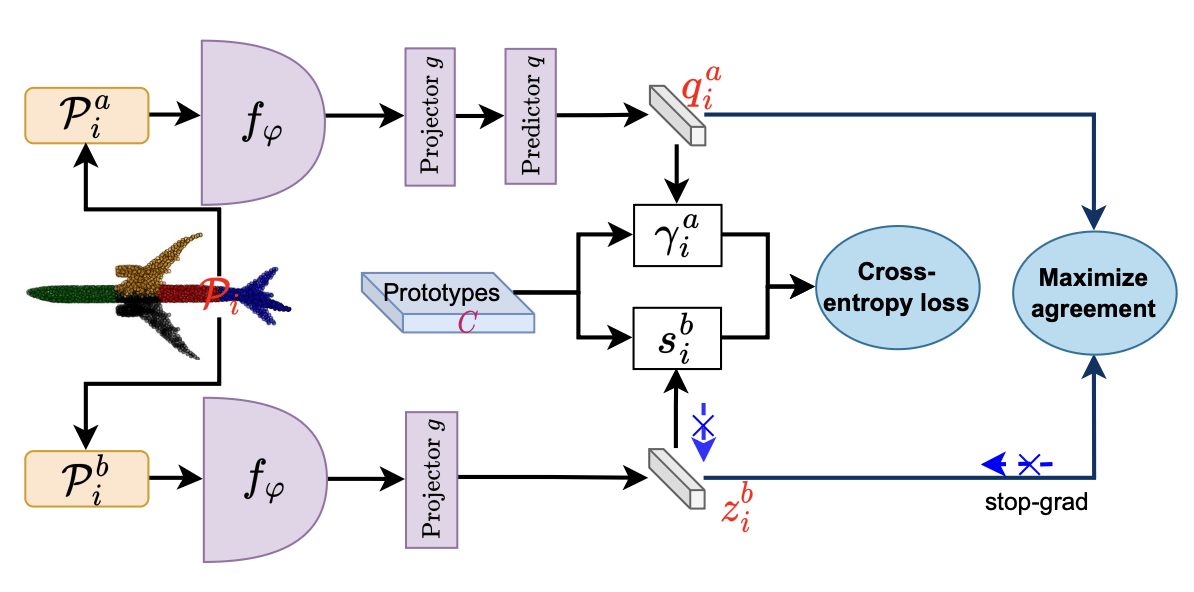
ConClu is a general unsupervised approach for point cloud pre-training that jointly performs contrasting and clustering. The contrasting branch borrows the SimSiam-style trick of maximizing similarity between two augmented views of the same cloud without needing negative samples, while the clustering branch softly segments each cloud into geometric partitions and uses those pseudo-labels to supervise per-point features.
Why point clouds need their own recipe
Prior self-supervised work on 3D data mostly split into two camps. Generative models like FoldingNet encode a cloud and try to reconstruct it, but they tend to be sensitive to rotation and translation. Contrastive methods are more robust, but they typically need large batches, memory banks, or careful negative mining to work well. On top of that, most approaches collapse the cloud into a single global embedding via pooling, which discards the local spatial structure that matters for tasks like part segmentation.
ConClu's design attacks both problems. The global branch drops negatives entirely, following BYOL and SimSiam, while the local branch adds explicit point-wise supervision through clustering.
How the two branches work
The pipeline runs two augmented views through a shared encoder (PointNet, DGCNN, or PointNet++) and splits into two objectives:
- Instance-level contrasting. Both views go through the encoder, a max-pool, and a projection MLP. A prediction MLP is applied to one branch and a stop-gradient to the other, and the model minimizes negative cosine similarity between prediction and projection. This asymmetric setup is what prevents collapse without needing negatives.
- Point-level clustering. A classification head predicts a soft assignment of each point to J geometric partitions. Prototypes are computed as weighted means of the points, distances to prototypes form a cost matrix, and pseudo-labels are recovered by solving an optimal-transport problem with the Sinkhorn-Knopp algorithm. The equal-partition constraint stops the trivial solution where every point lands in one cluster. Training alternates between updating the network with cross-entropy on the pseudo-labels and refreshing those labels, in an EM-like loop.
An orthogonal regularizer on the prototype matrix keeps the cluster centers from collapsing onto each other. After pre-training, both heads are thrown away and only the encoder is transferred downstream.
The numbers
Pre-training runs on ModelNet40 (roughly 12k CAD models, 2,048 points sampled per shape) and is evaluated across three downstream tasks. On linear-SVM classification, ConClu hits 89.6% on ModelNet40 with PointNet, 91.8% with DGCNN, and 92.4% with a PointNet++ backbone, edging out contrastive baselines like STRL and generative ones like OcCo. Notably, the PointNet result beats the fully supervised PointNet trained from scratch at 89.2%.
On ShapeNetPart part segmentation, the DGCNN backbone reaches 94.8% overall accuracy and 85.2% mIoU. On S3DIS indoor semantic segmentation, pre-training lifts DGCNN from 54.9% to 59.2% mIoU, and PointNet from 47.0% to 55.2% mIoU, a jump of more than 8 points for the smaller model.
What matters in practice
Two ablation results are worth flagging. First, the number of clusters is not fussy: performance stays within about half a point across J values from 32 to 128, with 64 chosen as the default. Second, because there are no negatives, the method is far more robust to small batch sizes than SimCLR. Dropping from batch size 48 to 8 barely moves ConClu's accuracy, while SimCLR degrades noticeably. That is a meaningful practical win for anyone pre-training on a single GPU.
Availability and limits
Code and pretrained weights are on GitHub under Apache-2.0, with a main.py entry point and PointNet/DGCNN backbones under the model directory. The framework is architecture-agnostic, so plugging in a different encoder is straightforward.
The caveats are honest ones. Pre-training happens on synthetic CAD data from ModelNet40, so gains on real-world LiDAR or messy indoor scans depend on how well those features transfer. The clustering assumes roughly equal-size partitions per shape, which is a reasonable prior for objects but a stronger assumption for large scenes. And the reported gaps over strong baselines like OcCo, while consistent, are often under a point of accuracy, so the real appeal is stability across tasks and backbones rather than a single blowout number.