
CompoSIA Crashes Self-Driving AI 173% More by Faking Rare Road Scenarios
A new driving world model separates scene layout, object appearance, and ego motion, then uses that control to break planners with a 173% collision rate spike.
 Pro
Takeaways
- CompoSIA generates driving videos with independent control over scene layout, object identity, and ego motion.
- Built as a Flow Matching DiT on top of the public Wan2.1 T2V 1.3B base model.
- Reports 17% better FVD on identity edits and 30 to 47% lower ego trajectory errors versus baselines.
- Adversarial edits push planner 3-second collision rate up 173% on nuScenes scenes.
- Noise-level identity injection allows appearance swaps from a single reference image, any pose.
- Code and weights released under MIT, ECCV 2026.
Autonomous driving stacks keep failing on the same thing: rare, weird combinations of ordinary traffic elements. A truck skids sideways in front of you while a cyclist cuts in from the right. Nothing about that scene is exotic on its own, but the combination almost never appears in real logs. A team from the University of Tokyo, Horizon Robotics, and the University of Glasgow just released CompoSIA, an ECCV 2026 driving video generator that lets you compose those edge cases on demand by pulling three levers independently: scene structure, object identity, and ego action.
The paper argues that existing controllable generators tangle these factors together, so you can nudge a scene but not surgically edit it. CompoSIA disentangles them, then uses the resulting fine-grained control to stress-test downstream planners. Across editing modalities, the average collision rate of 3s increases by 173%, which is the real headline of the work.
Why entangled control is a dead end
Safety-critical scenarios sit in the long tail of the driving distribution. You cannot log enough real miles to see them, so synthetic generation is the only scalable option. The catch is that a useful adversarial scenario usually needs precise, independent edits: keep this street, but swap the sedan ahead for a bus, and force the ego vehicle to accelerate instead of brake. Current controllable generative models provide incomplete or entangled guidance, preventing the independent manipulation of scene structure, object identity, and ego actions.

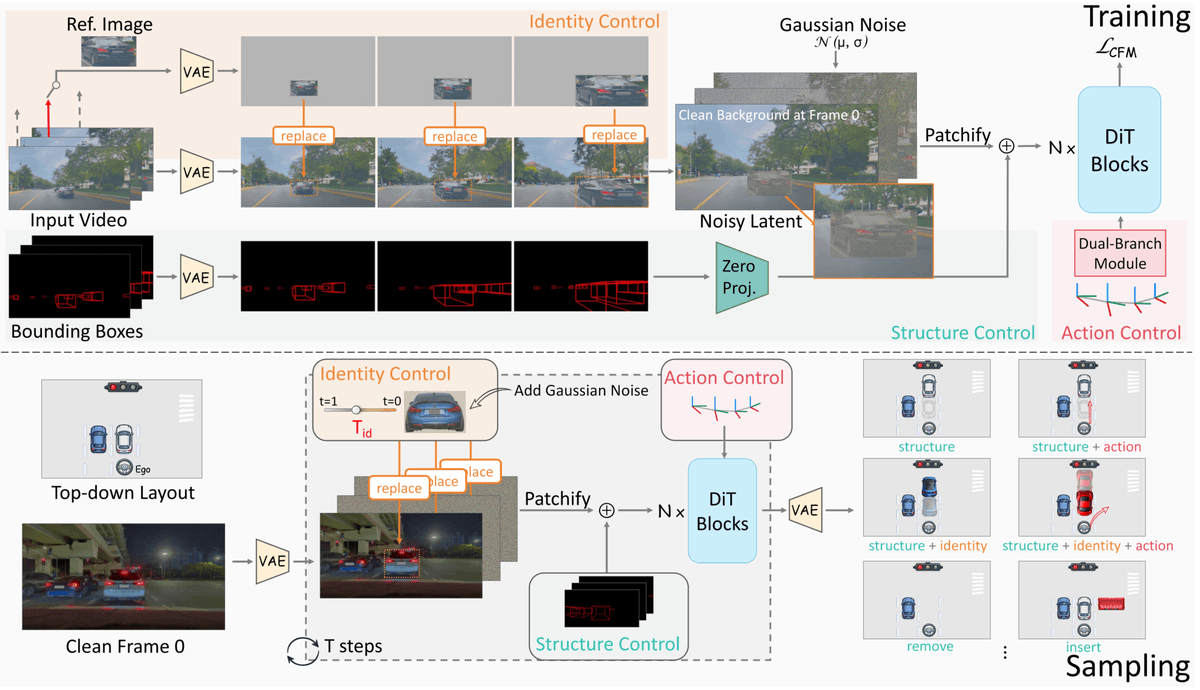
CompoSIA splits the world model conditioning into three explicit branches:
- Structure: object layout and trajectory placement, expressed through 3D bounding boxes and motion.
- Identity: the appearance and category of a specific vehicle, driven from a single reference image.
- Action: the ego vehicle's own trajectory, expressed as camera motion.
How the pieces fit together
The backbone is a Flow Matching DiT (diffusion transformer) built on the public Wan2.1 T2V 1.3B checkpoint. Flow matching is a diffusion variant that learns a velocity field between noise and data, and DiT replaces the usual U-Net denoiser with a transformer. During training, structure, identity, and ego-action signals are explicitly decomposed and injected into a Flow Matching DiT backbone in a disentangled yet compositional manner. During sampling, different combinations of conditions enable controllable driving video generation, supporting multiple editing applications.
Two ideas do the heavy lifting:
- Noise-level identity injection. Instead of conditioning on a reference image through a fixed pose, CompoSIA injects identity through the noise schedule itself. That makes the injection pose-agnostic, so a single reference image of a car can be rendered into whatever 3D pose the structure branch demands. An ablation shows the tradeoff: earlier stopping increases generation freedom but reduces similarity to the reference image, whereas later stopping enforces stronger identity preservation but increasingly anchors the generation to the reference image.
- Hierarchical dual-branch action control. Ego motion is encoded through a camera trajectory branch combined with temporal embeddings, using a PRoPE-style attention mechanism so the model can attend to both spatial pose and time. This is what drops rotation and translation errors so sharply compared to prior camera-conditioned baselines.
The numbers
Training and evaluation use the nuScenes dataset, and comparisons cover driving world models (MagicDrive-V2, Vista), general controllable video models (ReCamMaster), and driving-specific editors (DriveEditor, LoRA-Edit, TTM). The reported gains are meaningful:

- 17% improvement in FVD for identity editing. FVD (Frechet Video Distance) measures how close generated video distributions are to real ones.
- Reductions of 30% and 47% in rotation and translation errors for action control, measured against the requested ego trajectory.
- A 173% relative jump in the 3-second collision rate when planners are fed the edited adversarial scenarios versus the originals.
That last number is the point of the whole system. If you can push a planner from safe behavior to a crash by making surgical, plausible edits to a real log, you've found a real robustness gap.
What ablations reveal about the pipeline
Two ablations in the release make the disentanglement claim concrete. Without action conditioning, the ego motion becomes unstable. Without structure conditioning, surrounding vehicles fail to maintain consistent motion and spatial alignment. In other words, each branch is doing distinct work, not overlapping.
Where it breaks down
The authors are direct about limitations. Training data primarily consists of driving scenes, which restricts identity editing generalization to total out-of-distribution element categories such as animals. So you can swap a sedan for a bus, but dropping a moose into an intersection is out of scope without more diverse training video.
The other constraint is practical: the current identity editing pipeline requires specifying an approximate 3D bounding box size for the reference image during replacement or insertion, and this estimation is facilitated by a large language model such as Gemini, but the process remains semi-automatic. Expect to script around that if you want a fully automated adversarial pipeline.
Getting your hands on it
The code and model weights are released under MIT license, with paper, inference code, and model weights available and training code marked as coming. The install path is short:
conda create -n composia python=3.10 -y
conda activate composia
cd CompoSIA
pip install -r requirements.txt
The pipeline expects the Wan2.1 T2V 1.3B base checkpoint plus the released CompoSIA transformer and VAE weights, and reads nuScenes samples plus a metadata pickle. Evaluation modes for action, bounding-box, and identity edits are all configured in a single YAML, so you can start with a smoke test on a single mode before running the full battery.
For teams building AV planners, this is a tool you point at your own model to find where it silently fails. For video generation researchers, it is a useful case study in how to route multiple structured conditions into a single diffusion transformer without letting them collapse into each other. The disentanglement idea generalizes well beyond driving, and the released weights make it a reasonable starting point rather than a paper-only artifact.