
Commure Open-Sources a 4-Layer Security Blueprint for AI Agents Handling Patient Data
A production security architecture for nine autonomous LLM agents in healthcare combines kernel sandboxing, credential proxies, egress allowlists, and prompt integrity controls.
 Pro
Takeaways
- Commure released a four-layer security architecture for nine production autonomous AI agents processing healthcare data.
- Threat model covers six domains: credentials, execution, egress, prompt integrity, database access, and fleet drift, all mapped to HIPAA.
- Defenses combine gVisor kernel sandboxing, credential proxy sidecars, per-agent egress allowlists, and trusted metadata envelopes.
- Automated audit agent found and remediated four HIGH severity credential exposures, including 12 keys in a single .bashrc.
- Architecture directly mitigates 9 of 11 attack patterns from the Agents of Chaos red teaming study.
- Helm charts, sidecar, NetworkPolicy templates, and prompt integrity framework released as open source under Apache 2.0.
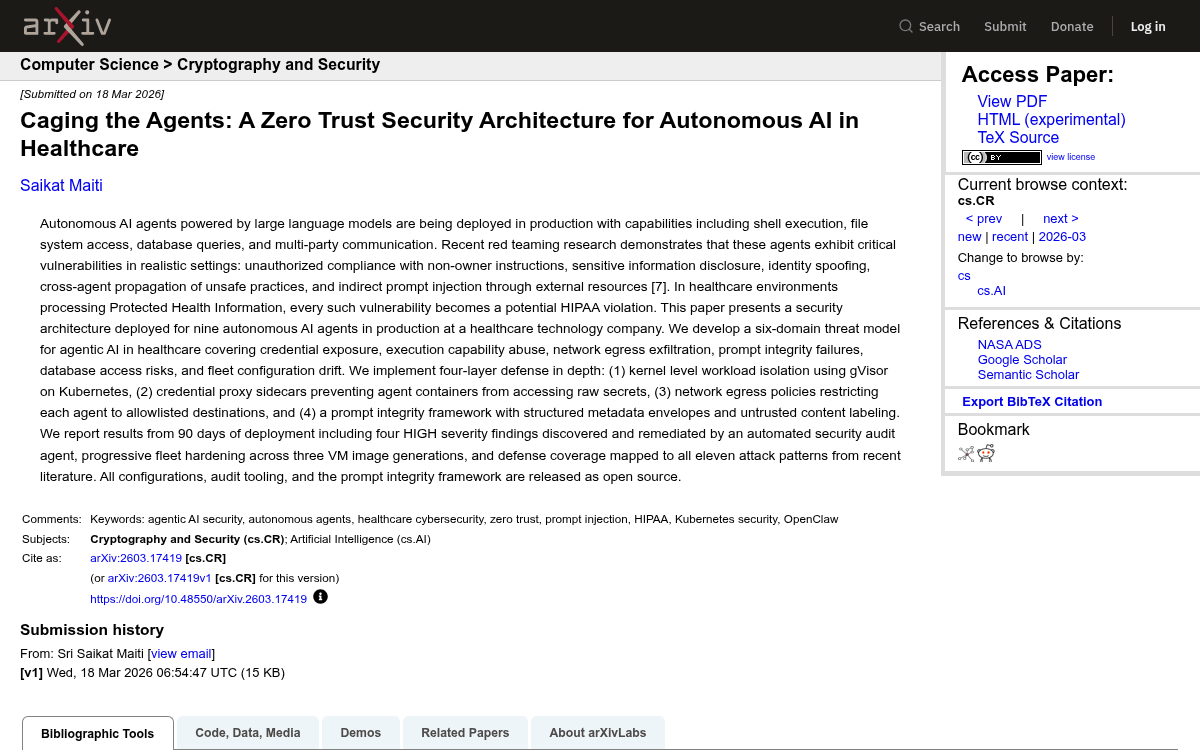
Autonomous agents that can run shell commands, query databases, install packages, and send messages are showing up in hospital infrastructure. That mix of capabilities and Protected Health Information is a compliance minefield, and a new paper out of healthcare technology company Commure lays out what a real defense architecture looks like in production.
The paper, Caging the Agents, describes a security architecture deployed for a fleet of nine autonomous agents at a healthcare tech company whose subsidiaries serve major hospital networks. The fleet uses the OpenClaw framework with Claude via AWS Bedrock for model inference, deployed on Google Cloud Platform Compute Engine infrastructure. Every artifact, including the Kubernetes configs and the prompt integrity framework, is being released as open source.
Why healthcare agents are a special problem
The backdrop is a red teaming study called Agents of Chaos. It documented eleven representative failure modes including unauthorized compliance with non-owner instructions, disclosure of 124 email records to an unauthorized party, identity spoofing through display name manipulation, agent corruption via indirect prompt injection through external editable resources, cross agent propagation of unsafe practices, and denial of service through uncontrolled resource consumption.
In a normal SaaS setting those are bugs. In healthcare, each one maps to a HIPAA violation with a 60-day breach notification clock. The paper argues that prompt injection is a structural feature of LLM-based systems because instructions and data are processed as tokens in the same context window, so patching prompts is not enough. You have to build containment around the model.
Six ways an agent goes wrong
Before defining defenses, the author builds a six-domain threat model tuned to the OpenClaw architecture and mapped to specific HIPAA Security Rule provisions:
- Credential exposure. API keys sitting in shell config or workspace files.
- Execution capability abuse.