
Columbia's Residual Copilot Fixes Robot Teleoperation Errors With Sub-Millimeter Precision
A residual copilot trained in simulation using a five-minute kNN model of the human operator improves precision assembly for both novices and experts.
 Pro
Takeaways
- Columbia and Penn researchers built a residual shared-autonomy copilot for fine-grained teleoperation: Residual Copilot.
- A kNN lookup table built from under five minutes of demos serves as the human surrogate in simulation.
- Copilot trained with PPO in Isaac Lab using domain randomization and admittance control.
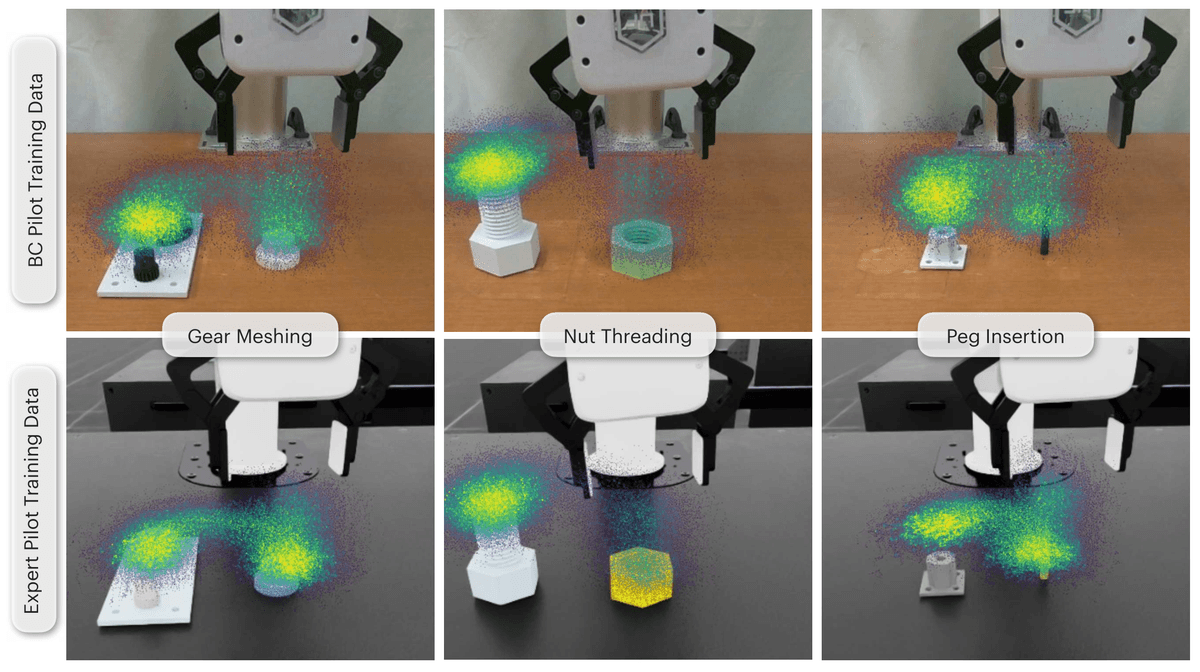
- Evaluated on nut threading, gear meshing, and peg insertion from NIST board #1 with 16 participants.
- Success improved up to 30 percent and workload dropped versus direct teleoperation and BC copilots.
- Copilot-collected data yielded 19/20 grasps vs 6/20 for downstream diffusion policies under matched successes.
Teleoperating a robot arm to thread a nut onto a bolt or mesh two gears with sub-millimeter clearance is surprisingly brutal, even for people who do it every day. Latency, awkward viewpoints, and the gap between a human wrist and a robot end-effector make the last millimeter of alignment the part that goes wrong. A team from Columbia and Penn is proposing a fix that sidesteps the usual chicken-and-egg problem in shared autonomy: Residual Copilot, a small correction policy that rides on top of teleoperation commands and cleans up contact-rich mistakes in real time.
The interesting twist is how they trained it. Learning effective assistance in simulation requires a faithful model of human behavior, which is difficult to obtain in practice. The authors propose a real-to-sim-to-real shared autonomy framework that augments human teleoperation with learned corrective behaviors, using a simple k-nearest-neighbor (kNN) human surrogate to model operator actions in simulation. Rather than training a neural network to imitate a person, they store a few minutes of teleoperation data and look up the closest match at simulation time.
Why the pilot model keeps breaking shared autonomy
Shared autonomy has two dominant flavors, and both have a self-defeating quality. The first blends operator commands with an expert autonomous policy, planner, or objective. The problem is obvious: if you already had a competent autonomous policy, teleoperation would no longer be the bottleneck. The second learns a copilot directly with reinforcement learning, which requires simulating a human sitting at the controls. Those surrogates are typically either abstract caricatures (a "laggy pilot" or a "noisy pilot") or behavioral-cloning models that are data-hungry and brittle under copilot-induced distribution shift in low-data regimes.
The paper argues that the surrogate needs two properties at once: it must stay coherent when the copilot starts pushing the system into new states, and it must be constructible from very little data, otherwise you're back to training a full autonomous policy.