
Columbia's IWS Trains Robot Policies Without Real-World Data, Matching Human Demos
Interactive World Simulator runs 10+ minutes at 15 FPS on a single GPU, letting robots train and evaluate policies without ever touching real hardware
 Pro
Takeaways
- What: Interactive World Simulator (IWS) is an open-source robot world model that runs at 15 FPS for 10+ minutes on a single RTX 4090, enabling policy training and evaluation without real hardware.
- Core tech: Uses consistency models (fast, single-step generative models) for both image decoding and latent-space dynamics prediction, avoiding the slowness of diffusion and the drift of RNNs.
- Data parity: Policies trained on 100% simulator-generated demonstrations match those trained on 100% real-world data across DP, ACT, pi0, and pi0.5 on six manipulation tasks.
- Evaluation proxy: Strong sim-to-real correlation means IWS can reliably rank policies and select checkpoints without running physical experiments.
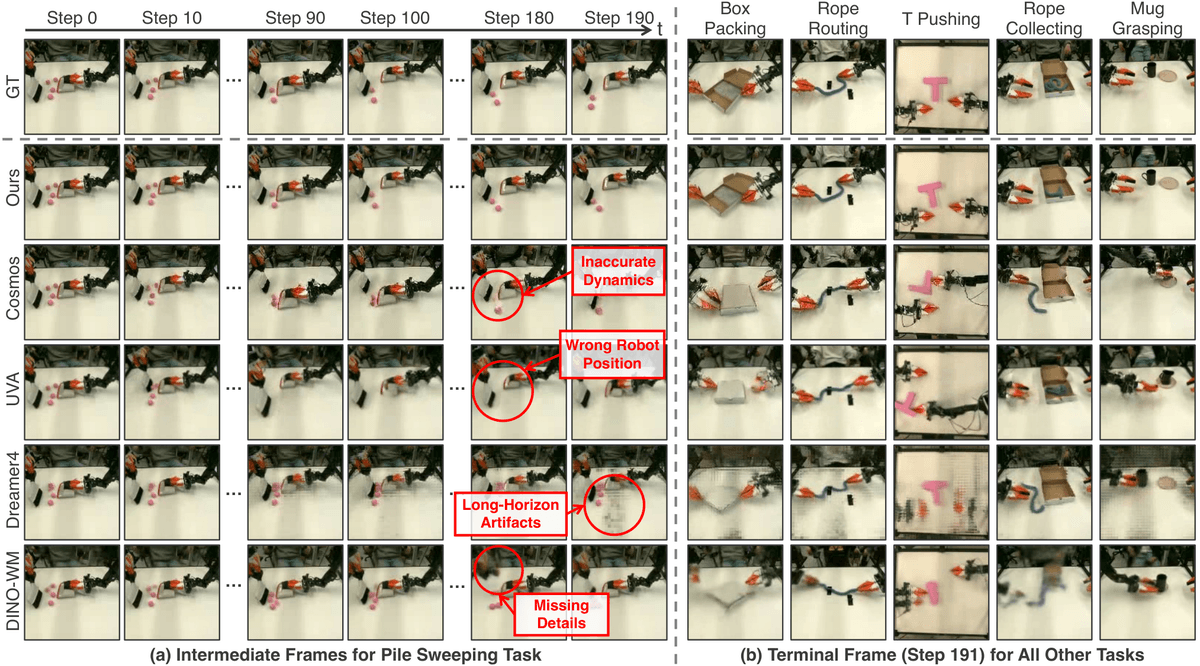
- Beats SOTA: Outperforms Cosmos, UVA, DINO-WM, and Dreamer4 on all video quality metrics (MSE, LPIPS, PSNR, FVD) over 192-step rollouts.
- Open source: Code, checkpoints, and datasets available at github.com/WangYixuan12/interactive_world_sim; minimum inference hardware is a 2080 GPU.
Training a robot policy today means one thing above all else: collecting real-world data. A human teleoperates a robot arm, records thousands of demonstrations, and hopes the resulting dataset is large enough for the policy to generalize. It is slow, expensive, and physically constrained. A new paper from Columbia, Toyota Research Institute, and Amazon proposes a different path: build a world model good enough that you never need the robot at all.
The Interactive World Simulator (IWS) is an action-conditioned video prediction framework that can simulate physically consistent robot interactions for over 10 minutes at 15 FPS on a single consumer RTX 4090 GPU. Policies trained entirely on data generated inside this simulator match the performance of policies trained on the same amount of real-world demonstrations. And when you evaluate policies inside the simulator, their scores strongly predict how they will do in the real world.
The wall that stops robot learning from scaling
The core bottleneck in robot learning is data. Imitation learning methods like Diffusion Policy (DP), Action Chunking Transformer (ACT), and the pi-series models have all shown strong results, but they depend on high-quality expert demonstrations that are scarce and expensive to collect. Classical physics simulators can be powerful, but they often require manually specifying object geometry, contact dynamics, friction, and deformation, and the resulting simulation may still have a large sim-to-real gap.
Recent video-generation and world-model methods offer a more data-driven alternative, but many are either not explicitly conditioned on robot actions, too slow for real-time interaction, closed-source, or unstable under long-horizon rollouts. Diffusion-based models like Cosmos and UVA require iterative denoising that makes real-time interaction nearly impossible on consumer hardware. State-space models like DreamerV4 accumulate errors autoregressively, causing robot pose drift over long tasks. IWS is designed to solve both problems simultaneously.
Consistency models: the key ingredient
The secret to IWS's speed and stability is consistency models (CMs). Unlike standard diffusion models that require many sequential denoising steps to generate an image, CMs are trained to map any noisy version of a sample directly back to the clean original in a single step. This makes them dramatically faster than diffusion while still capturing the multimodal distribution of possible futures -- critical for physical interactions where the same action can lead to different outcomes depending on contact.
IWS uses consistency models in two places: the image decoder and the latent dynamics model. The training proceeds in two stages:
- Stage 1 -- Autoencoder: A CNN encoder compresses RGB frames into compact 2D latent representations. A consistency-model decoder is then trained to reconstruct high-fidelity images from those latents. This stage takes about 6 hours on a single H200 GPU.
- Stage 2 -- Dynamics model: The autoencoder is frozen, and a separate action-conditioned consistency model is trained entirely in latent space. Given a sliding window of past latents and the robot's action sequence, it predicts the next latent frame. The architecture uses 3D convolutional blocks with FiLM modulation (a technique for injecting conditioning signals like actions into a neural network) and spatiotemporal attention. Stage 2 takes about 12 hours on a single H200.

At inference time, the dynamics model autoregressively predicts future latents, which are decoded into pixel-level frames. A fixed-length context window slides forward so memory and compute stay constant regardless of how long the rollout runs. One critical trick: during training, small amounts of noise are injected into the observation context so the model learns to be robust to the noisy, imperfect frames it will encounter during its own autoregressive rollouts. This is what enables stable 10-minute simulations without drift.
The model for the mug grasping task weighs only 176.02 MB, making it easy to train and infer and keeps it very accessible for the broader research community. The minimum hardware requirement for inference is a 2080 GPU.
From simulator to policy: does it actually work?
The team tested IWS on six real-world manipulation tasks using the ALOHA bimanual robot: Mug Grasping, Rope Routing, Rope Collecting, T Pushing, Box Packing, and Pile Sweeping. These cover rigid objects, deformable objects (rope), and object piles -- a deliberately challenging spread. Real-world data collection for each task takes around six hours for a single person, which is a manageable scale for most research labs. About 600 episodes of play data were collected per task to train each world model.
The key experiment: collect the same number of expert demonstrations inside the simulator (via teleoperation) and in the real world, then train four imitation policies -- DP, ACT, pi0, and pi0.5 -- on each. The results are striking. Policies trained on world-model-generated data perform comparably to those trained on the same amount of real-world data. Specifically, DP achieved 87.9% task score on 100% simulator data versus 90.3% on 100% real data. ACT actually scored slightly higher on simulator data (76.2%) than real data (73.6%).

The team also tested data scaling: does adding more simulator demonstrations improve policy performance the same way real data does? Training on 5 to 100 episodes from both sources showed consistent, parallel improvement curves. The world simulator data scales just like real data.
A reliable evaluation environment
The second major use case is policy evaluation. Real-world evaluation is slow: every trial requires manual resets, careful initial conditions, and a human watching the robot. IWS enables controllable, reproducible evaluation at scale. Policies evaluated both within the world models and in the real world across diverse tasks show a strong correlation between simulated and real-world performance.
The correlation is strong enough to be practically useful. If one policy substantially outperforms another inside the simulator, it is likely to do so in the real world. This means researchers can use IWS to select checkpoints and compare methods without running real-world experiments for every candidate -- a significant reduction in iteration cost.

How it stacks up against the competition
IWS was benchmarked against Cosmos, UVA, DINO-WM, and Dreamer4 on 192-step (19.2 second) rollouts across all tasks. The results across standard video quality metrics:
| Metric | IWS (Ours) | DINO-WM | Dreamer4 | Cosmos |
|---|---|---|---|---|
| MSE (lower is better) | 0.005 | 0.028 | 0.012 | 0.019 |
| LPIPS (lower is better) | 0.051 | 0.270 | 0.163 | 0.224 |
| PSNR (higher is better) | 25.82 | 17.79 | 20.81 | 18.91 |
| FVD (lower is better) | 243 | 1752 | 1747 | 799 |
IWS wins across every metric by a wide margin. Qualitative comparisons show that baselines suffer from robot pose drift, inaccurate object dynamics, and accumulated artifacts over long rollouts, while IWS maintains physically plausible interactions throughout.
What it cannot do yet
IWS is not a general-purpose simulator. Each world model is trained on a specific task with a specific robot setup, requiring roughly 600 episodes of play data and 18 hours of training per task. The model operates at 128x128 pixel resolution, which is sufficient for most manipulation tasks but may limit applicability to tasks requiring fine-grained visual detail. The sim-to-real correlation, while strong, shows a slight positive bias -- policies tend to score a bit higher in the simulator than in the real world -- so IWS should be treated as a ranking tool rather than an absolute performance predictor. Generalization to entirely new environments or robot morphologies is not yet demonstrated.
Getting started
The full codebase, pretrained checkpoints, and datasets are available on GitHub, with data hosted on Hugging Face. The repo includes scripts for keyboard and ALOHA robot teleoperation, stage 1 and 2 training, and a local interactive demo. The paper was accepted to RSS 2026. There is also a project page with a browser-based demo you can control with your keyboard.
For teams working on manipulation policies who are bottlenecked by data collection or evaluation cost, IWS represents a concrete, accessible path forward. The combination of open-source code, lightweight models, and consumer GPU requirements makes it one of the more practical world model frameworks to come out of the robotics research community in recent memory.