
Columbia's CuriousBot Touches Hidden Objects to Beat Vision AI by 2.5x
CuriousBot gives a legged robot the ability to open, push, lift, and flip its way through unknown spaces using a live 3D object graph and an LLM planner
 Pro
Takeaways
- CuriousBot is a legged robot system that physically interacts with its environment (pushing, lifting, flipping, opening) to discover hidden objects, achieving 82% average success rate vs. 32% for the best VLM baseline.
- The core innovation is a live 3D Relational Object Graph encoding five spatial relations (on, inside, behind, under, of) plus obstruction flags for occluded regions.
- The pipeline chains SLAM + YOLO-World/SAM + GPT-4o planner + six manipulation primitives in a closed loop, updating the graph after every action.
- On tasks like flipping boxes and pushing objects, every VLM baseline (LLaVa, Gemini, GPT-4o) scored 0%; CuriousBot scored 70-80%.
- Key limitations include no dynamic scene memory after interactions, hand-tuned skill heuristics, and sensitivity to SLAM drift and open-vocabulary detection errors.
- Code is coming soon; paper and videos are available at the project page and arXiv.
Most robots that explore a room do so by looking around carefully. CuriousBot, a new system from researchers at Columbia University and the Robotics and AI Institute, takes a different approach: it touches things. The system equips a Boston Dynamics Spot quadruped with the ability to push chairs, open cabinets, lift cloth, and flip boxes, all in service of finding out what is hidden underneath, behind, or inside them. The result is a robot that achieves an 82% overall success rate across five real-world exploration tasks, compared to 32% for the best vision-language model baseline.
Why looking is not enough
Current mobile exploration methods primarily focus on active perception rather than active interaction, limiting the robot's ability to interact with and fully explore its environment. Think of a camera sweeping a room: it can map what is visible, but a closed cabinet or a box-covered object stays invisible forever. Existing robotic exploration approaches via active interaction are often restricted to tabletop scenes, neglecting the unique challenges posed by mobile exploration, such as large exploration spaces, complex action spaces, and diverse object relations.
The closest prior work, RoboEXP, explored interaction-driven scene understanding but was confined to tabletop settings. Scaling that idea to a full room introduces three new problems the authors had to solve:
- Expanded exploration space: a mobile robot covers far more ground than a fixed arm, requiring navigation and mapping at room scale
- Complex occlusion relationships: real environments have objects hidden on, under, behind, inside, and in front of other objects simultaneously
- Larger action space: the robot needs both navigation and a diverse set of manipulation skills to handle whatever it encounters
The map that knows what it cannot see
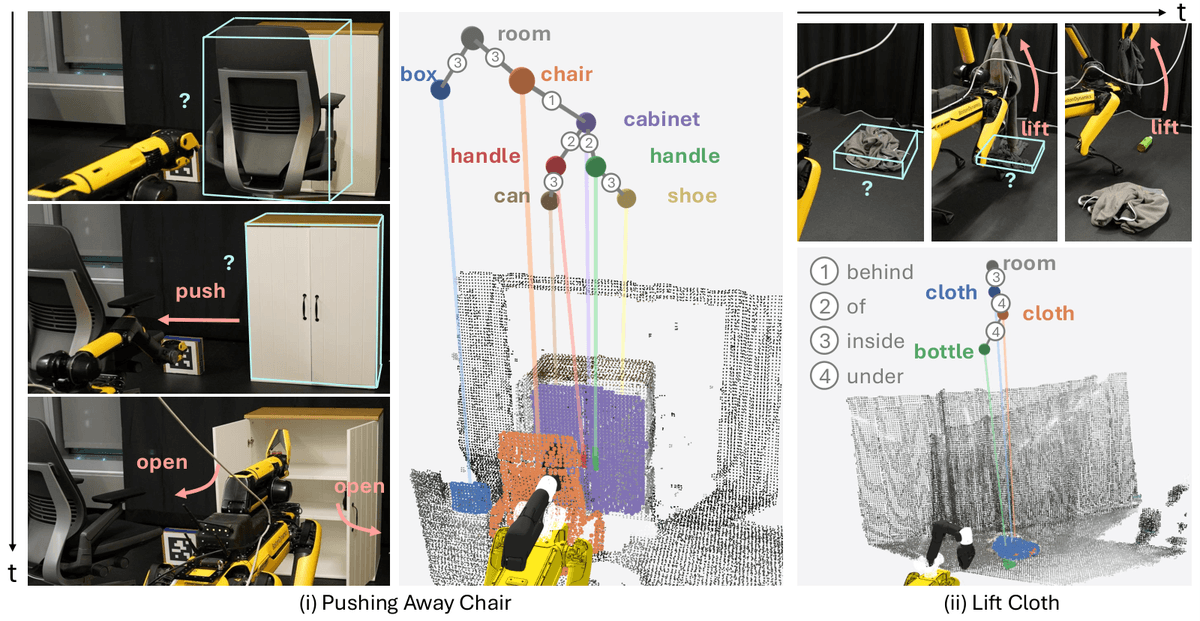
The core innovation is the 3D Relational Object Graph, a live data structure that encodes not just where objects are, but how they relate to each other and whether they are blocking something. The system can construct an actionable 3D relational object graph that encodes both the semantic and geometric information of object nodes, along with various object relationships, and perform manipulation tasks by retrieving objects through traversal of the actionable 3D relational object graph.
The 3D relational object graph comprises object nodes containing both geometric and semantic information, as well as object edges that encode complex object relations. Each node stores a point cloud, surface normals, and a semantic label. Each edge encodes a directed spatial relationship: on, inside, behind, under, or of. Crucially, nodes can be flagged as obstructions when the robot's voxel map detects a large unknown region behind them, telling the planner that something is probably hidden there.

Four modules, one curious robot
The pipeline has four stages that run in a loop:
- SLAM (Simultaneous Localization and Mapping): the robot uses RTAB-Map with an RGB-D camera to track its own position and build a 3D map of the room in real time, running at roughly 3 Hz
- Graph Constructor: YOLO-World detects objects open-vocabulary (no fixed class list), SAM segments them, and the system fuses detections across frames using 3D bounding-box IoU matching. Edges are added either from geometry (a box sitting on a shelf gets an
onedge) or from interaction (opening a cabinet reveals aninsideedge) - Task Planner: the graph is serialized as plain text using a depth-first traversal, with
[obstruction]tags appended to blocked nodes. GPT-4o reads this text and selects the next skill to execute. The authors show that this explicit 3D representation outperforms feeding raw images to a VLM, because the graph makes topological relationships explicit rather than forcing the model to infer them from pixels - Low-Level Skills: a library of six primitives executes the plan:
open,flip,lift,push,sit, andcollect. Each skill uses the geometric data in the graph to ground itself in the real world, for example, using PCA on the handle point cloud to determine the cabinet door's hinge axis before grasping
After each skill, the graph is updated and the obstruction flag is cleared on explored nodes, preventing the robot from revisiting the same spot.

Numbers that matter
The team ran five tasks, each repeated ten times under different initial conditions, on a Boston Dynamics Spot equipped with a RealSense 455 camera. They compared against LLaVa, Gemini, GPT-4o, and a simple heuristic baseline. The metrics were success rate, Object Recovery (fraction of hidden objects found), and Graph Edit Distance (GED, how many node/edge edits are needed to match the ground truth graph).
| Task | Best VLM | CuriousBot |
|---|---|---|
| Flipping Boxes | 0% | 80% |
| Opening Drawers | 80% | 80% |
| Checking Underneath | 60% | 90% |
| Pushing Boxes | 0% | 70% |
| Lifting Cloth | 100% | 90% |
| Average | 32% | 82% |
The gap is especially stark on tasks requiring non-obvious interactions. For flipping boxes and pushing boxes, every VLM baseline scored 0%, while CuriousBot hit 70-80%. The one task where a VLM matched or beat the system was lifting cloth, where GPT-4o reached 100% success, likely because the visual signal for a cloth-covered object is straightforward from an image alone.
An ablation on the number of few-shot examples fed to the LLM planner showed that dropping from 7 examples to 1 caused success rate to collapse from 89% to 11%, underscoring how sensitive the planner is to prompt quality.
Where it still struggles
The failure breakdown across all runs points to three culprits:
- Perception failures: imprecise SLAM drift and open-vocabulary detector errors produce wrong object graphs, which cascade into bad plans
- Decision failures: even with a correct graph, the LLM planner occasionally picks the wrong skill for a given node
- Action failures: real-world manipulation is unforgiving; early gripper release, loose grasps, and unexpected collisions between the robot body and objects all cause rollout failures
The authors also note a deeper architectural limitation: the system does not update the 3D scene graph dynamically after each interaction, meaning it cannot track objects that move unexpectedly during manipulation. Skill acquisition also still requires experienced roboticists to hand-tune heuristics through trial and error, which limits how quickly new skills can be added.
What this unlocks
The practical payoff is a robot that can autonomously prepare a scene for downstream tasks. The system can perform manipulation tasks by retrieving objects through traversal of the actionable 3D relational object graph. Concretely, once the exploration graph is built, the same representation can be queried to find and retrieve a specific object, even if it was hidden at the start. This matters for applications like warehouse inspection, household assistance, or search-and-rescue, where the robot cannot assume it knows what is where before it starts.
Code is listed as coming soon on the project page, which also hosts videos of all six task types. The paper is published in IEEE Robotics and Automation Letters and was supported by the DARPA TIAMAT program and the Toyota Research Institute. The modular design means the GPT-4o planner can be swapped for any stronger LLM as they become available, making the system a reasonable foundation to build on rather than a one-off demo.