
Columbia Proves Why Brains and AI Naturally Build Clean, Organized Thinking Maps
A new proof shows that supervised training forces neural networks to disentangle latent variables into orthogonal subspaces at every global optimum.
 Pro
Takeaways
- Columbia team proves abstract, disentangled representations must emerge at global minima of supervised feedforward training. Paper
- Method reformulates weight optimization as a mean-field problem over the distribution of neural preactivations.
- Result is proven for finite-width ReLU networks and extended to broader activation families and deep architectures.
- Learned axes align with task-relevant latent variables, matching semantics of input stimuli.
- Extends prior empirical work by Johnston and Fusi (2023) on multi-task disentanglement.
- No code released; guarantees hold at global optima and for feedforward, not recurrent or transformer, models.
A trio of theorists at Columbia's Center for Theoretical Neuroscience has answered a question that has been sitting between neuroscience and machine learning for years: why do trained networks, both artificial and biological, tend to organize task-relevant variables into clean, roughly orthogonal directions in activity space? Their answer is a mathematical guarantee. The paper proves that these so-called abstract representations must appear in the hidden layer of feedforward nonlinear networks whenever the network is trained on tasks that depend directly on those latent variables.
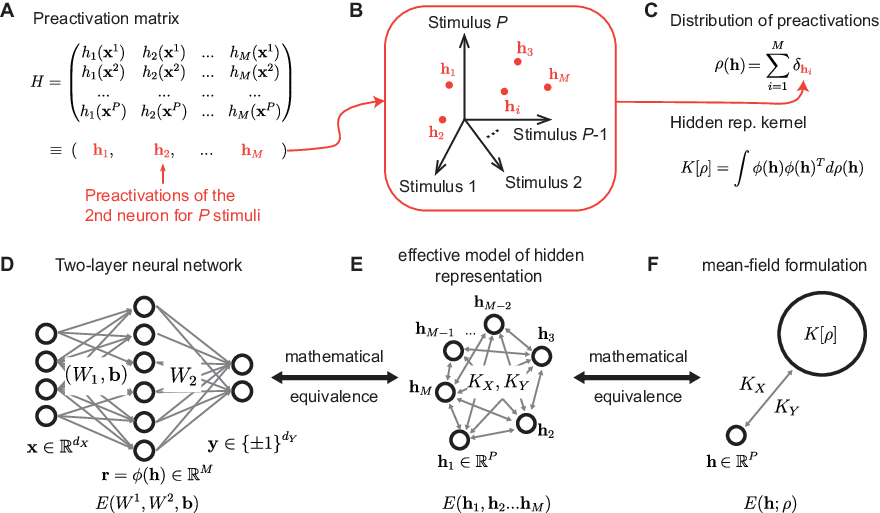
Bin Wang, W. Jeffrey Johnston, and Stefano Fusi reframe the usual weights-based optimization problem as a mean-field problem over the distribution of neural preactivations, then show that every global minimum of the task loss lands on a representation where the underlying factors are disentangled. It is a result that ties together brain-imaging observations, disentanglement research in ML, and the theory of feature learning in wide networks.
The puzzle behind disentangled brains
Recent experiments in neuroscience reveal that task-relevant variables are often encoded in approximately orthogonal subspaces of neural population activity. These disentangled, or abstract, representations have been observed in multiple brain areas and across different species. In plain terms, if a monkey is judging both the parity and the magnitude of a stimulus, you can find one direction in its neural activity that tracks parity and a nearly perpendicular direction that tracks magnitude, so a simple linear readout can recover either variable without interference.

These geometries matter because they support out of distribution generalization and rapid learning of novel tasks. But the mechanisms by which such geometries emerge remain poorly understood, and the mechanisms that have been investigated are typically unsupervised (e.g., based on variational auto-encoders). Supervised learning, which is closer to how animals actually train on behavioral tasks, had no comparable theory.
From empirical hint to mathematical proof
The empirical version of this story is a couple of years old. In a 2023 Nature Communications paper, Johnston and Fusi showed that the learning of multiple tasks causes abstract representations to emerge, using both supervised and reinforcement learning. That work demonstrated the effect through simulation and predicted where in the brain to look for it, but it did not explain why the geometry must appear.
The new paper closes that gap. The authors reformulate the usual optimization over the network weights into a mean field optimization problem over the distribution of neural preactivations. They then apply this framework to finite-width ReLU networks and show that the hidden layer of these networks will exhibit an abstract representation at all global minima of the task objective. The trick is treating each hidden unit not as an individual parameter to be tuned, but as a sample from a distribution over possible preactivation patterns, which turns a nonconvex weight-space problem into a tractable optimization over that distribution.
What the proof actually delivers
The technical contribution has three layers:
- An exact mapping. The framework establishes an exact mapping from the original network model to an effective model whose degrees of freedom are the neural preactivation patterns on training data.
- A guarantee for ReLU. For finite-width two-layer ReLU networks, every global minimum of the loss yields a hidden-layer representation in which the latent variables of the task sit in orthogonal subspaces.
- Generality. The analyses are extended to two broad families of activation functions and deep feedforward architectures, demonstrating that abstract representations naturally arise in all these scenarios.
Crucially, the learned geometry is not arbitrary. These abstract representations reflect the structure of the desired outputs or the semantics of the input stimuli. So the axes of the internal representation line up with the variables the task actually cares about, which is exactly the property that makes downstream few-shot generalization work.
Why it matters beyond neuroscience
For anyone working on interpretability, disentanglement, or transfer learning, the result reframes a familiar empirical observation as a structural property of task-driven optimization. A few implications worth noting:
- Disentangled features do not require a specialized objective like a beta-VAE. Plain supervised loss, given the right task structure, is sufficient.
- The mean-field-over-preactivations reformulation is a general analytical toolkit. The authors describe it as a mathematically tractable toolkit for understanding the emergence of different kinds of representations in task-optimized, feature-learning network models.
- It provides theoretical grounding for why probing methods often find clean linear directions for semantic variables inside trained networks.
Caveats and what is missing
This is a theory paper, not a release. There is no accompanying code repository or trained model on the arXiv listing, and the guarantees apply at global minima of the task loss on tasks whose targets depend directly on the latent variables. Real-world training rarely reaches a true global optimum, and many practical tasks involve latent factors that are correlated or only weakly identifiable from the labels. The paper also focuses on feedforward architectures, so the extension to recurrent networks or transformers, where representations arise from attention dynamics rather than a fixed forward pass, is still open.
Still, moving abstract representations from an intriguing empirical pattern to a provable consequence of supervised training is a real shift. It suggests that the geometry the brain uses to generalize and the geometry that trained networks converge to are not coincidences of architecture or objective choice, but a shared endpoint of optimizing for tasks that carve up the world along meaningful axes.