
Columbia Finds DINOv3 Predicts Human Object Perception at 0.83 Correlation
A psychophysics benchmark shows DINO-trained vision transformers group objects like humans, and Gram matrix distillation transfers that skill to supervised models.
 Pro
Takeaways
- Self-supervised DINOv3 ViT-B predicts human object-grouping reaction times at 0.83 of the noise ceiling, beating supervised backbones.
- New benchmark: 72 subjects, 1020 two-dot same/different trials on COCO images with eye tracking.
- Object-centric AUC (patch affinity vs. object boundaries) correlates with behavioral alignment at Spearman r=0.95.
- Distilling the DINOv3 Gram matrix into supervised ViTs boosts grouping accuracy by 8 to 18 points without hurting ImageNet.
- CLS-token distillation gives zero behavioral gain, isolating patch-level similarity structure as the active ingredient.
- Code and data are open source, usable as a drop-in evaluation for vision backbones.
A team from Columbia, Stony Brook, and collaborators just ran a large psychophysics experiment against modern vision backbones and found something concrete about why self-supervised transformers feel closer to human perception than their supervised cousins. When people decide whether two dots on a photo sit on the same object, their reaction times track almost exactly with the patch similarity structure inside DINO-family models. And the specific property that drives the alignment, the Gram matrix of pairwise patch similarities, can be transplanted into supervised models with a simple distillation loss.
The gap between grouping and classifying
Object grouping, deciding which pixels belong together as a single thing, is something the human visual system does effortlessly and something classifiers were never really trained to do. Recent work has shown that self-attention weights in supervised vision transformers perform some perceptual grouping, and self-distillation training like DINO, DINOv2, and DINOv3 produces attention maps that contain explicit information about semantic segmentation of foreground objects and their parts. The open question was whether that emergent segmentation actually matches how humans perceive scenes, not just how well it matches annotator labels.
Prior studies mostly used clean, isolated stimuli with clear Gestalt cues. Previous work with the two-dot paradigm was limited in scale, for example using 24 hand-selected images depicting two instances of either a vehicle or an animal. This paper scales that paradigm up dramatically and uses it as a benchmark.
The two-dot benchmark
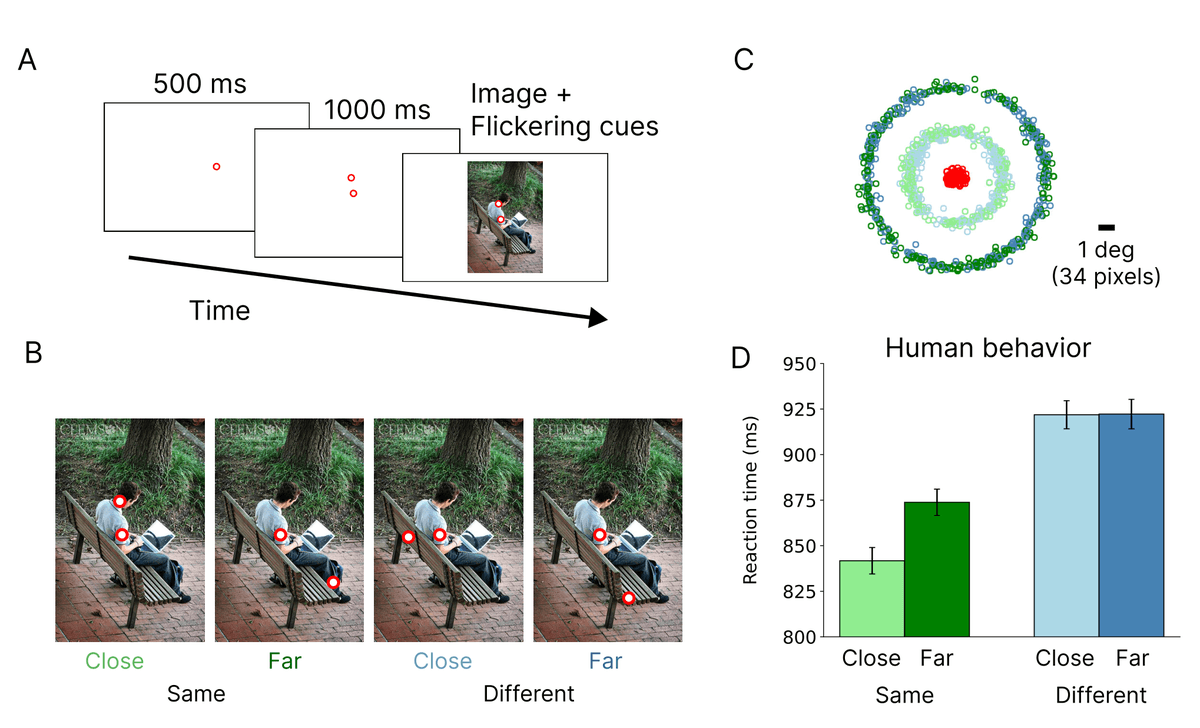
72 undergraduate students participated, with mean age 20.4 years, all with normal or corrected-to-normal vision. Each trial shows a natural image with two dots. One dot is at the center, the other is peripheral, and subjects press a button indicating whether the dots are on the same object or two different objects. Reaction time is the signal.

The stimuli come from COCO2017 validation images, filtered so a center object overlaps a second object, with four dot placements per image covering same-close, same-far, different-close, and different-far conditions. After manual quality filtering, 255 experimental images yielded 1020 trials. Gaze was tracked at 1000 Hz and trials with fixation breaks were dropped.
Two well-known human signatures show up cleanly in the data:
- Same-object advantage: subjects respond faster when both dots sit on the same object.
- Distance interaction: for same-object trials, close dots are faster than far ones; for different-object trials, distance barely matters.
How the models are scored
Nine models are evaluated, spanning ViT-Base and ConvNeXt-Base architectures trained under DINO self-distillation, MAE reconstruction, and supervised ImageNet variants. The scoring pipeline is deliberately simple: extract patch features at the two dot locations, concatenate them, and train a two-layer MLP readout to predict either the same/different label or the z-scored reaction time. The MLP for grouping is trained on roughly 30,000 auto-generated COCO training trials, then evaluated on the 1,020 held-out human trials.
For reaction-time prediction, they use 10-fold nested cross-validation and normalize each model's Spearman correlation by a human noise ceiling estimated by splitting subjects in half 20 times.
DINOv3 pulls away from the pack
The ordering across metrics is remarkably consistent. On grouping accuracy, DINOv3 ViT-B reaches 91.9%, considerably above supervised transformers sharing the same architecture, suggesting the training objective rather than architecture alone drives object-centric representations. MAE lands in the middle. On normalized reaction-time correlation, DINOv3 ViT-B hits 0.83, DINOv2 0.77, and supervised ViTs cluster around 0.59.
| Model | Grouping acc. | Norm. r vs humans |
|---|---|---|
| DINOv3 ViT-B | 91.9 | 0.83 |
| DINOv2 ViT-B | 89.0 | 0.77 |
| DINOv3 ConvNeXt-B | 86.7 | 0.76 |
| MAE ViT-B | 80.7 | 0.74 |
| DINO ViT-B | 76.5 | 0.71 |
| IN21k ViT-B (sup.) | 72.2 | 0.59 |
| IN1K ConvNeXt-B (sup.) | 60.0 | 0.47 |
The distilled DINOv3 ConvNeXt is a useful data point: a convolutional backbone can reach transformer-like alignment if it inherits the right feature structure, so architecture is not destiny.
A metric for object-centricity
To explain the ranking, the authors introduce an object-centricity score. For each patch, compute cosine similarity to every other patch, giving an affinity map. Threshold that map at many values and measure how quickly the true-positive rate (patches within the ground-truth object) rises versus the false-positive rate (patches outside it). The area under this ROC curve becomes the metric.

Across the nine models, object-centric AUC and behavioral alignment correlate at Spearman r=0.950, p=0.0001. In other words, the more a model's patch similarities respect object boundaries, the better it predicts human reaction times. The relationship holds across both transformer and convolutional backbones.
Gram matrix distillation is the mechanism
The most actionable finding is that this object-centric structure can be transferred. The authors fine-tune four supervised models (IN1K/IN21k ViT-B and ConvNeXt-B) on ImageNet classification while adding a Gram MSE loss that pushes the student's pairwise patch cosine-similarity matrix toward that of DINOv3 ViT-B. Only the last block is fine-tuned, and the training combines CrossEntropy classification loss with weight 1 and a Gram MSE loss with weight 10.
The effects are large and consistent:
- Grouping accuracy gains of roughly 8 to 18 percentage points.
- Object-centric AUC rises toward DINO-level values.
- Behavioral alignment improves across all four models, with transformers benefiting more than ConvNeXt.
- ImageNet top-1 accuracy is unchanged relative to fine-tuned baselines without the Gram loss, confirming improvements are not from altered classification performance.
A control experiment nails down what is doing the work. Instead of matching the Gram matrix, they tried distilling only the CLS token embedding from the same DINOv3 teacher. CLS distillation showed no improvement in behavioral alignment (IN21k ViT-B stayed at 0.59, IN1K ViT-B moved from 0.59 to 0.58), while Gram distillation moved the same models to 0.72 and 0.70, isolating patch-level correlation structure as the active ingredient. Global image embeddings are not enough. The pairwise patch structure is what matters.
This converges with the design of DINOv3 itself, where Gram anchoring was introduced as a training signal to preserve dense feature quality. This paper provides independent behavioral evidence that the same structural property is what makes representations look human-like.
What you can do with it
The code and behavioral data are on GitHub, which makes this benchmark drop-in for anyone evaluating vision backbones.
Concretely, this is useful if you are:
- Building perception systems for robotics, AR, or driver assistance where segmenting the right thing under ambiguity matters more than classification top-1.
- Stuck with a supervised backbone for licensing or infrastructure reasons and want DINO-like dense features without swapping models.
- Doing vision-language work where token similarity structure feeds into downstream attention or retrieval.
- Comparing model families and want a cheap behavioral proxy beyond ImageNet accuracy.
The limitations worth naming: the benchmark measures reaction times on 2D COCO scenes, so it does not probe 3D, motion, or occlusion reasoning. And there is still a gap between DINOv3 and the human noise ceiling, meaning object-centricity explains a lot but not everything about how people perceive scenes.