
Colorado State Researchers Map Engineering's Data Deserts to Unlock AI Benchmarking
A new framework maps out where engineering design datasets exist, where they're missing, and how a knowledge graph can make them discoverable.
 Pro
Takeaways
- Colorado State researchers propose a Map of Datasets for engineering design and systems engineering.
- Taxonomy classifies datasets by domain, lifecycle stage, data type, and format for faceted discovery.
- Working prototype uses a knowledge graph linking datasets to their tools and publications.
- Analysis identifies data deserts in early-stage design and system architecture research.
- Data oases exist in predictive maintenance and autonomous systems, where benchmarks are richer.
- Paper submitted to ASME IDETC 2026; sustainability of the resource remains an open problem.
Machine learning has thrived in computer vision and NLP largely because of shared benchmark ecosystems like ImageNet, GLUE, and COCO. Engineering design and systems engineering never got that treatment. A new paper from researchers at Colorado State University argues that the field is drowning in data but starving for accessibility, and proposes a structured way to fix it.
The paper, A Framework and Prototype for a Navigable Map of Datasets in Engineering Design and Systems Engineering by H. Sinan Bank and Daniel R. Herber, lays out a taxonomy and a working knowledge graph prototype to catalog engineering datasets across the entire system lifecycle.
The benchmark gap in engineering
While the "digital thread" has the potential to drive innovation, the fragmented and inaccessible nature of existing datasets hinders method validation, limits reproducibility, and slows research progress. Unlike fields such as computer vision and natural language processing, which benefit from established benchmark ecosystems, engineering design research often relies on small, proprietary, or ad-hoc datasets.
The "digital thread" here refers to the continuous flow of data generated as a product moves from requirements definition, through conceptual design, into manufacturing, operations, and eventual disposal. In Engineering Design and Systems Engineering (EDSE), this shift has produced a significant volume of data spanning the entire system lifecycle, from requirements definition and conceptual design to manufacturing, operations, and disposal. The problem is that most of this data sits in silos, behind NDAs, or as one-off releases attached to individual papers, making it nearly impossible to benchmark new methods against prior work.
A taxonomy with four axes
The core contribution is a classification scheme. The framework is built upon a multi-dimensional taxonomy designed to classify engineering datasets by domain, lifecycle stage, data type, and format, enabling faceted discovery. Instead of dumping datasets into a flat list, the taxonomy lets someone filter by, say, "structural CAD files during the conceptual design stage in aerospace," which is closer to how engineers actually search.
The four axes are:
- Domain: the engineering field (aerospace, automotive, energy systems, and so on)
- Lifecycle stage: where in the system's life the data was produced (requirements, design, manufacturing, operations, disposal)
- Data type: what the data represents (sensor time series, geometry, requirements text, simulation output)
- Format: the file or schema (CSV, STEP, URDF, RDF, and so on)
A knowledge graph as the discovery engine
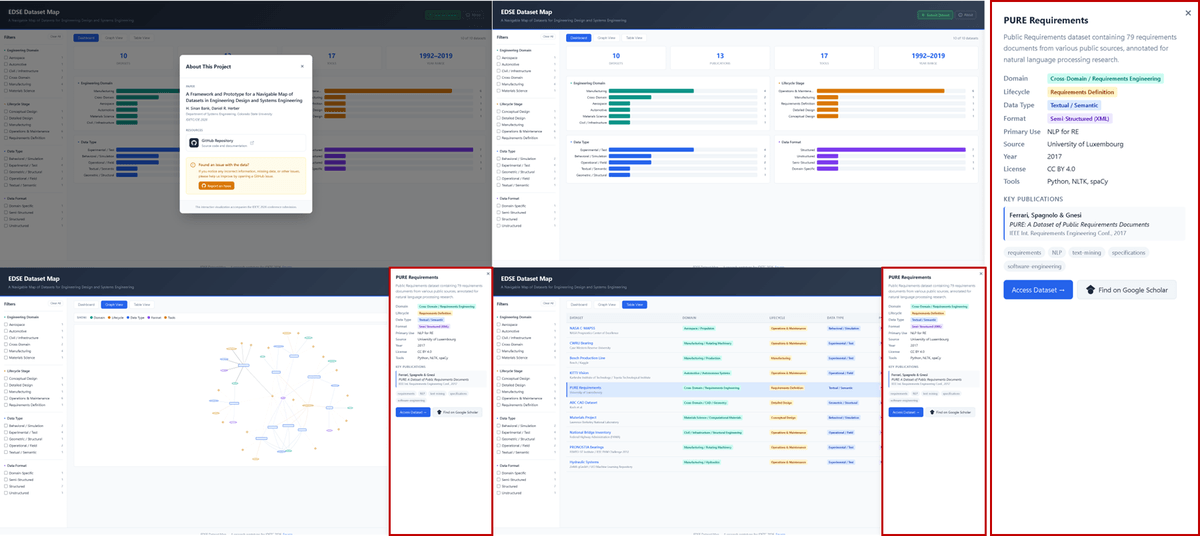
The prototype goes beyond taxonomy. An architecture for an interactive discovery tool is detailed and demonstrated through a working prototype, employing a knowledge graph data model to capture rich semantic relationships between datasets, tools, and publications.
A knowledge graph represents entities as nodes and their relationships as labeled edges. In this context, a dataset node can be linked to the tools that produced it, the publications that used it, and the other datasets it derives from or complements. That means a researcher looking at a predictive maintenance dataset can trace back to the simulation tool that generated it, or forward to every paper that has benchmarked against it, without leaving the interface.
Deserts and oases
Applying the framework to the current landscape produced the most concrete finding in the paper. An analysis of the current data landscape reveals underrepresented areas ("data deserts") in early-stage design and system architecture, as well as relatively well-represented areas ("data oases") in predictive maintenance and autonomous systems.
That result is a roadmap for anyone deciding where to invest research effort. Predictive maintenance and autonomous systems have accumulated enough public data that generative and discriminative models can be trained and compared meaningfully. Early-stage conceptual design and system architecture, by contrast, are still evaluated on hand-picked case studies, which is exactly why claims about "AI-driven design" are hard to validate.
What it is useful for
The framework is most immediately useful for a few concrete tasks:
- Finding a comparable dataset when starting a new EDSE method paper, without a week of Google Scholar spelunking
- Identifying gaps worth filling with a new dataset release, which now has a defensible "this is a data desert" justification
- Linking a dataset to the tools and papers around it, so downstream reproducibility becomes tractable
- Providing program managers and funders with a landscape view of where public data actually exists
Limits of a prototype
This is a framework paper with a working demonstration, not a released product. The paper identifies key challenges in curation and sustainability and proposes mitigation strategies, laying the groundwork for a dynamic, community-driven resource to accelerate data-centric engineering research. The honest read is that maps like this only stay useful if a community maintains them, and history is full of dataset registries that went stale within two years. The paper acknowledges this directly and proposes mitigation strategies, but the sustainability problem is not solved on paper.
The abstract does not indicate a public code release or a hosted version of the prototype, and the HTML version of the manuscript is currently the main artifact available. The work has been submitted to ASME IDETC 2026, so a more complete release may follow.
The real contribution
The headline is a dataset map, but the underlying move is treating engineering datasets as first-class citizens in a semantic graph, on par with tools and publications. That framing is what makes it possible to ask questions like "which datasets have never been reused outside their originating lab" or "which lifecycle stages have zero public benchmarks in aerospace." Those questions are the precondition for engineering design to develop the kind of shared measurement culture that made modern ML progress possible in the first place.