
Colorado School of Mines Exposes Why AI Gaze Trackers Stay Dangerously Overconfident
A new probabilistic metric and post-training calibration step fix the biased confidence scores that eye-tracking models produce when deployed outside their training set.
 Pro
Takeaways
- Paper shows appearance-based gaze models produce biased uncertainty estimates that overfit the training distribution. Read it here.
- Introduces coverage probability error (CPE), a strict metric comparing predicted vs actual confidence intervals.
- Proposes a post-training calibration step using a nonparametric regressor fit on a small target-domain sample.
- Reduces CPE variance across MPIIGaze and RTGene, including cross-dataset transfer scenarios.
- Also lowers angular prediction error because the corrected distribution escapes the Gaussian assumption.
- Architecture-agnostic recipe: bolt onto any probabilistic gaze model with left/right eye ResNet branches.
Gaze tracking models can tell you where someone is looking, but for anything safety related, like a driver monitoring system, knowing how confident the model is matters just as much as the prediction itself. A team from the Colorado School of Mines has published a paper arguing that the uncertainty estimates coming out of today's appearance-based gaze trackers are systematically wrong, and they propose both a proper way to measure that wrongness and a lightweight recipe to correct it.
The confidence problem no one is measuring
Appearance-based gaze tracking predicts yaw and pitch angles directly from eye images. It is a task full of uncertainties, and factors such as appearance of subjects, lighting conditions, and camera parameters can greatly affect the model's performance. To handle this, modern systems output a probability distribution rather than a single number, typically a Gaussian where the variance stands in for confidence.
The catch: because there are no individual uncertainty labels, current approaches acquire uncertainties by following distributions in the training dataset, and without regulations this lets the uncertainty model build biases and overfit the training data, leading to poor performance when deployed. In plain terms, the model learns to look confident on faces that resemble its training set and stays overconfident on everything else. Worse, the field has largely evaluated these variances using loose proxies rather than checking whether the stated confidence intervals actually contain the true gaze angle at the promised rate.
A stricter yardstick: coverage probability error
The first contribution is an evaluation metric borrowed from statistical forecasting. For any nominal confidence level (say 90%), you check the fraction of test samples where the true gaze angle actually falls inside the predicted interval. If the model is well calibrated, those two numbers match. If not, the gap is the coverage probability error (CPE).

The plot above shows the failure mode clearly: when the model claims 90% coverage, the true observations only fall inside the interval about 82% of the time. That 8-point gap is invisible to standard angular-error metrics but catastrophic for any downstream system that trusts the confidence score.
Fixing it after training with a nonparametric regressor
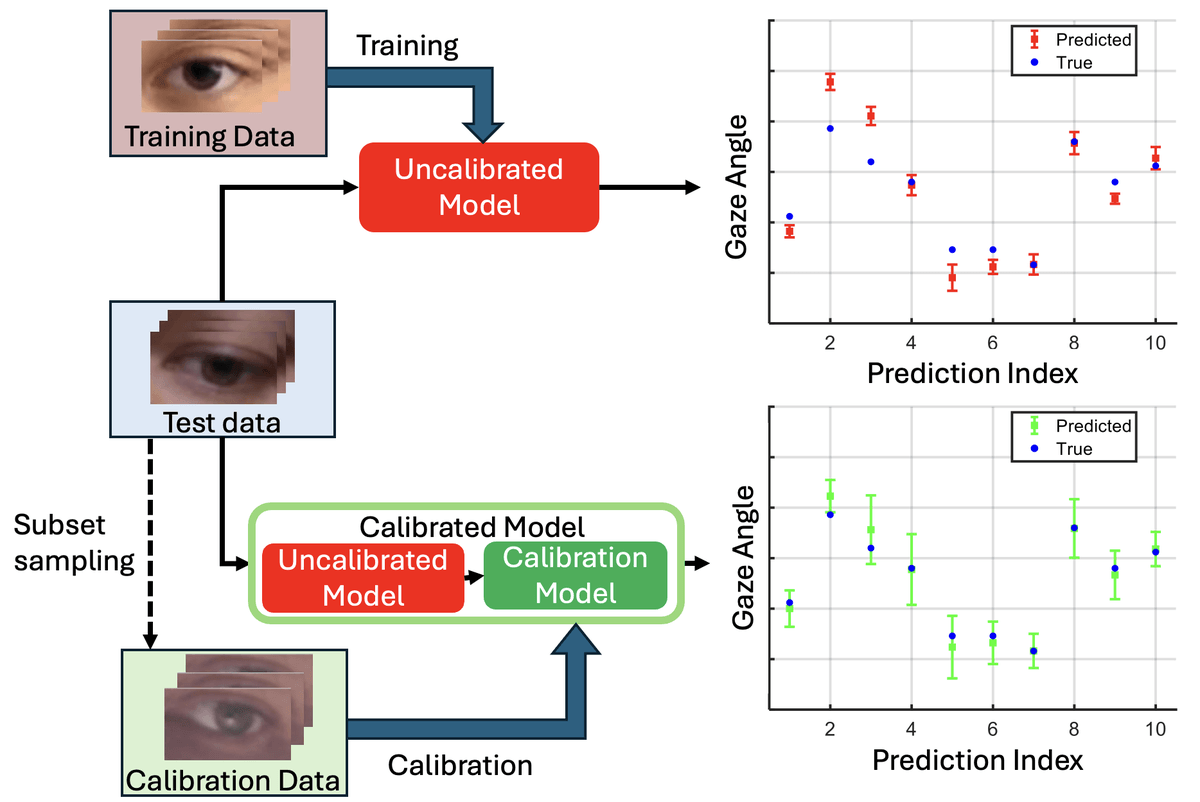
The second contribution is a correction strategy. Rather than retraining the whole network, the authors treat calibration as a small, separate step performed with a slice of deployment-domain data.
The base architecture is straightforward. The uncertainty-aware model takes inputs of left and right eye patches together with head angles to output two normal distributions describing the gaze angle estimates, where mean values are angular estimates and variances represent uncertainty. Two ResNet branches process the eyes, their features concatenate with the head pose, and fully connected layers produce yaw and pitch means plus variances.

The calibration step works like this:
- Collect a small subset of testing data to learn the model's error behavior.
- Fit a nonparametric regressor that maps the model's stated cumulative probability to the empirically observed cumulative probability.
- At inference time, route the raw Gaussian output through the regressor to get a corrected distribution.
The nonparametric choice matters. The original Gaussian distribution assumption may not necessarily agree with the true distribution, but the nonparametric correctional regressor allows the post-calibration model to take any distribution, allowing closer resemblance to the true distribution.
What the numbers show
The team ran experiments on MPIIGaze and RTGene, two gaze datasets with visibly different image characteristics. Samples in RTGene are much noisier than MPIIGaze images, which lets the authors test both in-distribution and cross-dataset generalization.
Two findings stand out:
- Performances of uncalibrated models on uncertainty accuracy are much less consistent compared to the calibrated model. The CPE spread collapses across all four train/test scenarios after calibration.
- Angular prediction errors also experienced noticeable drops, an improvement brought by the nonparametric nature of the correctional regressor. Because the corrected distribution is no longer forced to be Gaussian, its median tracks the true angle better than the original mean did.

Where this actually helps
The paper does not release code or weights, but the technique is architecture-agnostic. If you already have a probabilistic gaze model, you can bolt on the calibration regressor with a few hundred labeled samples from your deployment domain.
The practical wins are in systems that already consume uncertainty as a signal: driver drowsiness detection that suppresses warnings when confidence drops, AR/VR foveated rendering that widens its render region under uncertainty, and human-robot interaction pipelines that fall back to other cues when gaze becomes unreliable. The limitation worth noting is that calibration requires a labeled sample from the target domain, so this is not a zero-shot fix; if you have no ground-truth gaze data in production, you still cannot correct the bias.
Beyond gaze specifically, the broader point generalizes to any regression task that outputs a variance and never verifies it. Coverage probability error is cheap to compute and hard to game, and it exposes a class of silent failure that RMSE will never catch.