
Cohere Labs Finds VLM Encoders, Not Scale, Break Spatial Reasoning
A controlled study inside LLaVA shows that swapping image encoders shifts spatial reasoning more than architecture tweaks, and neither fully fixes it.
 Pro
Takeaways
- Controlled LLaVA study isolates why VLMs fail at 2D spatial reasoning.
- Image encoder choice drives spatial performance more than positional encoding tweaks.
- AIMv2-based LLaVA beats CLIP, SigLIP, and SigLIP2 variants on most spatial benchmarks.
- Adding 2D rotary positional encoding helps inconsistently, sometimes degrading CV-Bench scores.
- Frontier models like Qwen2.5-VL lead but still fail unevenly across spatial tasks.
- Scaling and general multimodal training do not reliably translate into spatial grounding.
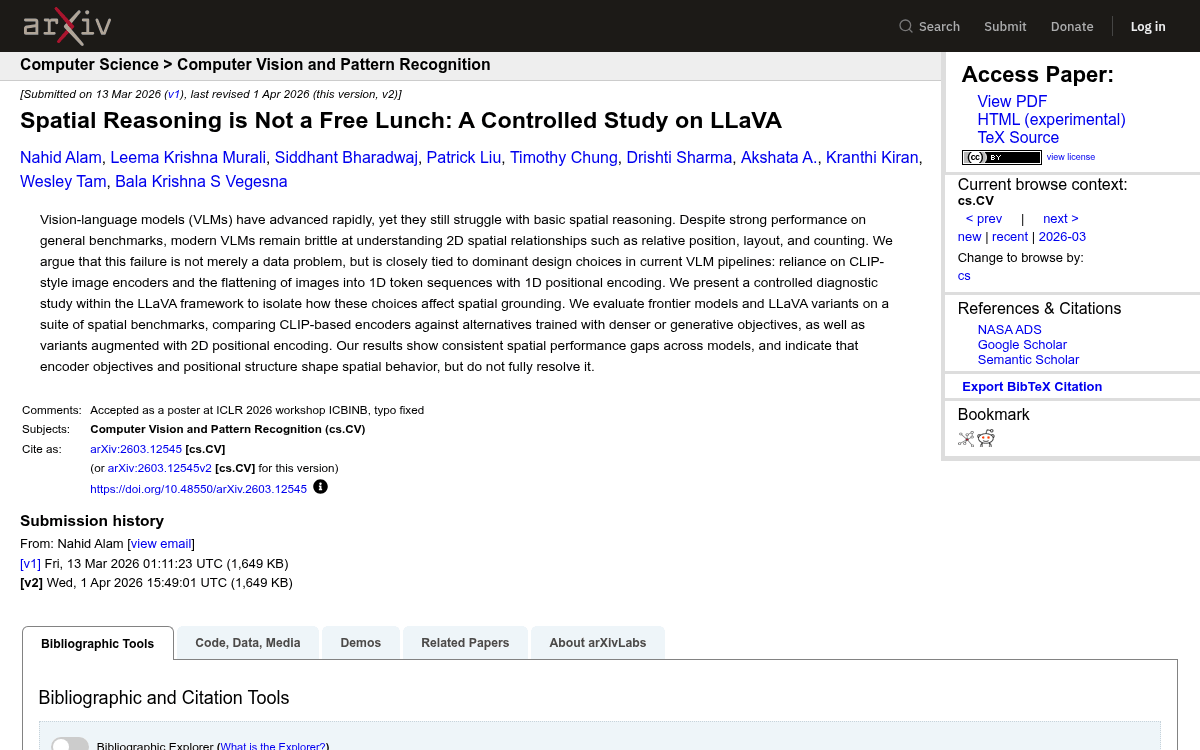
Vision-language models can describe a photo, answer trivia about it, and pass reading-comprehension tests on charts, but ask them whether the chopsticks are to the left or right of the bowl and things get shaky. A new diagnostic paper from Cohere Labs Community and EleutherAI collaborators, Spatial Reasoning is Not a Free Lunch, tries to figure out why, by holding almost everything constant inside the LLaVA pipeline and changing only the pieces suspected of breaking spatial grounding.
The headline finding is uncomfortable for anyone hoping scale alone will solve this: spatial performance remains uneven across tasks and models, indicating that spatial grounding is not consistently captured by general-purpose training and scaling. Even the frontier VLMs tested trade wins task by task, with no model dominating.
Why VLMs keep tripping over left and right
The authors point at two design choices that almost every modern VLM inherits. First, the image encoder. Modern vision-language models almost universally rely on large pre-trained image encoders such as CLIP and SigLIP, and these encoders are trained to match a whole image to a caption, not to preserve where things sit in the frame. While this paradigm has driven progress on captioning and VQA, it does not explicitly optimize for structured spatial representations. Prior work shows that CLIP-style encoders emphasize semantic alignment while underperforming on fine-grained and spatially grounded tasks.
Second, the fusion step. Once image patches meet text tokens, most VLMs flatten the 2D grid into a 1D sequence and apply 1D rotary positional embeddings (RoPE), the same trick used for text. That collapse throws away the fact that patch 17 sits directly above patch 33, not just 16 positions away. Qwen2-VL introduced multimodal RoPE that keeps row and column indices separate, but nobody had cleanly isolated how much that positional structure actually helps.
The controlled swap
The setup is deliberately boring, which is the point. All experiments are conducted within the LLaVA framework. Controlled LLaVA-1.5 (7B) variants are constructed by swapping the image encoder while holding the language backbone and training pipeline fixed. Four encoders were compared: CLIP, SigLIP, SigLIP2, and Apple's AIMv2, each trained both with standard 1D RoPE and with a 2D variant.
Unlike standard 1D RoPE, 2D-RoPE encodes both horizontal and vertical patch indices and is applied to query and key projections during multimodal attention. Training followed the standard two-stage LLaVA recipe of projection pretraining then full instruction tuning, on 256x256 images, using the original LLaVA data. That constraint matters when reading the numbers.
Encoders matter more than positional tricks
Across seven spatial benchmarks (MMVP, CV-Bench 2D, TallyQA, GQA, VSR, TopViewRS, and CountBenchQA), a clear ranking emerged among the controlled variants:
- LLaVA-AIMv2 yields the most consistent improvements over the CLIP-based LLaVA baseline, achieving the best LLaVA scores on CV-Bench 2D Overall, TallyQA, and CountBenchQA.
- LLaVA-AIMv2-2D-RoPE further improves MMVP and achieves the best LLaVA score on VSR.
- SigLIP and SigLIP2 variants were more erratic, winning some tasks and losing badly on others.
- Adding 2D-RoPE was a coin flip: it helped AIMv2 on MMVP and VSR, and SigLIP on GQA, but hurt the CLIP baseline and CV-Bench scores for AIMv2.
The takeaway the authors push is that spatial failures in VLMs are strongly coupled to the visual backbone: encoders optimized primarily for global image-text alignment do not reliably support spatial reasoning, while encoders trained with denser or generative objectives can improve spatial outcomes within the same multimodal framework.
The frontier is not saving you either
Alongside the controlled variants, the paper benchmarks Qwen2.5-VL, LLaVA-NeXT, LLaVA-OneVision, SmolVLM2, Gemma3-4b-it, PaliGemma2, and Molmo in the 2B to 8B range. Qwen2.5-VL comes out ahead most often, leading on MMVP, CV-Bench 2D, VSR, TopViewRS, and CountBenchQA, but no single model wins everywhere and scores on tasks like TopViewRS (top-down map reasoning) top out under 0.46 for the whole field. Qualitative bounding-box tests reinforce the pattern: LLaVA-AIMv2 draws tighter boxes around a cup of green liquid or scattered green onions than LLaVA-SigLIP2, which often lands in roughly the right neighborhood but misaligned.
What this study actually delivers
This is a diagnostic paper, not a new model release. There is no checkpoint to download that solves spatial reasoning, and the authors are explicit that preserving 2D positional structure alone is not sufficient; spatial grounding depends jointly on the visual features learned by the encoder and the positional structure used during multimodal fusion. The real contribution is showing, under a fixed language model and training pipeline, that swapping encoders moves spatial metrics meaningfully while a fashionable architectural fix moves them unpredictably.
A few caveats worth keeping in mind before applying this to your stack:
- Images were resized to 256x256, which the authors flag as a confounder that deserves its own controlled study.
- DINOv2 and SigLIP2 with NaFlex (flexible resolution) were left for future work, both plausible candidates to push spatial numbers higher.
- The scope is static 2D reasoning only. 3D and video spatial reasoning are outside the paper.
- Absolute scores for the controlled 7B variants still sit well below the best frontier models, so the results are directional, not a recipe for a state-of-the-art build.
If you are training a VLM where object counting, relative position, or bounding-box grounding matters, the practical read is straightforward: your encoder choice is probably doing more work than your positional encoding scheme, and CLIP-style pretraining is likely leaving spatial signal on the floor. Encoders with denser or generative objectives are a better starting point, but you should still expect to measure spatial capability directly rather than assume general benchmark gains transferred.