
Cognitive Biases Inside 6G AI Agents Are Quietly Destroying Network Performance
Researchers show that LLM agents managing 6G networks inherit human-style cognitive biases, then demonstrate mitigation techniques that cut latency 5x and boost energy savings ~40%.
 Pro
Takeaways
- Tutorial catalogs 14 cognitive biases inherited by LLM agents managing 6G networks, with math formulations and mitigations.
- Anchoring mitigation via Truncated Weibull randomization lifts energy savings from 12% to 25% peak.
- A 1B-parameter local SLM hits 0.95 s mean inference, fitting non-RT RIC timescales without cloud LLMs.
- Debiased collective memory with inflection bonus yields 5x latency reduction and 38.25% median energy savings.
- Ablations quantify contribution of each memory term: 42%, 28%, and 35% degradations when removed.
- Bias mitigation introduces token, state, latency, and signaling costs that must be partitioned across O-RAN layers.
Autonomous network management is quietly shifting from rule-based scripts and reinforcement-learning controllers to LLM-powered agents that perceive telemetry, reason with memory, negotiate across domains, and act through APIs. A new tutorial paper argues that this shift comes with a hidden liability: the same cognitive biases that distort human judgment show up inside agentic 6G systems, and they materially degrade latency, energy, and fairness outcomes. The authors also publish the paper alongside two open-source use cases that quantify how much those biases cost and how far targeted mitigations can go.
Why KPI chasing is not enough
The telecom automation stack has climbed TM Forum's maturity ladder from script-based Level 1 to analytics- and AI-assisted orchestration at Level 3, but the optimization loop still fixates on numerical KPIs. Those metrics are imperfect proxies for the real objectives, a failure mode captured by Goodhart's Law: when a measure becomes a target, it ceases to be a good measure. The proposed remedy is agentic AI, where LLM-powered agents perceive multimodal telemetry directly, reason over history, and negotiate across RAN, edge, and core domains rather than chasing scalar scores.
The catch is that these agents inherit systematic distortions from their training data, prompts, and interaction patterns. Prompts are a primary entry point for bias, where framing effects skew perception. For instance, prompting a network agent to maximize throughput at all costs can lead to a solution that ignores critical latency or fairness metrics.
A taxonomy built for network control
The tutorial catalogs fourteen well-studied biases and maps each one to concrete telecom failure modes. A few stand out:
- Confirmation bias: an xApp queries only low-load cells for PRB allocation, ignoring high-load ones.
- Anchoring bias: an energy optimization agent sticks to default power despite high SINR allowing lower settings.
- Availability heuristic: a fault predictor overreacts to three recent XnAP resets, ignoring long-term failure rates.
- Automation bias: an xApp propagates erroneous rApp fault detection without verification.
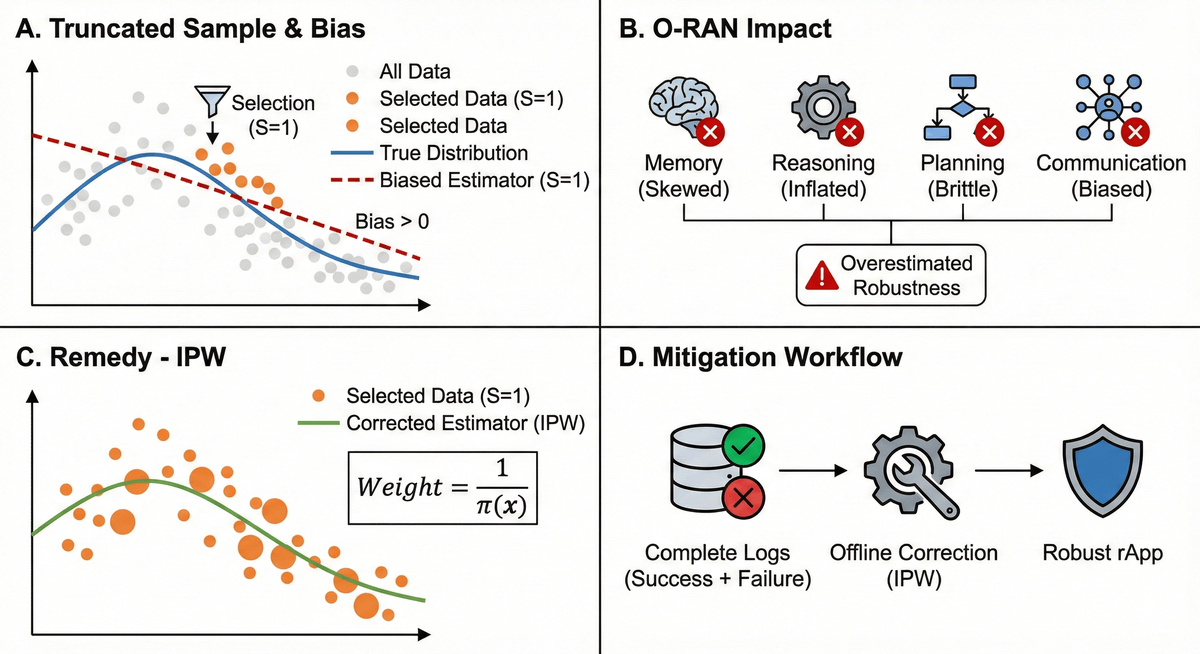
- Survivorship bias: a slice-scaling rApp trained only on successes ignores failure modes.
For each bias the paper gives a compact mathematical formulation (e.g., anchoring as a regularized utility with a deviation penalty against an initial proposal, availability as salience-weighted sampling) and pairs it with mitigation primitives drawn from statistical learning: importance weighting, multi-horizon fusion, entropy regularization, softmax-based trust calibration, and diversity objectives.
Use case one: dismantling anchoring in slice negotiation
The first experiment tackles anchoring in RAN bandwidth negotiation between an eMBB and a URLLC slice sharing 60 MHz, with tail-latency SLAs of 50 ms and 10 ms respectively. To avoid the response times of distant commercial LLMs, the agents are powered by a locally hosted small language model, the lightweight otel-llm-lb-it, achieving sub-second inference latencies with a 0.95 s mean. That is enough to fit inside the non-real-time RIC control loop.
The mitigation replaces a deterministic anchor (the minimum bandwidth needed to meet the CVaR SLA) with a randomized one drawn from a slice-specific Truncated 3-Parameter Weibull distribution. Rather than generic uniform randomness, an exponential penalty is applied to greedy demands by tuning a shape parameter of 5.0 for URLLC and 2.0 for eMBB. URLLC gets a tightly peaked, safety-first distribution; eMBB gets a wider exploratory one.
The payoff is measurable. The randomized strategy intelligently consumes the eMBB slack, allowing latency to gracefully explore the boundary up to 25 ms, translating into massive efficiency gains. The Weibull strategy shatters the rigid 12% energy savings wall of the deterministic model, pushing median system-wide energy savings to roughly 17.5% and peaking at 25%. URLLC still stays comfortably under the 10 ms tail-latency ceiling.
Use case two: an unbiased collective memory
The second experiment targets temporal and confirmation biases in a RAN-edge cross-domain negotiation, this time using Gemini Flash 2.5 as the reasoning backbone. Agents share a memory of past strategies, but a vanilla vector store systematically over-retrieves recent successes and starves the agent of failure context. The open-source implementation replaces the score with a debiased combination:
S(m) = alpha * Sim(m, q)           # semantic similarity
     + beta  * exp(-theta * dt)    # temporal decay
     + delta * 1[failure(m)]       # inflection bonus for past failures
The inflection bonus is the clever piece. It artificially boosts the retrieval score of memories that ended in SLA violations or unresolved negotiations, forcing the agent to reason over what went wrong rather than mining a feed of wins. Ablations quantify each term's contribution:
- Ablating semantic similarity degrades SLA compliance by 42% as proposals lose grounding in current network conditions.
- Removing temporal context reduces adaptation speed to sudden traffic shifts by 28%.
- Ablating the inflection bonus produces a 35% increase in repeated SLA violations and unresolved negotiations.
The behavioral shift is stark. Standard memory agents retrieve about 4.89 successful strategies per failure, while unbiased memory agents show a balanced 0.91 ratio thanks to the inflection bonus. That balance shows up in the SLA numbers: a median latency of 0.41 ms and median energy savings of 38.25%, compared with 12.5% for the memoryless baseline and 27.38% for vanilla memory. The paper reports roughly 5x lower latency and about 40% higher energy savings versus the memoryless baseline.
The catch: mitigation has a cost
Debiasing is not free. The authors are candid that these techniques introduce a mitigation tax across four axes:
- Token consumption: symmetric sampling across supporting and refuting evidence doubles retrieval work, and computing counterfactual likelihood ratios adds forward passes.
- Statefulness: multi-horizon estimators require the agent to maintain parallel state versions, which strains edge memory.
- Convergence latency: the entropy regularizer that breaks anchoring also slows policy convergence, a problem for sub-millisecond reactions like beam steering.
- Signaling overhead: challenge-response protocols for anti-groupthink negotiation turn simple broadcasts into iterative multi-turn dialogues.
For safety-critical infrastructure the trade is easy to justify, but the paper makes clear that bias mitigation is not a drop-in wrapper. It has to be partitioned across the O-RAN control plane, with heavier techniques hosted in the non-RT RIC and SMO while near-RT xApps handle lightweight verification gates and cross-source consistency checks. Source code for both use cases is available for non-commercial use, which makes this one of the more reproducible pieces of agentic-networking research to appear recently.