
CODERS Catches the Exact Survey Item Where Respondents Stop Paying Attention
A new machine learning method pinpoints the exact survey item where respondents stop paying attention, turning careless data into salvageable information.
 Pro
Takeaways
- CODERS pinpoints the exact survey item where each respondent stops paying attention, rather than flagging whole participants.
- Combines autoencoder reconstruction errors and a new LongStringPattern index via nonparametric changepoint detection.
- Simulations show onset estimates land within 2-3 items of the true changepoint across prevalence levels.
- Near-perfect detection for straight-lining and pattern responding; struggles with random or middling responses when onset is early.
- Complements traditional screeners (personal reliability, psychometric antonyms) rather than replacing them.
- Open-source R package carelessonset is available, requiring only the number of measured constructs as input.
Long questionnaires are a quiet disaster for behavioral research. Participants start out engaged, then somewhere around item 150 their attention wanders and they begin clicking answers without reading. A new method called CODERS uses autoencoders and changepoint detection to pinpoint the exact item where each respondent tunes out, and it ships as a ready-to-use R package.
Why survey fatigue breaks your data
Behavioral science instruments are famously long. Common personality measures tend to consist of hundreds of items, such as the Revised NEO Personality Inventory with 240 items or the Minnesota Multiphasic Personality Inventory-2 Restructured Form with 338 items. Fatigue, boredom, and item wording all push respondents toward what the literature calls careless responding, where participants are not basing their response on the item content because they stopped reading, didn't understand, or lost motivation.
The damage is not cosmetic. Careless responding produces errors in statistical hypothesis testing, deteriorated model fit, and lower scale reliability , and incidence rates as low as 5% can be problematic . Traditional screeners like personal reliability, psychometric antonyms, or the longstring index flag entire respondents as bad and delete them. That throws out the attentive portion of their answers along with the careless tail.
The changepoint reframe
The authors of the paper, Max Welz and Andreas Alfons, argue for a more granular question: at which item, if any, does a participant stop paying attention? If you can locate that boundary, you can treat everything after it as missing data and keep the attentive prefix. CODERS (Careless Onset Detection in Extensive Rating-Scale Surveys) hunts for a structural break in a per-item score built from two indicators:
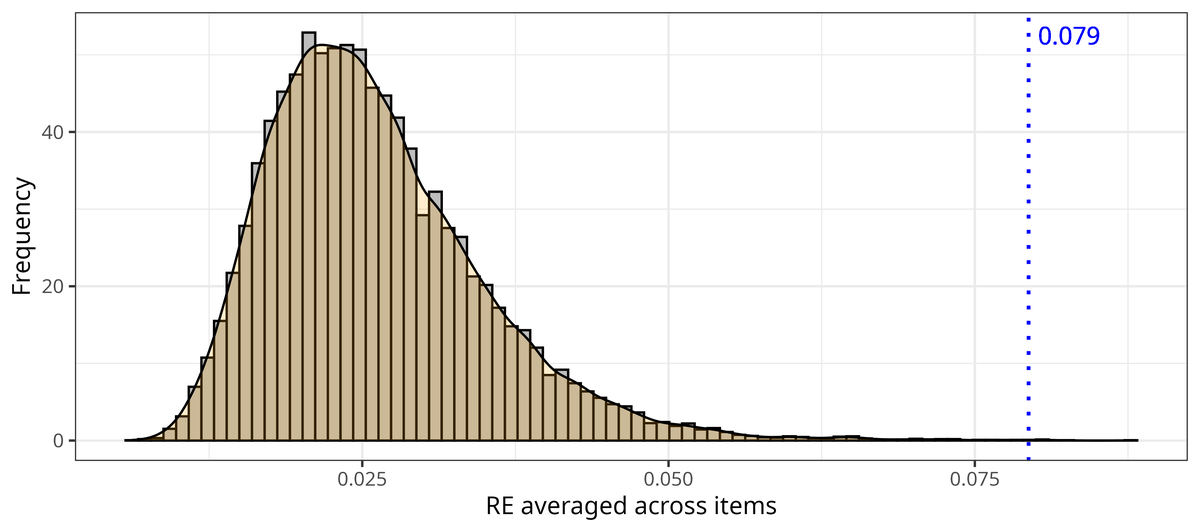
- Autoencoder reconstruction error (RE) for inconsistency. An autoencoder can be viewed as a nonlinear generalization of principal component analysis , and it learns the latent construct patterns of attentive respondents. Random or content-independent answers cannot be compressed into that low-dimensional space, so they reconstruct poorly and produce a spike.
- LongStringPattern (LSP) for invariability. This generalizes the classic longstring index to detect repeating patterns of any length up to the number of answer categories, so it catches 1-2-1-2 or 1-2-3-1-2-3 sequences, not just straight-lining.
Both series are then fed into a nonparametric changepoint detection test from Shao and Zhang (2010), which searches a multivariate time series for a single break and provides critical values that control the false positive rate at a chosen significance level, without assuming a distribution for the underlying scores.

How well it works
The authors simulated 500 participants answering a 300-item Big Five instrument, calibrated to the correlation structure of Johnson's 2005 dataset. Carelessness was seeded as random, extreme, straight-lining, or pattern responding, at prevalence levels ranging from 0 to 100%. The headline numbers:
- False positive rate stays close to the nominal significance level (0.1%, 0.5%, or 1%) even when 60% of respondents are careless.
- False negative rate for detecting partial carelessness sits around 18-26% in the baseline onset regime.
- When a changepoint is flagged, on average the estimated onset is only two to three items away from the true onset .
- Near-perfect detection for invariable careless responding (straight-lining and patterns).
- Random responding is the hard case. In the early-onset regime the FNR reaches roughly 75% because the autoencoder needs enough attentive responses up front to learn what attentive looks like.
Combining both indicators clearly beats using either alone. RE-only misses invariable patterns; LSP-only misses inconsistent random answers.
What it uncovered in real data
Applied to Johnson's 20,993 Big Five respondents, CODERS flagged between 0.8% and 3.8% of participants as partially careless depending on the significance level, with the average onset landing around item 145. Only a handful of these overlap with the participants flagged by personal reliability or psychometric antonyms, which is the point. The traditional methods aim at identifying which respondents are careless, whereas CODERS aims to detect the onset of careless responding in partially careless respondents. The two approaches are complementary.
Post-hoc inspection of individual cases surfaced behaviors the traditional screeners miss entirely: respondents who started careless and became attentive, respondents who switched from inconsistent to invariable carelessness mid-survey, and one who cycled through the patterns 1-1-3-3-3, 5-1-3-3-3, and 1-5-3-3-3 for hundreds of items.
Where it breaks and when to use it
CODERS is designed for a single changepoint. It will not catch respondents who go careless, then attentive, then careless again, and simulations confirm it stays conservative in that scenario. It also struggles when careless responses look statistically similar to attentive ones, such as "middling" (randomly picking one of the three middle categories on a 5-point scale), which CODERS detects with an 85-95% false negative rate. And because the underlying changepoint test is asymptotic in the number of items, statistical power drops on short surveys. The authors recommend it primarily for lengthy multi-scale instruments.
The R package carelessonset is on GitHub, with plotting utilities for every flagged respondent available in a companion repository. The only parameter a user really needs to set is the number of constructs the survey measures, which determines the size of the autoencoder's bottleneck layer.