
CoAct TD Beats Epsilon-Greedy by 248% With Just Two Lines of Code
A single-author paper flips a core reinforcement learning intuition, showing that picking the worst-looking action can more than double Atari 100K scores.
 Pro
Takeaways
- CoAct TD Learning replaces epsilon-greedy's random exploration with the action minimizing the current Q-function.
- Improves Atari 100K human-normalized median by 248% over epsilon-greedy and 204% over NoisyNetworks.
- Theorems prove counteractive actions yield higher expected TD error than random actions by the disadvantage gap.
- Zero additional compute cost, plug-and-play drop-in for any TD-based algorithm including DDQN and QRDQN.
- Empirically measured TD gain is up to 25% higher than epsilon-greedy, confirming theoretical predictions.
- Approaches model-based RL sample efficiency without learning any environment model. Full paper.
A new paper argues that one of the oldest tricks in deep reinforcement learning, the epsilon-greedy exploration strategy, has been leaving performance on the table for a decade. The fix is almost embarrassingly simple: when your agent decides to explore, do not pick a random action, and definitely do not pick the highest-value action. Pick the action your Q-network currently thinks is the worst.
That is the core idea behind Counteractive Temporal Difference Learning (CoAct TD), introduced by Ezgi Korkmaz. The reported gain is a 248% improvement over epsilon-greedy across the Arcade Learning Environment 100K benchmark, with zero additional computational cost and only two extra lines of code.
Why epsilon-greedy has outlived its welcome
Sample efficiency is the perennial bottleneck in deep RL. The magnitude of samples required to learn and adapt continuously is one of the main limiting factors preventing state-of-the-art deep RL algorithms from being deployed across settings ranging from LLM reasoning to physical robotics.
The awkward truth is that despite decades of exploration research, most deep RL systems still lean on epsilon-greedy: with probability epsilon, take a uniformly random action; otherwise take the argmax of the current Q-function. Techniques with provable optimal regret bounds exist for tabular MDPs, but incorporating count-based methods into high-dimensional state spaces requires substantial complexity, including training additional deep neural networks to estimate counts or other uncertainty metrics. As a result, many state-of-the-art deep RL algorithms still fall back on sampling a uniformly random action with probability epsilon.
Alternatives like NoisyNetworks work, but they add parameters to the Q-network and drag training cost up with them. CoAct TD sidesteps that trade-off entirely.
The counterintuitive move
Here is the mechanic. During exploration steps, instead of sampling a ~ Uniform(A), CoAct TD selects:
a_min = argmin_a Q(s, a)Then it stores that transition in the replay buffer and computes the TD update using a_min. At first glance this looks like sabotage. Why would you ever intentionally take the action your model rates as worst?
The answer hinges on a distinction between the randomly-initialized Q-function and the optimal one. From the perspective of the optimal Q-function Q*, the action that minimizes the current Q-network is essentially a uniform random action. But from the perspective of the current Q-network, that same action carries meaningful information because it will produce a larger TD-error update than any other choice.
In other words, the min-action is random with respect to actual reward, but adversarial with respect to what the network currently believes. That mismatch is exactly where the learning signal lives.
The theoretical scaffolding
The paper formalizes this with three ideas worth understanding before the theorems make sense:
- Eta-uninformed: early in training, the Q-function has little correlation with actual rewards, so the reward from its min-action is close to the average reward.
- Delta-smooth: for similar states, the max Q-value is approximately the same, because the network has not yet learned to sharply distinguish them.
- Disadvantage gap D(s): the expected difference between a random action's Q-value and the min action's Q-value in state s.
With those in hand, the main theorem shows that the expected TD error from taking the counteractive action exceeds the expected TD error from a random action by roughly D(s) - 2δ - η. A parallel theorem extends the result to double Q-learning, where action selection and evaluation use separate weight sets.
A supporting proposition adds a subtle wrinkle: marginalized over random initializations, the min-action distribution is uniform over the action set. But conditional on a specific initialization, it is deterministic. That is what lets the method behave like exploration while still producing large, learnable TD signals.
The algorithm in practice
CoAct TD slots into any TD-based algorithm. The rough shape looks like this:
if random() < epsilon:
    a = argmin_a Q(s, a)      # counteractive action
else:
    a = argmax_a Q(s, a)      # greedy action
s_next = env.step(a)
td = r + gamma * max_a Q(s_next, a) - Q(s, a)
buffer.add((s, a, r, s_next))
That is it. No auxiliary networks, no count estimators, no intrinsic reward machinery. The author calls it modular and plug-and-play, and the paper backs that up by dropping it into both DDQN and QRDQN unchanged.
The numbers
Experiments run in the Arcade Learning Environment 100K benchmark, the standard 26-game suite for measuring sample efficiency, plus the full 200-million-frame setup. All results use five random seeds.

On QRDQN with the 100K benchmark, CoAct TD roughly doubles the human-normalized median score against epsilon-greedy throughout training. On DDQN, the headline numbers from the paper's table:
| Metric | CoAct TD | Epsilon-greedy | NoisyNetworks |
|---|---|---|---|
| Median | 0.0927 | 0.0377 | 0.0457 |
| 20th percentile | 0.0145 | 0.0056 | 0.0102 |
| 80th percentile | 0.3762 | 0.2942 | 0.1913 |
CoAct TD improves on the canonical epsilon-greedy by 248% and on NoisyNetworks by 204%. Notably, it approaches the performance of model-based RL methods without ever learning a model of the environment.
Watching the TD signal directly
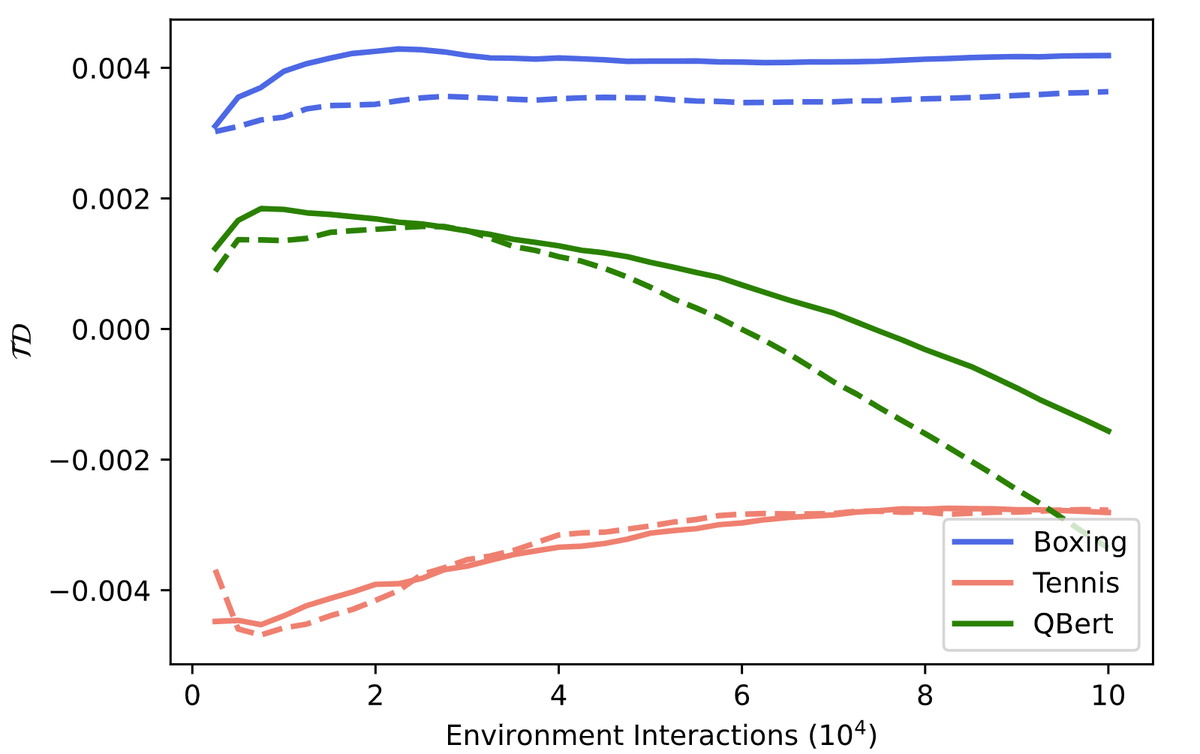
The paper also measures the actual TD magnitudes during training to confirm the theory is doing what it claims.

The median normalized TD gain for CoAct TD Learning is up to 25 percent larger than that of epsilon-greedy, while NoisyNetworks shows no such positive bias relative to a uniform random action. That is a clean empirical fingerprint of the effect the theorems predict.
Where it helps, where it might not
The method looks strongest in the low-data regime, exactly where sample efficiency matters most. In the 200-million-frame setup, the story is more mixed: on some MDPs CoAct TD converges faster, while on others it simply converges to a better policy. So it is not uniformly a faster-convergence story at scale, but rather a better-final-policy story on some games.
A few caveats worth flagging:
- The theory relies on the Q-function being uninformed and smooth, conditions that hold early in training but weaken as the network converges. The method's edge should diminish late in training.
- All experiments are in Atari. Continuous-control and policy-gradient settings are outside the tested scope.
- The paper mentions that in principle small noise injection may be needed to guarantee Q-learning convergence, though in practice training noise sufficed across every benchmark.
Why this matters
The real breakthrough is not the 248% number, it is the conceptual reframing. Exploration in deep RL has historically been treated as an information-theoretic problem to be solved with counts, uncertainty estimates, or auxiliary curiosity signals. CoAct TD reframes it as a TD-signal-maximization problem, and shows that the current Q-network already contains everything you need to identify high-TD transitions: just look at its minimum.
If the result generalizes beyond Atari, it suggests that a lot of exploration machinery bolted onto modern RL pipelines, from bootstrapped ensembles to noisy networks to intrinsic rewards, may be doing something a two-line argmin change already does more cheaply. That is a claim worth stress-testing on continuous control and offline-to-online settings, but the theoretical grounding here is unusually clean for an empirical RL paper.
The paper does not appear to release a code repository. Given the algorithm is a two-line modification, reproduction should be trivial for anyone already running DDQN or QRDQN baselines.